







Signify’s Core Business Weakens in a Challenging Q3
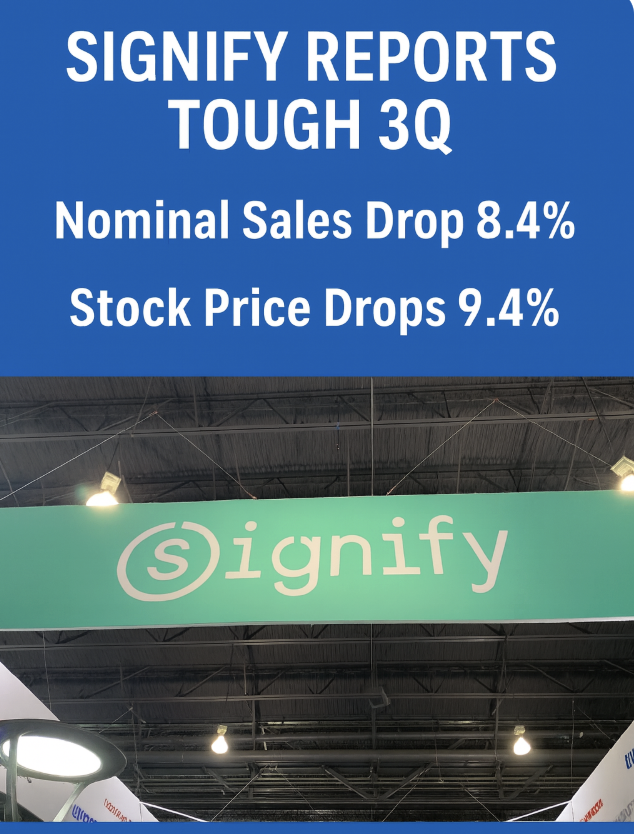
Signify reported Q3 2025 sales of €1.407 billion, down 8.4 percent year over year, with comparable sales declining 3.9 percent. The adjusted EBITA margin slipped to 9.7 percent, down 80 basis points. Net income dropped to €76 million, and free cash flow came in at €71 million, compared to €119 million last year.
CEO As Tempelman, who joined the company six weeks ago, described the market as “very challenging.” He cited three major headwinds: redirected Chinese overcapacity flooding Europe, soft demand in key European markets, and delayed public-sector projects in the U.S.
The most troubling results came from the OEM division, where sales plunged 26 percent. Tempelman confirmed that Signify lost two major OEM customers—a hit that materially affected the top line. The Professional segment declined 6.8 percent, while the Consumer division, led by Philips Hue, grew 3.7 percent. Hue’s September launch exceeded expectations, driven by strong online sales and new motion-sensing features for existing fixtures.
A Market Under Pressure
Global trade dynamics are reshaping the competitive landscape. Chinese manufacturers, constrained by U.S. import tariffs, have redirected their excess capacity to Europe, intensifying price pressure in professional trade channels. Signify said it largely offset these tariff impacts through pricing adjustments, but with lower volumes, margins have yet to stabilize.
In the U.S., project activity remains sluggish, especially in the public sector, where funding delays continue to stall progress. Tempelman stressed that projects aren’t being lost but postponed. Still, competition is fierce at the lower end of the trade channel, particularly for non-connected, price-sensitive products.
Strategy Reset on the Horizon
Tempelman announced plans for a Capital Markets Day in mid-2026 to outline Signify’s long-term direction. He intends to review the company’s portfolio, revisit capital allocation, and sharpen its strategic focus. The company will maintain its current operating model but shift “from product-led to market-led,” investing more heavily in digitalization and AI.
During the Q&A session, Tempelman handled investor questions with composure. When asked whether the OEM weakness was structural or cyclical, he acknowledged the loss of two major OEM customers as a significant setback. He suggested the impact would “go away after a year,” though it was unclear what that meant in practical terms. He also pointed to continued price and demand headwinds, avoiding a firm timeline for recovery.
Tariffs and Trade Shifts
On tariffs, Tempelman explained that redirected Chinese overcapacity into Europe was creating extra price pressure across trade channels. CFO Željko Kosanović added that Signify had largely neutralized tariff increases through pricing—yielding a modestly positive effect on revenue and a neutral effect on profit.
When Martin Wilkie of Citi Research asked about Chinese exports, Tempelman clarified that while shipments from China to the U.S. had declined, similar volumes had been redirected to other regions, especially Europe, amplifying price competition.
U.S. Market Weakness
Akash Gupta of JP Morgan pressed for more detail on Signify’s U.S. business, observing that one of the company’s competitors had reported flat professional lighting revenues, while Signify had a tougher quarter. He asked where the company was seeing growth and whether there were any notable losses in market share.
Tempelman said that while the U.S. market had grown year-to-date, the third quarter turned out softer than expected, showing a “flattish” pattern. He cited two main factors: weaker project activity—particularly in public-sector work, which had been delayed rather than lost—and heightened competition at the lower end of the trade channel.
He concluded that Signify was performing in line with the market in professional projects, outperforming in connected and agricultural lighting, but slightly underperforming in the trade and DIY categories.
Kosanović added that consumer demand remained strong heading into Q4, the company’s traditional peak season, while the conventional business remained steady. However, the Professional and OEM segments continued to face pressure across both the U.S. and Europe, especially in the public sector.
The Signify N.V. (LIGHT.AS) share price slid to €21.10 on Friday, down 9.44%, reflecting heightened investor caution amid the company’s weak performance outlook. In June of 2021 it traded above €50.00.
Read the 3Q Press Release here