






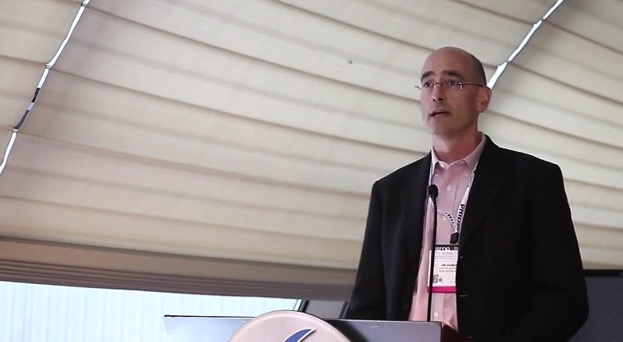
Now Updated with Video Links. On 6 MAY, the EdisonReport hosted a panel discussion at the Marriott Marquis in New York to discuss DesignLights Consortium (DLC) and their affect on our industry. Irina Rasputnis agreed to speak on behalf of the DLC. Other panelists were Bob Smith, Eaton’s Cooper Lighting; Jerry Caroom, XtraLight; Jim Gaines, Philips Lighting; Mark Hand, Acuity Brands; and Tom Veltri, Hubbell Lighting. Ms. Raputnis was offered 15 minutes for an opening statement, other panelists were offered three to five minutes.
It is clearly DLC‘s goal to prevent the ‘crap’ (as one DLC Utility representative stated), but, like many government policies, bureaucracies have unintended consequences. Many in our industry believe that DLC’s policies limit competition.
The day after the panel discussion I saw Ms. Rasputnis on the exhibit hall at LIGHTFAIR, and she asked if Tina Halfpenny, the Director of the DLC, could review the video before we published it. This was an unusual request, but I immediately agreed. Later that afternoon, I received an email from Ms. Halfpenny stating her displeasure with the panel discussion. Her email was critical of the panel discussion, and she did not want me to post video representations of DLC. This was an even more unusual request. However, in an effort to accommodate this request, your humble editor has gone to great lengths to exclude any video of Ms. Rasputnis, while still giving an accurate portrayal of the panel discussion.
Ms. Rasputnis gave a strong and persuasive opening statement. and it is only fair to Ms. Rasputnis to include her full statement.
“I imagine you are all here because you are familiar, so I won’t describe the program. But what I would like to emphasize here are some components of the program that you might not be aware of and the role that we play in the industry and the role we play within the industry to get to where we are. I don’t think everyone will say that we are right on the mark every time, for everyone, but we have to balance a wide range of diversity of perspectives from the utility which we support and the industry community which we support. As you know, lighting over the past five to eight years has changed and been a rapidly growing industry and LEDs marking their introduction in late 2000’s, the market just exploded. The DLC came into the game to become an independent performance verification program, and we have been working to support utility incentives. As you know, these incentives have time and time again created markets, driven adoption, and transformed markets with energy savings and performance in mind and that is the role that they play.
However, the massive growth of the DLC is indicative of the massive growth of the market. As the market has grown, the market segments have grown, and they have specific needs, and we have been striving to meet all of those needs. It would be impossible to meet those needs without industry contribution, and there are people in the room who have been instrumental in shaping the DLC and participating in our industry with processes and attending the stakeholder meetings, which is a place where we really tried to drive discussion on the where DLC will go and what it will look like. With that, I will end my opening statement and I look forward to your questions.”
Bob Smith of Eaton’s Cooper Lighting discussed a particular job that Cooper lost years ago to a manufacturer who beat Cooper’s warranty. However the product failed as the OEM used fans in the fixture and that OEM later went out of business. Even though the manufacturer offered a seven-year warranty, they were only in business for three years. Mr. Smith’s point was that the DLC has helped to prevent those scenarios from re-occurring.

Of the panelists, Jerry Caroom of XtraLight was the most critical of DLC. Mr. Caroom discussed the history of the DLC and explained that not being on the QLP list meant no rebate would be available and no sale would occur. He went on to say that the DLC hinders innovation, causes resources to be diverted, and causes harm to lighting manufacturers—the very people responsible for bringing new technologies to the market. He explained that DLC has zero responsibility to the public for products that do not meet specifications. He suggested an alternative would be to have published guidelines or for the industry to simply rely on existing certified labs. He maintained that the “Wild Wild West” days are over and LIGHTFAIR 2015 is a testament to that.

Mark Hand stated that Acuity had about 7,000 products of the 90,000 on the QLP list. Initially they were dragged into the DLC by their Northeast Sales team. Mr. Hand shared a quote from one of his sales people, “I simply can’t sell a fixture if you are not on this list.” He stated that DLC is essentially a marketing program that allows him to sell and it has raised the bar. In essence, the DLC makes the fight more fair because competitors have the same burden. He did list a few cons to the program and then closed by saying, “The pros do out weigh it. If we did not have this program, I honestly don’t know where we would be.”

Jim Gaines of Philips Lighting gave the reasons from Philips point of view as to why they support DLC, some things they would like to see changed, and some concerns. Mr. Gaines stated that the revolution is over and we are in evolution. He explained that the DLC gives the product a stamp of quality based on independent evaluation. It enables rebates and makes it easier for utilities to select products for rebates. Philips would like to see changes. He was concerned about discussion of a tier structure, which would cause them to design products to meet a specification and not what the customer is looking for. He cautioned against too much structure. He went on to say that L90 at 36,000 hours is a concern, and he suggested luminaires in which you could replace components if long life is required. Personally, he wants to see a more fostering approach on TLEDS and make allowances to large volume U-bends and CFL and non-integrated replacements. He concluded by saying it’s painful to introduce a new product and wait two years for a new category.
Tom Veltri of Hubbell spoke of the costs for generational upgrades. When a new chip is introduced, Hubbell has to make a business decision about when to upgrade their products with the latest technology because of all of the testing costs associated with upgrades.

After the opening statements, we took questions and comments from the audience.
Bob Fiermuga, Eclipse Lighting, has been in business for 29 years and commented that the industry went through fluorescent and HID and did not have the micromanagement that DLC imposes. Customers want to use his product, but utility companies won’t rebate his products since they are not on the DLC list. He explained that Eclipse has UL or ETL, LM-79, LM-80 and questions why he has to pay a tax to DLC. He asked, “Where is the accounting, where is this money going to?”
John Castner of Dialight spoke about ANSI Standards and the lack of standards with LED.

Jim Gaines responded, “I think for manufacturers the rebates are a little bit like taking drugs. As long as we are taking the drugs, we are going to have to do things like toe the line–I don’t mean to say anything negative about DLC, but that is the consequence of wanting to take the drugs, is that you have to qualify.”
John Watkins of FSC Lighting spoke about issues with HID and how the industry worked through those issues.

Ms. Rasputnis responded, “…Not having a DLC listing for your product does not limit entry to the market. It only limits your eligibility to receive incentives in some situations.”
Many in the audience openly laughed at her response. Until this point, Ms. Rasputnis had done a very good job of presenting the benefits of the DLC to manufacturers and utilities alike. However, this statement is profound in that it confirms that the person responsible for a program that affects most lighting manufacturers does not fully comprehend the impact of what they have done to our industry.
This would be like the IRS Commissioner saying that paying income tax is voluntary. While the statement might be technically true, the duty to pay the tax is mandatory. The same thing could be said for the DLC.
Ms. Rasputnis called on Edward Bartholomew from National Grid, a DLC member. Mr. Bartholomew explained that National Grid does not always require DLC. He stated, “For innovation we can provide even more incentive money.” He further stated that National Grid has seen CFL’s and HID, and it is incredibly helpful to have DLC at least set the bar as to what standards we at least need to meet.” He went on to say, “I see products every week that come across my email that are crap.”
He surprised the audience by stating if a product submitted for a project is not DLC approved, but does meet DLC requirements, National Grid will typically approve it. He went on to say that if a product was not DLC approved and did not meet DLC requirements it would land on his desk. He could still approve the project if it had distinguishing characteristics that justified approval. He further stated that he could make those decisions in less than 2 days.
Jerry Caroom asked what his company would have to do to get a product approved by National Grid. Edward stated that if he meets the DLC requirements, there should not be a problem.
Mr. Bartholomew was a breath of fresh air and his passion and clear competence regarding the subject matter was well received by the audience.
Howard Weinberg of Emergence Technologies wanted to understand the membership. Ms. Rasputnis explained that members were either utilities or efficiency programs, such as New York’s NYSERDA. Ms. Rasputnis said, “We engage as actively with industry, we don’t call them members, but we have very open and robust engagement processes.” Ms. Rasputnis went on to explain that DLC hears from the large lighting companies and stated, “We especially want to hear from the little guys, and we strive to reach a broader audience. “
Mr. Weinberg continued the discussion saying the situation was almost like an antitrust violation. He explained, “The broader problem is that the utility companies now have designed a mechanism by which they can limit competition, limit products in the marketplace, by virtue of this perception that you put out, that the DLC is this go-to source…”
 .
.
Mark Hand pointed out that National Grid was probably one of the few that had trained experts who could read and digest LM 79 and LM 80 reports. He said, “Until we can shake this industry out, until those cowboys fall away…we are going to have this scenario. For us the situation is better the devil I know.”
Ms. Rasputnis was asked about paper submittals without having to conduct new testing for small changes such as the voltage of a driver. She responded, “Are we on a roadmap to streamline and improve the process? Yes, we are, and we are always sensitive to the burden on manufacturers.” She went on to say, “What it will look like, I am not really sure, but we are going to start looking at that and even laying out options and we will be looking for your input as well.”
We commend Ms. Rasputnis on this answer because it shows flexibility and inclusiveness.
Bob Smith stated that Eaton’s Cooper Lighting went through a cost justification for submitting to DLC and understanding the value proposition. He explained, “When you look at it from a national footprint, including Canada, the DLC program is cost justified. He also said that the numbers were high, and they spend a lot of money with the DLC, but it is not nearly as high as it is perceived to be, given that Eaton has the largest number of products DLC approved.”
John Watkins of FSC Lighting stated, “The QPL is like the good housekeeping sign of approval. If you don’t have QPL, you are done in the rebate business. If there is no rebate, it is automatically assumed something is wrong with your product, and I don’t think that is the intention of your program.”
Thor Scordelis from LeoTek asked how will the DLC know when the technology is mature enough to eliminate the need for the DLC?

Ms. Rasputnis responded, “Yep, so we get asked that question regularly because this is the business we are in and as a non profit working our way out of our jobs as quickly as we can, so we are sensitive to the market and how quickly it is developing. How do we know, well how do you know? We do market assessments; we look at indicators; there is in the energy efficiency non profit world; there is this term, the theory of market transformation, and there are indicators and there is a curve…” She went on and explained in detail about market transformation and that at some point there could be a federal standard in place. She said, “I don’t think we are there today, but we could be very close to there; we could be years away, and there is a constant evaluation of where we are.”
Next, I asked Ms. Raputnis about their fiscal year end.
Ms. Rasputnis: “We are on a calendar year.”
Moderator (EdisonReport): “So in January, is there an annual financial report published every year?”
Ms. Rasputnis: “Yea, I think we are subject to fiduciary requirements that all 501(c)3’s are subject to, we have a Board of Directors…”
Moderator: “…So there is a public record that we can find an annual report every January?”
Ms. Rasputnis: “I don’t know if it’s January because usually the annual report happens several months in arrears or the audit happens several months in arrears, but I don’t know. Bob, do you know when that report gets published?”
Bob McTighe, the Director of Finance and Administration for NEEP, responded off-mic, and said it takes several months to roll up the numbers.
Moderator: “So pretty soon we should be seeing the 2014?”
Ms. Rasputnis: “I’ll just clarify that the Design Lights Consortium is a project of the Northeast Energy Efficiency Partnerships.”
Moderator (this question is directed to Mr. McTighe): “So would there be one for DLC or would it be rolled up under NEEP?”
Mr. McTighe explained, again off-mic, that it is rolled up and that the four biggest programs are noted.
I don’t know what that means, and I was clearly being stonewalled. A straightforward answer would have been that DLC is set up as a program under NEEP, and NEEP chooses not to publish the DLC numbers. When I asked Ms. Rasputnis about an annual report, her immediate answer was “yea.” But as they bobbed and weaved and spoke of audits and notes and arrears and fiduciary responsibilities, it appears there really is no DLC report. And, if I did not continue my pursuit of questioning, the audience would have been left with the impression that their numbers are public.

While we strongly commend Ms. Rasputnis for participating in our panel discussion, we equally condemn the lack of financial transparency around this organization. In 2015, in the lighting industry, we value transparency, authenticity and accountability. While the DLC does provide a service, all three characteristics are sorely lacking.
Editor’s Note: This is our first in a series of reports on the DLC. Our next report will focus on the role of D+R International.