








The Smart Node on the Ceiling: Umesh Baheti’s Vision for Luminaire Level Lighting Controls
Yesterday I shared my thoughts on the overall success of ArchLIGHT Summit, with an emphasis on the tradeshow floor. But as always, your humble editor tries to split my time evenly—half on the floor and half in the classroom. This year’s educational content was the strongest I’ve seen at any ArchLIGHT Summit.
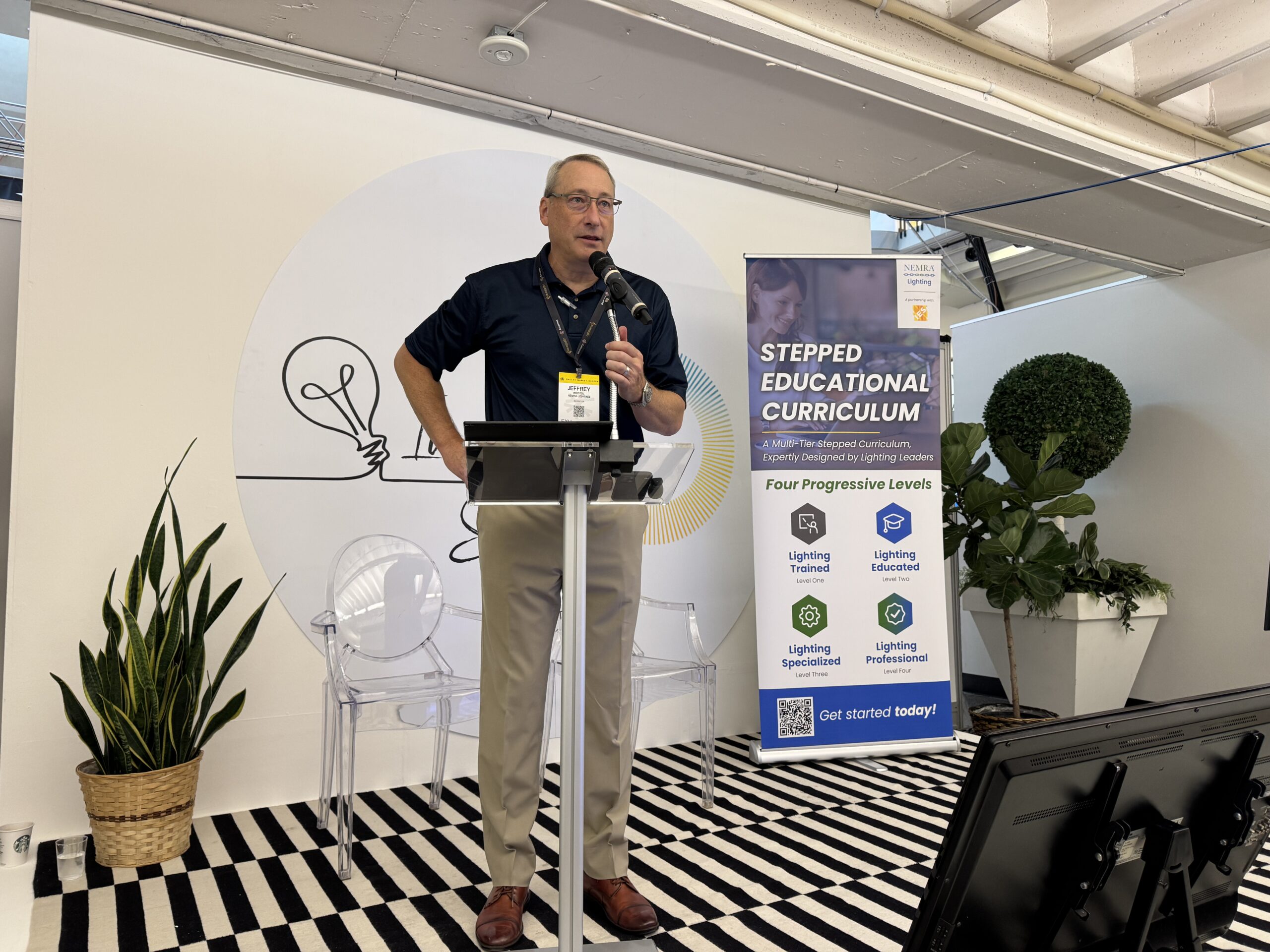
On Tuesday, Jeff Bristol of NEMRA Lighting opened the conference by introducing Umesh Baheti, SVP of Product Management & Engineering at MaxLite. At the NEMRA Lighting sponsored event, Umesh delivered one of the most thought-provoking talks of the show. Speaking from his perspective as a technologist rather than as a representative of MaxLite, he explored how luminaire-level lighting controls (LLLCs) are pushing the industry away from centralized systems and toward distributed intelligence.
From Centralized to Distributed
“The evolution is clear today that more and more specifications are being driven towards LLLCs,” Umesh explained. “These devices are getting extremely smart—you can embed motion sensing, daylight harvesting, even environmental data like temperature and humidity—all within a single fixture.”
He contrasted centralized gateways with distributed nodes: “If a power pack controlling a zone goes down, you lose everything in that zone. But with distributed systems, the failure of one fixture doesn’t bring down the rest. You build resiliency right into the system.”
Breaking Wireless Myths
Umesh also took aim at common myths. “There is a lot of skepticism that wireless doesn’t work, that it’s not reliable, or that it’s hackable. That’s not true,” he said. “Today’s mesh networks are completely self-healing. If you lose a node, the signal will bounce to another. And the cybersecurity standards are the same ones that protect your online banking.”
Then he drove the point home with an analogy: “If we can trust wireless for our finances and our health, why can’t we trust it for our lighting systems?”
Why the Shift Is Happening
Umesh pointed to four forces converging:
- Regulations: DOE mandates and energy codes such as ASHRAE 90.1 and Title 24 are pushing adoption.
- Sustainability goals: “We don’t want our landfills filled with old equipment—we need to be good stewards and promote green technologies.”
- Business needs: Hospitals want lighting that improves patient wellbeing; owners want smarter asset tracking.
- Technology enablers: Decades of chip development and falling costs are making embedded sensors practical.
“The controls piece is growing,” he said. “It used to be a low single-digit percentage of sales. Now, those numbers are climbing higher, sometimes double-digit growth. This is a huge opportunity for the industry.”
Energy Savings as Proof
Case studies back up the hype. Umesh cited the DLC which showed an average of 47–50% energy savings across nearly 200 buildings with LLLCs deployed. “In offices, the savings reached 74%—far beyond just the energy savings you get from LEDs alone.”
Looking Forward
Umesh closed by urging specifiers to think beyond the immediate bill of materials. “When you specify controls today, you’re also future-proofing your customers,” he said. “Decisions about open versus proprietary, wired versus wireless, centralized versus distributed—they determine how adaptable your system will be when new IoT applications arrive two, three, or five years from now.” LLLCs aren’t just the next step in lighting—they are the foundation of smart, connected buildings. Umesh’s message was clear: lighting is no longer just illumination; it’s infrastructure.
Go Deeper: ArchLIGHT Summit 2025 Kicks Off with a Strong Start
This article was updated at 8:41 a.m. EST, 18 SEP 2025