






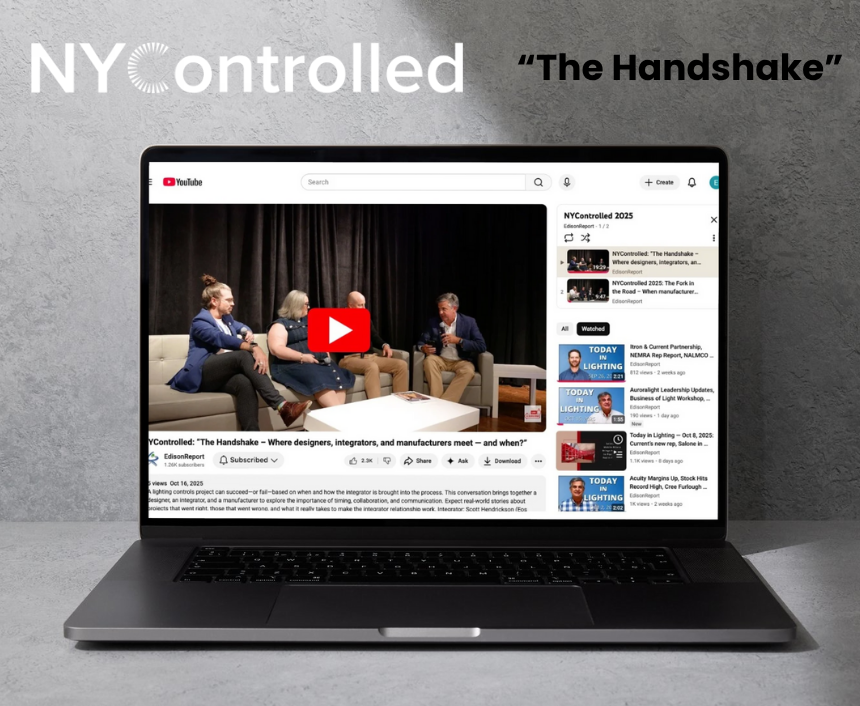
At NYControlled 2025 in New York City, the Conversation Corner featured a lively discussion titled “The Handshake: Where Designers, Integrators, and Manufacturers Meet and Win.” Joining me were Scott Hendrickson and Amanda Lyon of EOS Lightmedia, along with John Yriberri of Modular Lighting Instruments.
The panel explored how collaboration between designers, integrators, and manufacturers can make or break a project—and how early involvement is key to success.
“Timing depends on the complexity of the project,” Yriberri explained. “For simple ELV or line voltage dimming, you may not need an integrator. But when advanced control systems and individual addressable fixtures are involved, looping in the integrator early prevents costly issues down the line.”
Lyon agreed, noting that delays often lead to systems that “don’t communicate well,” forcing teams to rely on suboptimal solutions. Hendrickson added that lighting designers should have an integrator “on speed dial” to ensure power, data, and control coordination from the start.
When asked what smooth collaboration looks like, Hendrickson emphasized strong communication and trust: “The integrator protects the lighting design. When they and the designer understand each other, that’s where the magic happens.” Yriberri echoed that sentiment from a manufacturer’s perspective, saying that early coordination avoids “fighting fires at the end of the job.”
The panel also addressed a common question—when does the integrator start getting paid? Hendrickson clarified that most early-stage advice is offered freely: “It’s better for us to invest time in the design community early on. Typically, billing starts when the project goes to bid for integration.”
Misunderstandings about roles often blur lines on projects. Lyon pointed out that not all designers are equally comfortable specifying complex control systems, while Yriberri stressed that clarity upfront—through documented responsibilities—prevents finger-pointing later. Hendrickson added that integrators must respect the designer’s role: “They sometimes overstep by specifying without collaboration. Communication is key to maintaining trust.”
Each guest also shared what they feel is most misunderstood about their roles. Yriberri said manufacturers are often seen as transactional, when in fact “we’re committed to seeing the project succeed all the way through.” Lyon noted that controls themselves are a design choice—“the final part of my design, not just a technical step.” Hendrickson added that integrators are often undervalued as “end-to-end service providers” who bring engineering expertise and long-term support.
Looking at how the field has evolved, the panel agreed that controls have become dramatically more prevalent and complex in the past decade. “Ten years ago, most projects had one universe,” said Hendrickson. “Now, ten to twenty universes and multiple protocols are common.”
Closing the discussion, Yriberri emphasized how the luxury residential market has driven integrator involvement, while Lyon encouraged designers to use these partnerships as learning opportunities. “Integrators bring real-world experience—leverage that,” Hendrickson concluded. “Ask questions, get their insights, and you’ll deliver better projects every time.”
The handshake between designers, integrators, and manufacturers isn’t just symbolic—it’s essential for successful, well-coordinated lighting design in today’s increasingly complex projects.