





Signify vs. Lepro Trial: Groundwork and Documentation on Day Two
Monday focused primarily on jury selection, an event your humble editor did not attend. Consequently, the second day of testimony in the Signify Lepro trial felt like the first real dive into the case. It unfolded less like a dramatic showdown and more like a methodical laying of groundwork. The day was dense with procedure, documentation, and competing narratives regarding willful infringement.
The case is currently being heard before Honorable Judge Jennifer A. Dorsey and a federal jury in Nevada. Interestingly, while eight jurors were initially selected, Judge Dorsey announced Tuesday morning that only seven would move forward. These seven jurors—five women and two men—arrived with binders in hand. This was a clear visual cue that the Signify Lepro patent trial will be a document-heavy affair.
A Courtroom That Fights the Senses
Before any testimony began, the physical conditions of the courtroom made an immediate impression. The acoustics are notably poor, as voices drop and echoes linger. Furthermore, the lighting is even worse.
Ironically, this case centers on lighting innovation, yet the space is illuminated by outdated recessed downlights. Each contains two 13-watt CFL lamps with a random mix of 2700K and 4100K color temperatures. The fixtures resemble older Lightolier-style luminaires, and the result is a room that feels dim, flat, and visually fatiguing—an ironic setting for a case centered on lighting innovation.
Pre-Jury Arguments: The Wayback Machine Dispute
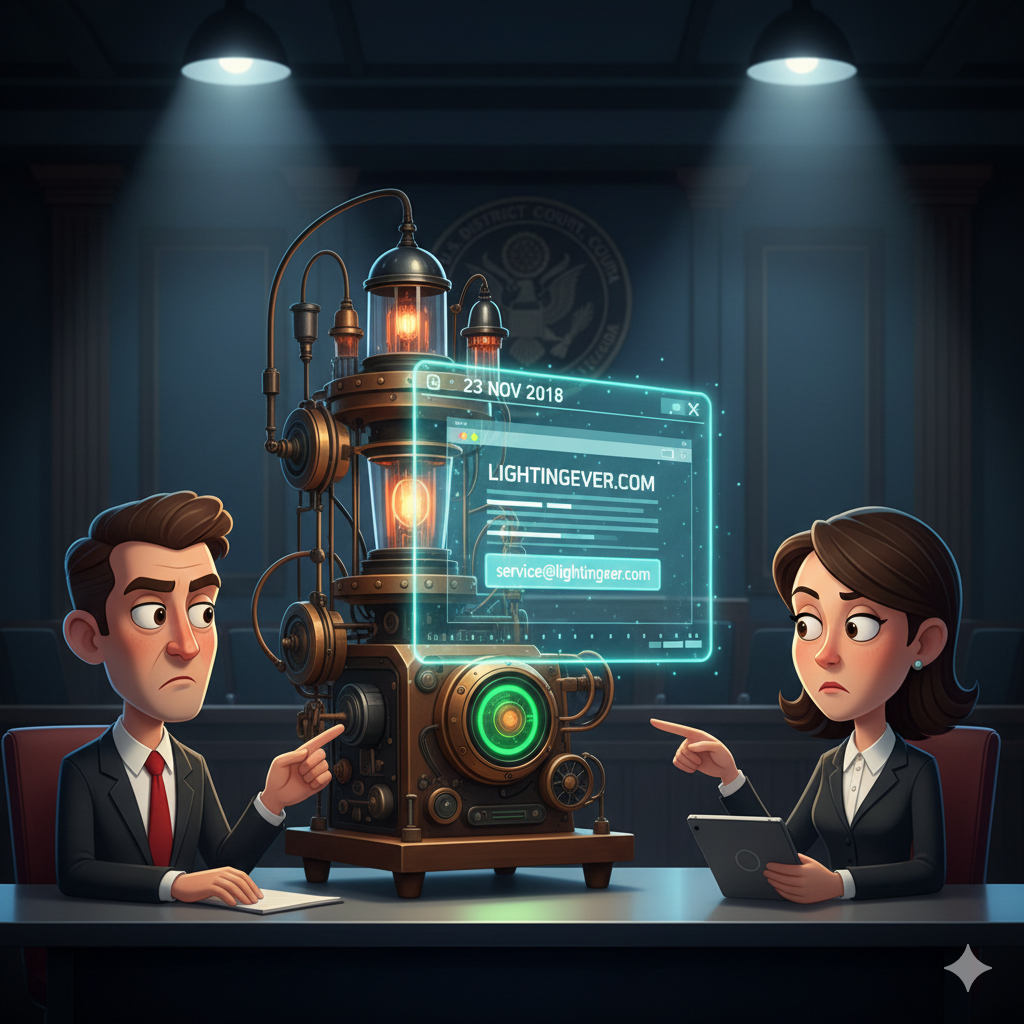
Before the jury was seated, the court addressed a key evidentiary issue. Signify’s attorneys asked the judge to admit documentation from the Wayback Machine. They specifically wanted to prove that a Lepro email address, [email protected], was publicly listed on their website in November 2018.
Lepro’s counsel, led by Nicholas Brown, objected strongly. He argued that the email constituted hearsay because the sender, Lynda Dai, was not present to be cross-examined. However, Signify’s attorney, Adam D. Swain, countered that if the defense claimed the email was never received, they should produce their own witness. Ultimately, Judge Dorsey ruled in favor of Signify, allowing the evidence to be used.
Direct Examination: Aaron Rugh Takes the Stand
The first witness of the day was Aaron Rugh, Senior Intellectual Property Counsel for Signify. During his testimony in the Signify Lepro patent trial, Rugh explained that Signify prefers to handle IP concerns face-to-face rather than through litigation.
Rugh testified that Signify has over 1,700 licensees in their EnabLED program. He argued that allowing unlicensed competitors to operate freely would give them an unfair “free ride” on patented technology. When asked if any company had ever ignored all communication, Rugh identified only one: the defendant, Lepro.
A Timeline of Silence
Rugh testified that Signify first became aware of Lepro through online research. Although registered in Nevada, Rugh said Lepro’s operations appeared to be based in China. Signify investigators visited the listed Nevada address—a strip mall location—and found no apparent operating office.
On 3 June 2017, Signify sent its first letter to Ji Wu of Home Ever, Inc., doing business as Lighting Ever, at 1810 E. Sahara Ave., Suite 704, Las Vegas, via certified mail and email. The letter referenced several LED products, including UFO high-bay fixtures, floodlights, and work lights, and requested a discussion regarding Signify’s SSL patent portfolio and licensing program.
Rugh testified that the letter was received and that Signify obtained a return receipt. An email response followed, stating the inquiry would be forwarded to the appropriate department.
No further response came.
A follow-up letter was sent on 31 July 2017, again via certified mail and email. Rugh testified that at the time, Signify had approximately 798 licensees.
Additional letters followed on 24 January 2019 and 6 April 2021—and warning of potential willful infringement and treble damages under U.S. patent law.
Rugh testified that no response was ever received from Lepro.
Furthermore, Rugh stated that Signify identified violations of approximately 19 U.S. patents. He also referenced a 2026 brochure, distributed last month at CES, where Lepro claimed to have sold over 45 million units in three years, reaching $100 million in sales in 2020 alone.
Cross-Examination: A Scattershot Approach
Cross-examination was conducted by Nicholas Brown of Greenberg Traurig, representing Lepro. Brown’s questioning ranged widely—from Signify’s corporate structure and global subsidiaries to its competitors and historical acquisitions.
Brown pressed Rugh on Signify’s size, noting revenues of $6–7 billion, its global subsidiaries, and competitors such as Acuity and Hubbell. (I was surprised to hear Hubbell mentioned twice as a large competitor, and I simply looked up at the CFL fixtures and thought I was in the Wayback Machine.)
A significant portion of the cross-examination focused on royalty rates. Brown attempted to establish inconsistencies between Rugh’s testimony and prior deposition statements regarding whether Signify’s 3%, 4%, and 5% royalty rates, established in 2008, remain fair today.
Rugh maintained that the rates are fair, uniformly applied, and form the basis of all licensing agreements—whether structured as percentage-based or flat-rate licenses. He testified that Signify has never refused to license a company willing to engage in good faith and that competitors are treated the same as non-competitors.
As the questioning continued through patents, drivers, dimming technologies, and royalty stacking, the jury appeared disengaged. The line of questioning grew increasingly diffuse, and its strategic purpose was not immediately clear.
This first witness did not deliver courtroom fireworks, but it did establish the central narrative Signify intends to present: repeated outreach, documented notice, and a lone defendant that refused to engage while continuing to sell large volumes of product into the U.S. market.
For Lepro, the challenge will be to counter not only the patent claims themselves, but the implication of willful disregard.
4 FEB 2026, 8:37 Eastern, This article has been updated.