







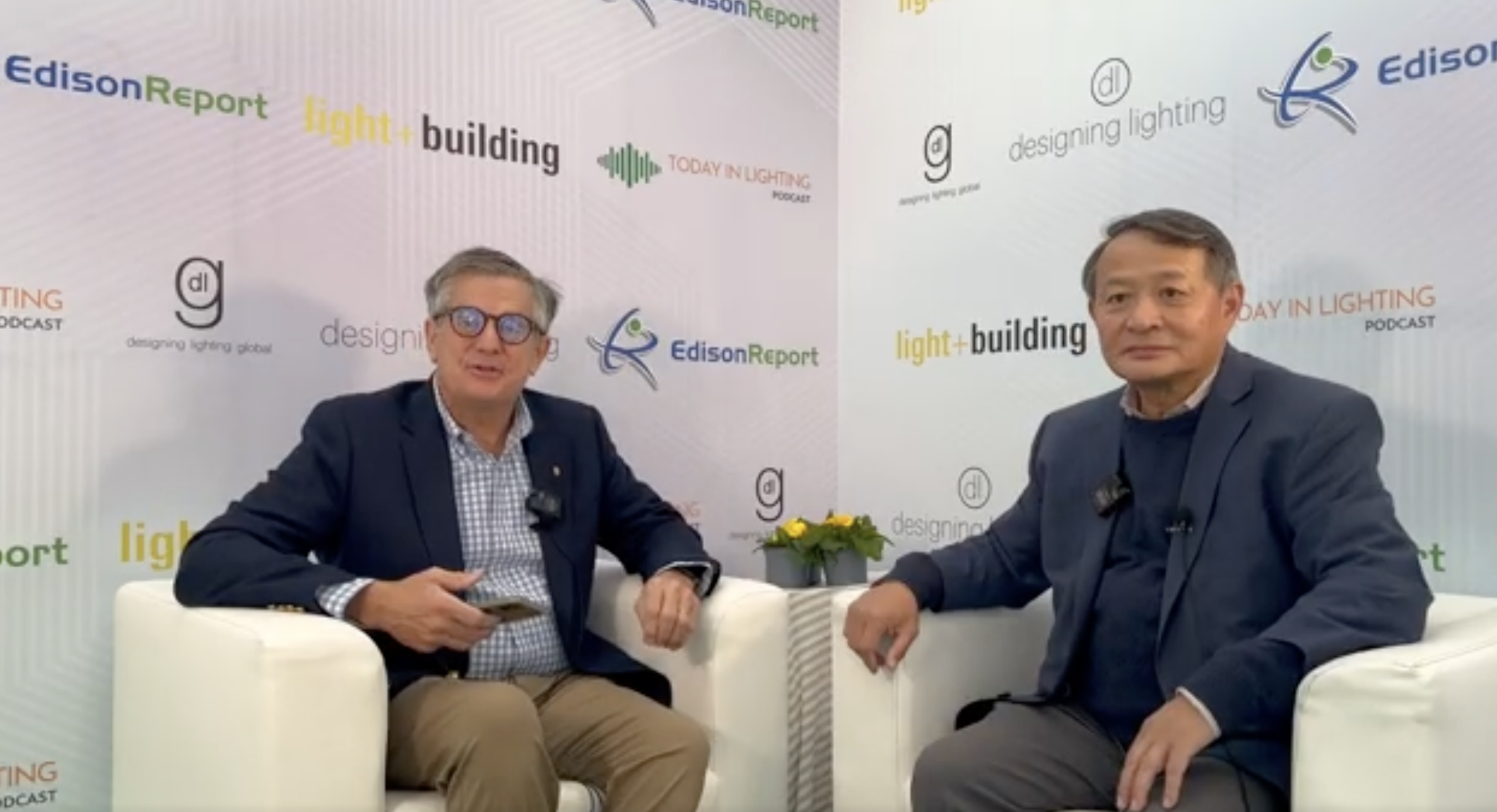
Bridgelux is doubling down on light quality while maintaining strong efficacy. The company is using phosphor innovation and vertical integration to push CRI performance higher. At Light + Building 2026, CEO Yiqun Lee explained how this Bridgelux LED technology strategy is gaining traction across key markets.
Light Quality Gains Priority
The industry focus is shifting. Lumens per watt still matters, but light quality now drives many decisions.
Bridgelux’s F90 technology delivers CRI 90 with efficacy comparable to CRI 80 products. That balance removes a long-standing tradeoff. Designers no longer need to sacrifice efficiency to achieve better color rendering.
Lee noted strong adoption of KSF phosphor technology. Many residential lamps sold through major retailers now use this approach. Bridgelux supplies LED chips to manufacturers, which then deliver finished products to the market.
Expansion Beyond COB
Bridgelux built its reputation on COB LEDs. Over the past several years, the company expanded into SMD and CSP technologies.This shift followed a merger that added wafer-level manufacturing. As a result, Bridgelux became vertically integrated. The company now controls both chip production and packaging.
That integration allows faster development and better optimization. It also supports new product formats. Bridgelux now offers linear boards that help customers upgrade from CRI 80 to CRI 90 without redesigning fixtures.
Vertical Integration Drives Performance
Vertical integration remains central to the Bridgelux LED technology strategy. It improves both speed and quality.
Bridgelux can select its own materials and fine-tune combinations for better performance. It also gains full visibility into manufacturing, which improves consistency and traceability. Lee remains closely involved in technology. In addition to his CEO role, he leads technical development as group CTO.
Smart Lighting and RGBW Innovation
Bridgelux is also investing in smart lighting. Its DriveLux platform integrates driver and control into a compact module with Bluetooth control.
The company is advancing RGBW technology as well. These systems combine color mixing with high-quality white light. They achieve CRI 95 and support tuning from 1,800K to 6,500K. Bridgelux is extending this capability into linear “neon” solutions for architectural and outdoor use. These systems deliver uniform color while maintaining strong white light performance.
Interest at Light + Building was strong. Bridgelux is showing that meaningful innovation in LED components is still possible.
Read more:
Light + Building 2026: Smaller Numbers, Stronger Conversations