







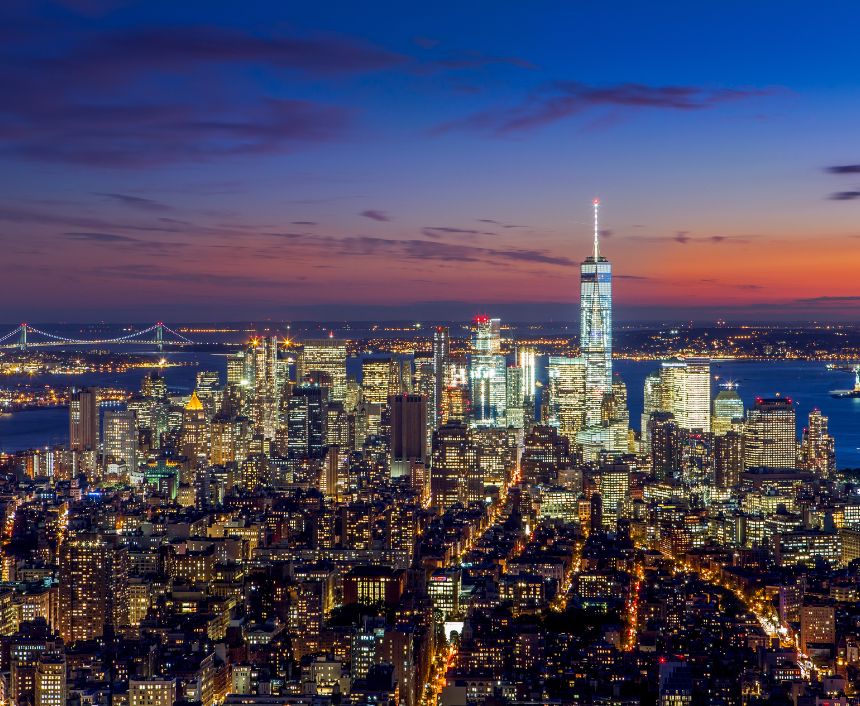
For generations, the glow of New York City at night has been one of the most iconic images in the world — the skyline blazing, Times Square pulsing, the Empire State Building cycling through its colors like a beacon visible for miles. But a bill now making its way through the New York State legislature could meaningfully change how the city looks, and feels, after dark.
The legislation is called the Dark Skies Protection Act (Assembly Bill A4615), and its sponsor, Manhattan Assemblywoman Deborah Glick, says the goal is straightforward: reduce light pollution, protect wildlife, conserve energy, and improve quality of life.¹ What’s proving far less straightforward is convincing New Yorkers that dimming the city’s lights is a good idea.
What the Bill Actually Does
The legislation would regulate outdoor lighting statewide — from residential floodlights and building uplighting to commercial spotlights and billboards — requiring non-compliant fixtures to be turned off between 11 p.m. and sunrise, unless they are motion-activated lights that automatically shut off within a set period.¹ The bill proposes banning a variety of different types of outdoor lighting during those hours, including searchlights, spotlights, and floodlights used for architectural lighting, parking lots, landscape lighting, and billboards, unless they are properly shielded.³
The “shielding” requirement is perhaps the most sweeping change. By 1 January, 2028, property owners must shield all outdoor light fixtures—both permanent and portable—at residential, commercial, industrial, and municipal buildings so they direct light downward rather than outward or upward into the sky.²
The bill’s own language is pointed: it notes that “our ancestors were able to experience a night sky full of stars, but now 80% of Americans can no longer see the Milky Way,” and warns that excess artificial light can disrupt the body’s natural circadian rhythms, affecting hormone production and other biological functions.² If signed into law, the measure would take effect January 1, 2028.
What’s Exempt — and What’s Not
Critics who have imagined a pitch-black Times Square or a dark Empire State Building can take some comfort. Regulations would still permit lighting for airports, highways, construction sites, emergency services, and other critical safety uses. Seasonal decorative lights and small low-wattage fixtures would also be exempt. Outdoor sports venues could keep lights on past 11 p.m. only long enough to finish games already in progress.¹
Iconic landmarks like the Empire State Building and One World Trade Center would most likely fall under exceptions or special use cases,¹ and Times Square would likely be exempt as well.³ Assemblywoman Glick was direct on that point: “There are sporting events or concerts. So until those are completed — while they’re in progress — nobody is saying you have to shut the lights off at 11 o’clock.”¹
As for fines, Glick said the state bill itself would carry none — calling it “really about encouraging the Department of Environmental Conservation to provide educational materials to raise awareness” — though local municipalities could impose fines from $100 to $1,000 if they choose.¹ ³
The Case For: Birds, Sleep, and the Carbon Footprint
Supporters ground their arguments in both environmental science and public health.
The NYC Bird Alliance reports that artificial lights disorient migrating birds, causing between 90,000 and 230,000 bird deaths in the city each year.¹ New York State lies along the Atlantic Flyway, a critical migratory corridor, and advocates argue that clearer skies could save countless birds along the route.³ The bill points out that 80 percent of migratory bird species travel at night using the night sky to navigate, making city lights a serious hazard.²
There’s also a human health dimension. A NYC Department of Health and Mental Hygiene study found that nearly one in seven New York City residents have their sleep disturbed by artificial light at least three nights per week.¹
The energy argument is harder to dismiss as well. New York City has pledged to reduce its carbon emissions to one-fifth of current levels by 2050.³ Eliminating unnecessary overnight lighting would be a measurable step in that direction.
The Case Against: Safety, Crime, and Common Sense
The opposition is vocal — and not without merit. For many New Yorkers, outdoor lighting is not an aesthetic luxury. It’s a safety tool.
One Brooklyn resident put it plainly: “Anything could happen. Even with the light on. We’re scared. Imagine with no light? We cannot live like this here.”¹ Another New Yorker told amNewYork: “There will be an increase in burglaries and robberies. Also, someone could trip walking into their own house if their walkway is dimly lit.”³
Researchers find the science on this genuinely mixed. A National Institutes of Health study on reduced street lighting found that “the effect of changes to street lighting on crime appears to vary across contexts” — meaning dimmer streets don’t automatically mean more dangerous ones, but they don’t mean safer ones either.⁴ Political critics have been less measured. NYS Conservative Party chairman Gerard Kassar dismissed the bill flatly, saying its sponsor “wants to push one last ridiculous idea before she retires.”
Where Things Stand
The bill is currently sitting in committee in both the State Senate and Assembly. Should both chambers approve it, it would need the governor’s signature to become law — and there is no clear timeline for a floor vote.¹
New York would not be alone if it moved forward. Lawmakers in New Jersey introduced a similar bill targeting light pollution, energy waste, and glare,³ while dark sky legislation continues to gain traction across the country and in Europe, driven by growing scientific consensus about the harms of chronic light pollution on ecosystems and human health.
Assemblywoman Glick framed the goal this way: “We want to have enough ambient light for everybody to conduct their lives safely, but not so much that it is as if it’s daytime at midnight.”¹
That’s a balance that New Yorkers — and their legislators — are still working out. The city that never sleeps may not be ready to even close its eyes at 11 p.m., but the conversation about what all that light is actually costing has clearly, finally, begun.
Assembly Bill A4615, the Dark Skies Protection Act, is currently under review by committees in both chambers of the New York State Legislature.
Sources