








Lighting Legends Talk Failure, Mentors and Finding Your Own Path
DENVER — At the recent IES26 Lighting Icons Roundtable, put two of the lighting industry’s most accomplished figures in front of a room filled with emerging professionals, and you might expect a discussion about technical achievements and awards.
Instead, much of the conversation was about failure.
And mentors.
And humility.
That made the Lighting Icons Roundtable at IES26: The Lighting Conference one of the more memorable sessions in Denver.
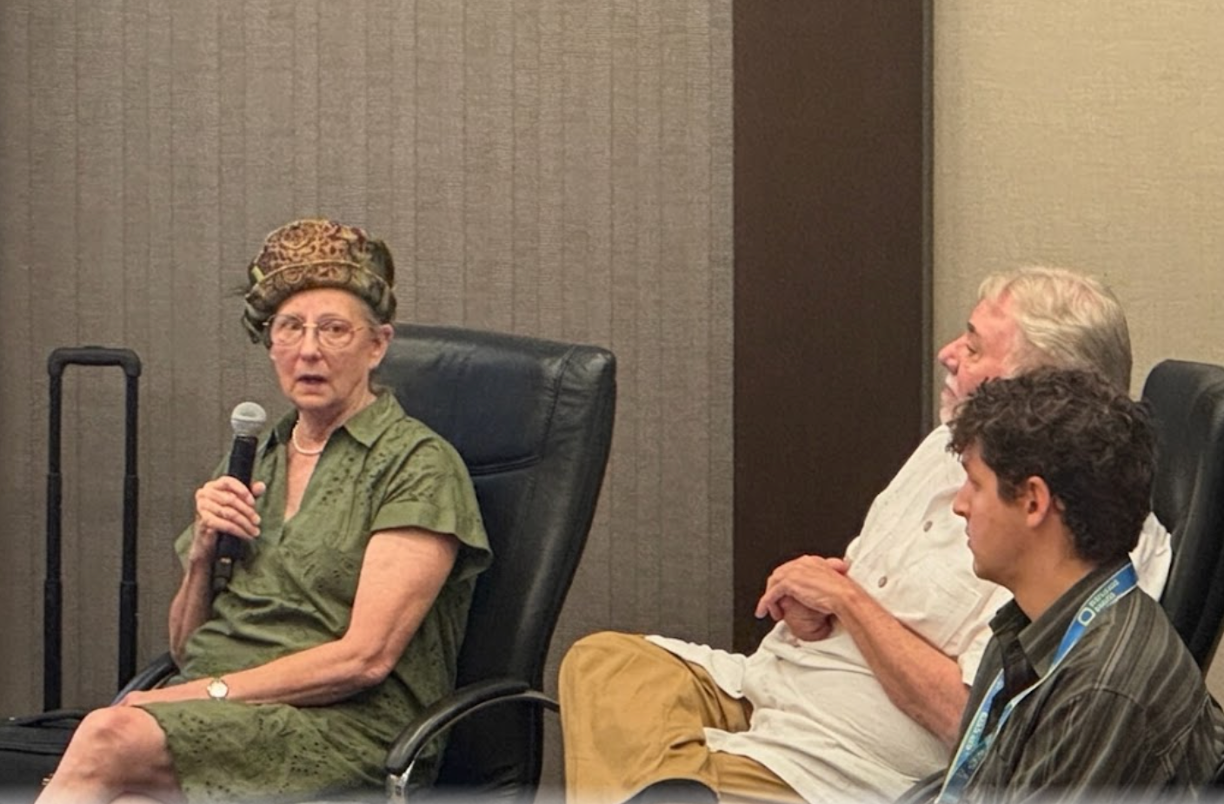
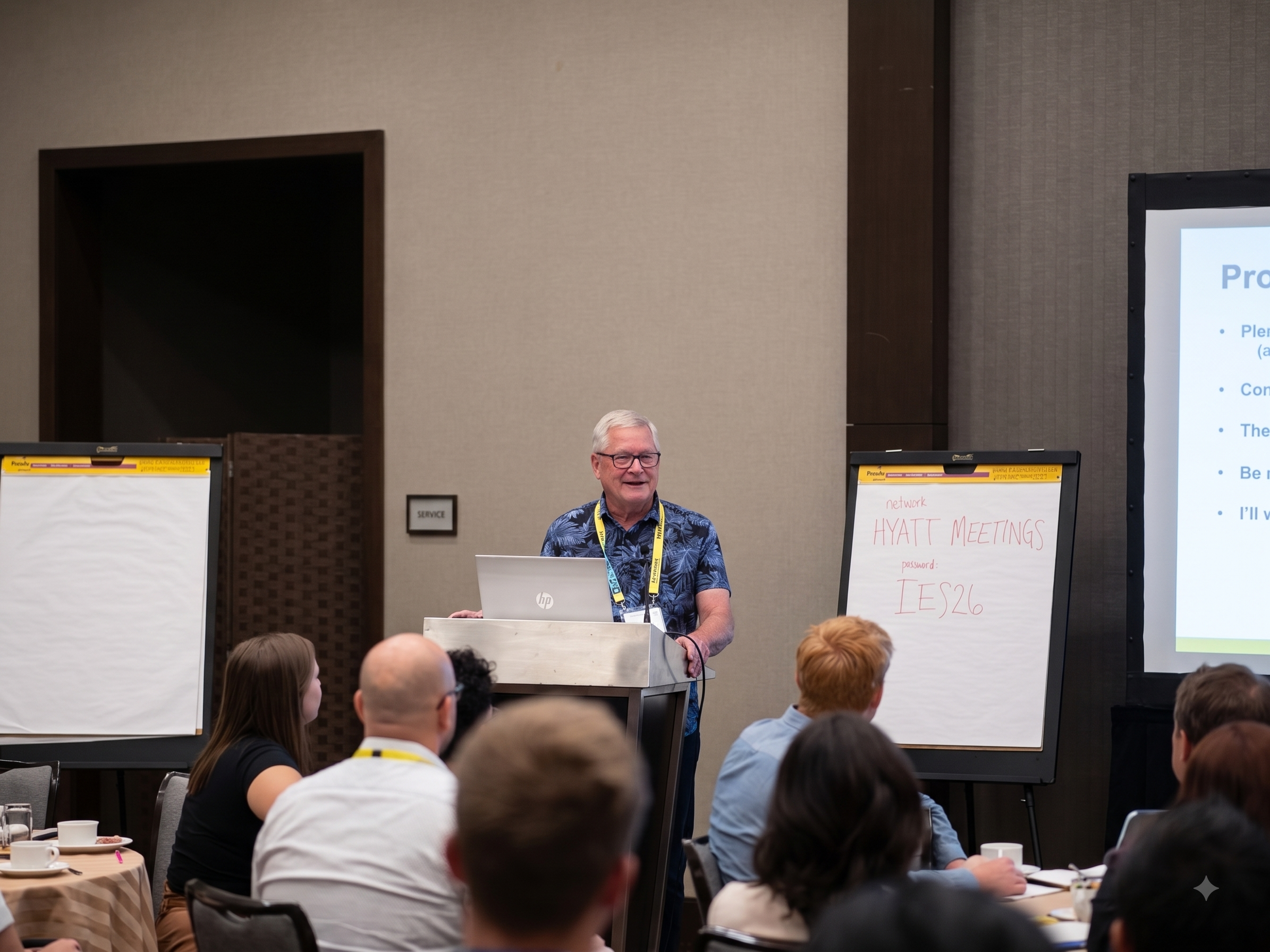 IES Past President Mark Roush moderated the conversation with Naomi Miller and David DiLaura. Both have received some of the Illuminating Engineering Society’s highest honors. They have also spent decades influencing how the industry thinks about light.
Yet Mark established early that this would not be a typical career retrospective.
“Careers aren’t just jobs,” he told the Emerging Professionals in the audience. “They’re a series of accidents and opportunities.”
The Importance of Mentors
One of the strongest themes was mentorship. Naomi and David shared an important early mentor, Stephen Squillace of Smith, Hinchman & Grylls in Detroit.
Naomi remembered him as perhaps the most passionate person she had encountered early in her career.
David described that passion more vividly. “You could feel it—like heat from a giant furnace,” he said.
Mark had his own mentoring story about David.
While still in school, Mark questioned something David had written. Instead of dismissing the young student, David sought him out. The two spent roughly three hours discussing the issue while others at the conference enjoyed the evening’s festivities.
Later, David invited Mark and his professor to his home, where the discussion continued. Ultimately, David acknowledged that Mark had been right.
For Mark, the experience was formative. One of lighting’s leading technical minds had taken a young student’s challenge seriously enough to devote hours to it.
The story also foreshadowed one of the session’s central messages: You never become too accomplished to learn from someone else.
“You Have to Screw Up”
The conversation became especially candid when Mark asked how failure had contributed to their success. Naomi didn’t hesitate. “As a lighting designer, as a person—I’ve failed in every way,” she said with a laugh.
She encouraged younger designers to study their mistakes rather than hide from them. Anyone who has designed lighting and later walked into the completed space knows the feeling. Something isn’t illuminated properly. A physical obstruction was overlooked. The color isn’t right.
Naomi’s advice was simple: Own it and learn from it.
She also discussed the sometimes painful peer-review process at Pacific Northwest National Laboratory. Early in her tenure, criticism of her work could feel personal. Eventually, she learned to accept that someone else might know more. They might also have a better way to express an idea.
David followed with perhaps the story of the session.
Early in his career at Smith, Hinchman & Grylls, he was performing lighting calculations for a large General Electric research facility in Schenectady, New York.
David made a simple but disastrous mathematical error. He multiplied by pi instead of dividing by pi. The resulting calculation was off by approximately a factor of ten.
By the time someone caught the mistake, equipment had been selected. Considerable design work had also been completed. David soon found himself in the company president’s office.
“DiLaura, tell me why I shouldn’t fire your ass,” he recalled being told. He was given 24 hours to explain what happened.
David went back and studied more than the mathematical error. He wanted to understand what caused him to make it in the first place.
He returned the following day and gave his explanation. The president listened and finally told him, “You can keep your job. Get out.”
More than five decades later, David still remembers the lesson. “Until you make a mistake like that, you really aren’t a professional yet,” he said. “You have to screw up—deeply and badly. Then you have to recover. Then you’re a professional.”
From LEDs to Flicker
Naomi was asked about a conversation that changed the direction of her career.
She recalled working in a design office in Troy, New York. Manufacturer representatives arrived with something relatively new: LEDs. One product caught her attention, but not for the reason the rep probably hoped.”This is great, but it flickers,” Naomi recalled saying.
The representative didn’t understand what she meant.
Naomi explained that when she moved her eyes, she could see repeated images of the light source. She soon realized something important: Not everyone perceived flicker the same way she did.
That observation helped launch a long-running interest in LED flicker and its potential effects on people.
Follow Your Own Path
David offered another memorable story when discussing advice for younger professionals.
Someone once asked him why he was so “weird.”The comment bothered him enough that he went to his mentor. According to David, his mentor reframed the word around the idea of following one’s own path.
“When you are weird, you are following your own path,” David recalled. That idea clearly stuck. David has spent a career following paths few others would consider.
He told the audience about his private collection of historical documents on the science of light. The collection includes a book printed in 1475 that discusses Aristotle’s theory of vision.
It also includes Johann Heinrich Lambert’s Photometria, published in 1760. There was one problem. Lambert wrote it in Latin, and an English translation didn’t exist. David didn’t know Latin. So he learned it. Then he translated the book.
Mark seemed almost amused as he explained the significance to the audience. “There was a book he couldn’t read,” Mark said. “So Dave goes out and learns Latin.”
David’s latest intellectual detour is quite different. At age 80, he has written a science-fiction novel dealing with artificial intelligence becoming conscious.
Unlike the typical dystopian AI story, David takes a more optimistic view.
“They’re going to help us,” he said.
Don’t Just Light the Desktops
The discussion eventually returned to lighting. Naomi was asked how her design philosophy had evolved. Her answer was refreshingly straightforward:
If you want a space to feel bright, she explained, light the walls. Don’t concentrate exclusively on horizontal illuminance.
“Don’t just light the freaking desktops,” she said.
Naomi also believes the industry needs to think beyond visual tasks. Research has expanded our understanding of light’s psychological and physiological effects. As a result, she sees reason to reconsider how low some interior light levels should go.
“I design not just for visual tasks, but also for human health,” she said.
David offered a different observation about how lighting has changed. “The world is now self-luminous,” he said.
Computers, phones, displays and equipment increasingly generate their own light. In some automated factories, even the machines no longer need illumination to perform their work.
“We used to light the desk because we had to, and we used to light the paper. We used to light the machinery,” David explained.
For David, the rise of the self-luminous environment represents a fundamental change in what lighting professionals are being asked to illuminate.
You Never Outgrow a Mentor
One of the best audience questions asked when Naomi and David realized they no longer needed mentors.
David explained that becoming a full-time teacher helped him understand what mentoring actually requires.”A powerful mentor makes themselves vulnerable,” he said. Without that vulnerability, he argued, it is difficult for a mentee to develop real trust.
Naomi had an even simpler answer.
“The point at which I will no longer need a mentor is when I’m six feet under.”
She still calls longtime colleagues Peter Boyce, Peter Ngai, and Terry McGowan when she gets stuck and needs advice.
It was a revealing answer from someone who has spent decades being the person others call for advice.
Get Involved
Naomi also challenged the Emerging Professionals to become active participants in the industry’s future.
“You have to be part of the change,” she said. Her recommendation was to join IES committees, even if you don’t consider yourself an expert. Volunteer to take notes. Help with illustrations. Research references. Offer your writing skills. Do whatever is useful.
At first, you may sit through several committee meetings without understanding all the personalities or even exactly what is happening.
Then something changes. You learn, contribute and eventually help drive change rather than simply respond to it.
Knowing When to Let Go
David, now 80, offered another perspective that probably seemed distant to many of the Emerging Professionals in the room.
Eventually, he said, there are areas where you have to accept that you won’t keep up with everything.
“There are many things that I have decided I will not attempt to keep up with,” he explained. “They’re in my past. They’re done.”
That doesn’t mean David has stopped learning. His science-fiction book and continued interest in artificial intelligence suggest otherwise.
Instead, his point was about choosing where to spend your time. “It will take great courage to finally say, ‘I’m done,'” he said. Then he quickly cautioned the younger audience: “Don’t do that yet!”
Lighting’s Greatest Resource
For all the technical accomplishments represented on that stage, the Lighting Icons Roundtable was surprisingly personal.
Naomi and David talked about people who helped them, mistakes that shaped them and lessons they continue to learn. Neither presented a career as a carefully executed master plan.
That may have been exactly what the Emerging Professionals needed to hear.
Naomi summed it up particularly well while discussing her lifelong relationships within IES.
“My family is all the people I know and love,” she said. “They are the people I choose, not simply the people I was born to.”
She added that IES has, in many ways, become part of that family.