







ams OSRAM Q1 Results Show Growth in AI Photonics and Semiconductors
ams OSRAM delivered strong first-quarter 2026 results this week while advancing deeper into the fast-growing AI infrastructure market. The company reported improved margins, positive free cash flow, and new momentum behind its Digital Photonics strategy.
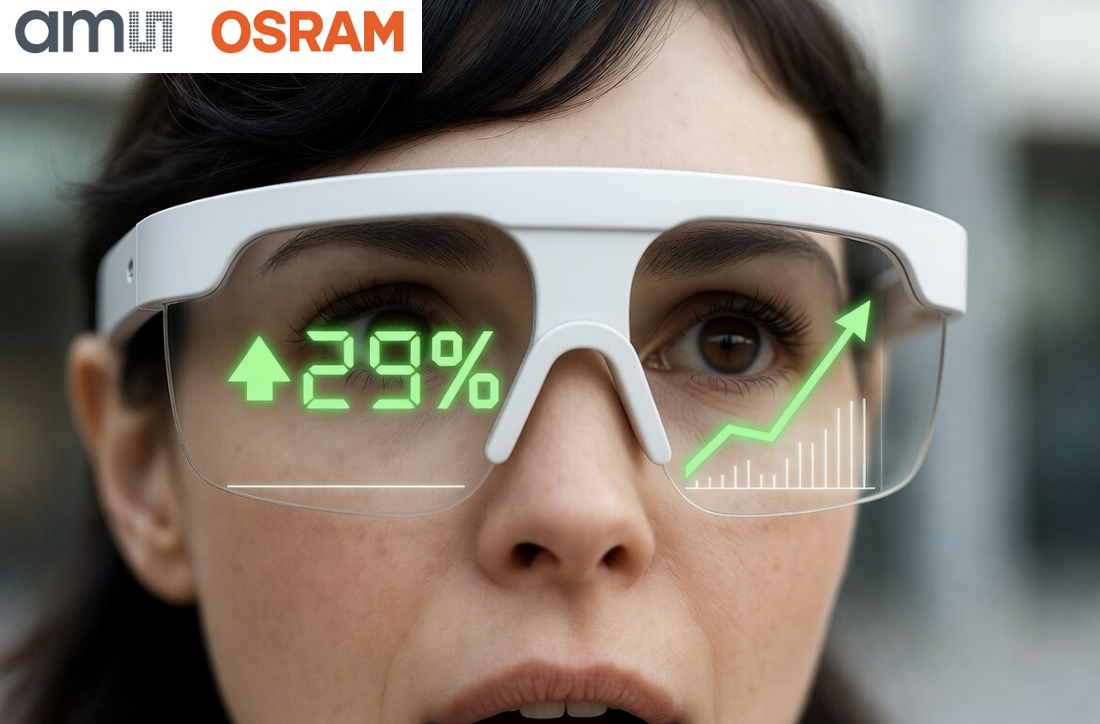
The market was very happy with the results as the stock gained 29% on very heavy trading.
The Austria-based lighting and semiconductor company also announced a development agreement tied to AI data centers. That news helped strengthen investor confidence as ams OSRAM continues shifting beyond traditional lighting into photonics, sensing, and semiconductor technologies.
First-quarter revenue reached EUR 796 million. That figure landed in the upper half of company guidance. Adjusted EBITDA margin came in at 16.5%, also near the high end of expectations. While reported revenue declined slightly year-over-year due to divestments and currency headwinds, the company said its core semiconductor business grew about 8% on a like-for-like basis.
CEO Aldo Kamper said the company’s transformation strategy is beginning to show results. “We delivered a strong start into the year,” Aldo said in the earnings release. He added that the company’s new AI photonics agreement reflects growing demand for its Digital Photonics platform.
ams OSRAM Targets AI Data Centers
The biggest news from the quarter was ams OSRAM’s move into AI infrastructure.
The company signed a development agreement with a leading AI photonics partner focused on optical interconnect technology for AI data centers. The technology uses highly parallel micro-emitter arrays designed to improve power efficiency, thermal management, reliability, and scalability inside advanced computing systems.
As AI workloads continue growing, data centers are searching for faster and more energy-efficient optical communication systems. ams OSRAM believes its expertise in emitters, sensors, and optical systems positions the company well for that opportunity.
The move also highlights a broader trend within the lighting industry. Many lighting manufacturers are increasingly leveraging semiconductor and optical expertise in adjacent technology markets.
Smart Glasses Remain a Growth Opportunity
ams OSRAM also continues expanding into augmented reality smart glasses. The company described what it called a complete portfolio value proposition for AI-enabled AR eyewear. It estimates potential content opportunities of EUR 50 to 100 per device, depending on volume and product lifecycle.
The company already supplies components used in smart glasses currently on the market. For the lighting industry, the strategy shows how lighting and optical companies are evolving beyond illumination. Companies like ams OSRAM are increasingly competing in automotive, AI, industrial, sensing, and wearable technology sectors.
Positive Free Cash Flow Improves Financial Position
ams OSRAM recently completed the sale of its Specialty Lamps business to Ushio. The company also signed an agreement to divest its non-optical mixed-signal sensor business to Infineon Technologies.
Despite the operational progress, financing costs continued to pressure profitability. The adjusted net result for the quarter was a loss of EUR 72 million. Still, the company maintained its fiscal 2026 outlook and said it sees a path toward positive free cash flow in 2027.
For the broader lighting industry, the quarter reinforces a major shift already underway. Lighting manufacturers are no longer just lighting companies. Increasingly, they are becoming semiconductor, sensing, and photonics companies serving AI, automotive, industrial, and wearable technology markets alongside traditional illumination applications.