






Inside the Luminaire EPDs: Energy Leads, Materials Matter
After nearly four years of roundtables, data requests and more than a few standards detours, the lighting industry now has its first industry-average environmental product declarations (EPDs). The five EPDs cover downlights, cylinders, linear, troffers and post tops. These declarations represent a significant step forward in understanding luminaire embodied carbon and its impact. They were unveiled 6 OCT at an LCA Incubator Roundtable hosted by the GreenLight Alliance and the International Association of Lighting Designers (IALD). Your humble editor was on the call. When I asked whether anything was off the record, the answer was simple: the soft launch is fair game.
Leela Shanker, Sustainability Director at WAP Sustainability, led the session. She noted that the effort began almost exactly four years ago at a roundtable in Stickbulb’s Brooklyn offices. Emilio Hernandez, Chair of the GreenLight Alliance, described a process with 20 roundtables, nearly 100 organizations and about 30 participating manufacturers. “It’s great to have a product to show for it,” Emilio said.
What Designers Are Getting
The EPDs are cradle-to-grave, global in scope and valid through 2031. They are published through Environdec, the program operator for the International EPD System, and the IALD holds them under a Creative Commons license. Christopher Knowlton, CEO of the IALD, said the association will be the long-term home for the work. That home includes the EPDs, specification language, LCA training modules, project precedents and a community for manufacturers and designers. Questions can go to [email protected].
Results are reported per functional unit: a luminaire delivering 1,000 lumens over a 35,000-hour life. For specifiers who think in fixtures, not lumens, each EPD includes a conversion factor; for the linear EPD it is 10.05. “We’re all used to using different multipliers for CRI or color temperature,” Leela said. “This is just an extra one for sustainability performance.”
The Rules Changed Along the Way
Vicki Rybl of WAP Sustainability walked through how the methodology shifted since the group’s May update. The project moved from a construction products PCR to the International EPD System’s electronic and electrical equipment PCR. It also adopted a luminaire-specific PCR based on the PEP ecopassport PSR-0014. Module D, the credit for recycling materials after the product’s life, was removed because the rules require it. The PCR also allowed only functional-unit results in the EPDs, so per-fixture (declared-unit) results will live in supplemental documents on the IALD site.
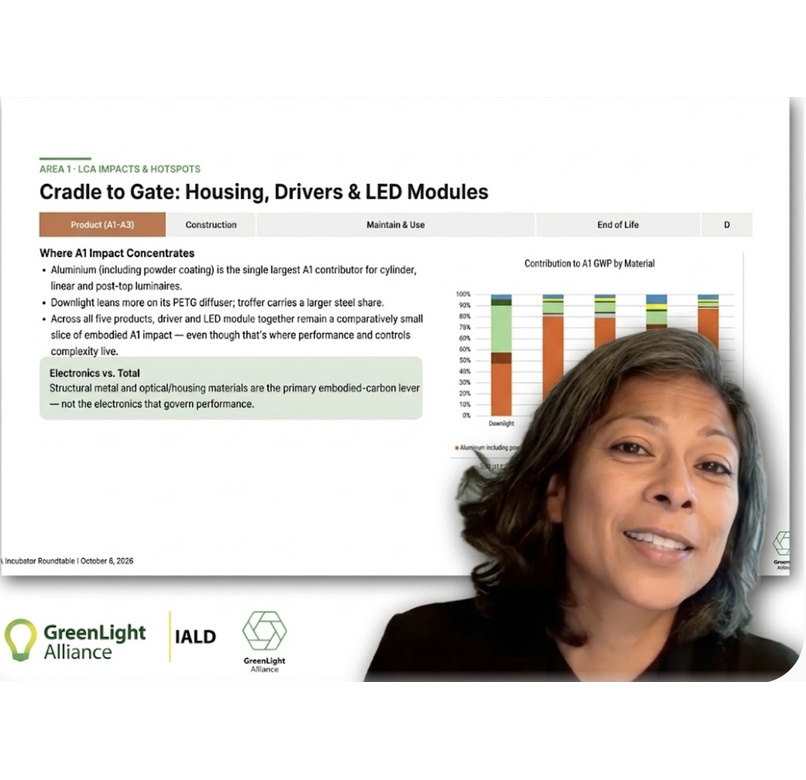
Aluminum Is the Big Lever
Where You Plug It In Matters
The use phase still dominates. The data shows just how much location matters: energy mix alone can drive up to a 13X difference in use-phase results for the same luminaire. The same linear pendant with no controls ranges from roughly 30 to almost 400 kg CO2eq across cities, purely because of the local grid. The manufacturer takeaway is to improve efficacy, use renewable energy in your plants and your suppliers’ plants, and disclose the grid-mix assumption.
That will matter more over time. Global Alliance for Buildings and Construction data presented in the session projects embodied carbon rising from 25% of building-sector carbon in 2021 to 49% by 2050.
Lifetime Is the Next Fight
The liveliest moment came from Jean-Marie Croué, Director General of the Syndicad du Luminaire, (French Lighting Manufactuerer’s Association.) He argued that luminaire lifetime is “the most important issue for EPD calculation right now.” Under current rules, he said, two manufacturers can declare 20 and 40 years for essentially the same product. He wants lifetime tied to the housing material and measured in years, not light-source hours.
What It Means for Your Next Spec
Josh Jacobs of WAP Sustainability added a practical note. Industry-wide EPDs help with LEED v4 and v4.1 and Green Globes, but only for manufacturers named as participants. LEED v5 won’t give credit for industry-average EPDs alone; it rewards products that beat the average.
That makes these EPDs a baseline, not a finish line. The group listed five next steps: refining lifetime assumptions, replacing generic driver and LED data with real EPDs, a standard template for designers, a global grid approach and broader sampling. The team will use the EPDs in IALD Specifications Lab training at Enlighten Americas in Austin on 15 OCT. A formal press release will follow the conference.
Go Deeper: Leela Shanker Unveils Sustainable Designer Workflow at IALD Enlighten Europe 2025
LEDucation Thought Leaders: Leela Shanker Discusses the Circular Economy
Industry-Wide Luminaire EPDs Verified for Five Fixture Types