








Get-A-Grip on Lighting Unleashes on DLC (and D+R International)
On 3 Oct 2025, the Get A Grip On Lighting podcast devoted a full episode to the DesignLights Consortium (DLC) and its long-time contractor D+R International.
This is one of those pieces I feel compelled to write, even though I hate writing it. Our team debated about posting the video earlier in the week. We ultimately did, though we suspect most won’t watch it—and even fewer will stick with it to the end. For context, 60 Minutes built its brand on accountability journalism in 15–20-minute segments. By contrast, this Get A Grip On Lighting episode runs more than 100 painful minutes. The core argument could have been made in under ten minutes–and been much more effective!
Hosts Michael Colligan and Greg Ehrich framed the show with a disclaimer—“we are not accusing anyone of illegal activity”—but in essence the video implies illegal activity. Stripping away the rhetoric, the name-calling, and the mafia analogies about DLC, below are the key points the hosts raised, with my comments in italics. At the end of the article, you can see some of the inflammatory quotes as well as my five-point plan on how to fix the DLC issue. The scenario offered by your humble editor will make the DLC more responsive, transparent, and efficient, while exponentially lowering costs to the lighting industry.
Charity Optics vs. Market Behavior
Michael and Greg argue DLC “doesn’t look or act like a charity,” despite being a 501(c)(3).
The hosts compare DLC to IES throughout the entire podcast, which isn’t fair to either organization and I have never thought of either as a charity. But Michael makes the point that IES does accept donations and DLC, at least on their website, does not. I looked it up and the IRS does treat 501(c)(3)’s as charities. Whether a 501(c)(3) is a charity or not seems irrelevant to me.
DBA vs. legal entity
Michael spends a lot of time discussing the relationship between DesignLights Consortium, Efficiency Forward, and D+R International which they claim “adds opacity” over who employs whom and who is ultimately accountable.
As I understand things, DLC is the 501(c)(3) , a non-profit. They have hired D+R International, a for-profit company, to do the actual work. Not sure what role Efficiency Forward plays.
Board composition and governance clarity
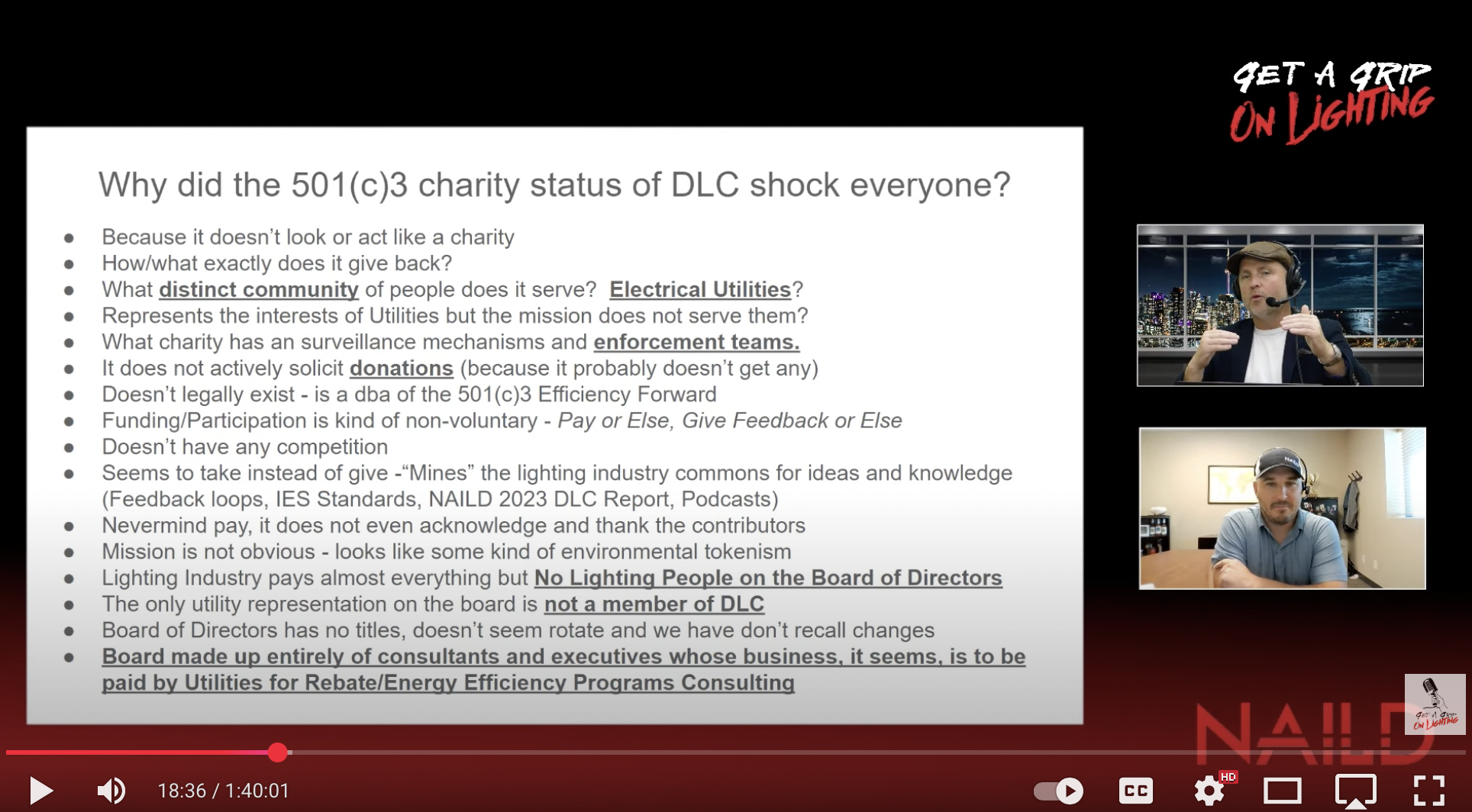
Michael and Greg complain that DLC lists directors without typical nonprofit officer roles (president, treasurer, etc.) or visible rotation. Michael states that several directors have served for many years. The criticism: a lack of term limits and published roles “reduces accountability.” The hosts further claim most directors are consultants or corporate executives who sell services to utility efficiency programs—i.e., the very ecosystem DLC influences—while no lighting people serve on the board and utility representation is minimal.
This is a very important point. I have never heard of anyone who is “running” to be on the DLC Board of Directors like we see in other organizations. The DLC, and the industry, would be better served, if lighting people and utility people were on the BoD and if the BoD actually set policy. Michael claims that some people have been on the Board since 2018. Perhaps there is a legitimate reason for the the way the Board is organized but I don’t know what that could be. It would be interesting to see the minutes of their Board meetings. Keeping minutes is mandatory; publishing them isn’t, unless their own rules or bylaws says otherwise. Those minutes, if made public, would be quite telling.
Specification power held by a for-profit contractor
Michael asserts that D+R has for years drafted DLC specs and policies, processed QPL applications, maintained the DLC database/website, and helped run stakeholder meetings. They argue a for-profit firm should not be the de facto author and gatekeeper of standards that shape rebate access.
This point is crucial. Why does DLC hire D+R, a for profit company, to do this work? Why doesn’t DLC hire the employees directly? What is the need for a for-profit middleman?
Public representation vs. payroll
Pointing to former staffer Brady Nemeth’s resume and an April 2000 interview with him, the Get-A-Grip hosts contend that D+R personnel at times masqueraded as DLC employees. They urge DLC to clarify who signed which paychecks, when, and to draw a bright line between charity staff and contractor staff in public forums.
This is small ball. Whether we like it or not, D+R is a contractor to DLC. At EdisonReport we deal with contractors all of the time. Some even have email addresses of their clients and position themselves as an actual employee of their clients. Also, playing video clips from an interview from five ago, where you don’t have the full context, is a cheap shot.
“Gatekeeping” of incentive dollars
The show characterizes DLC listing as a practical prerequisite for many rebates and calls DLC a gatekeeper to the money. They contend this creates a “pay-to-play” dynamic that feels coercive, not charitable, for manufacturers forced to list products to compete where rebates drive demand.
This point is very well made. I better understand Michael’s relentless point about charities. DLC does feel much more like a gatekeeper than a charity.
Fear of reprisal and delisting
The hosts say manufacturers fear “delayed listings, increased scrutiny, or quiet exclusion” if they criticize DLC. They add that several companies who contributed to a past NAILD advisory effort insisted on anonymity “citing fear of reprisal.”
This concern has circulated for years, including among non-NAILD companies that worry about reprisal. Whether that fear is justified remains unclear. Reports of products being disqualified for publicly disagreeing with DLC haven’t surfaced. If DLC were delaying or rejecting applications unjustly, it likely would be widely known. More than a decade ago there were delays, but those were attributed to the sheer volume of applications.
Spec churn and market disruption
The hosts argue new versions (e.g., “6.0”) trigger repeat testing/costs and inventory risk, functioning as “continuous extraction” without commensurate public benefit.
This is a great point! As the QPL qualifications continue to change, it places a huge financial and time burden on manufactures and distributors. It is as if the goal posts continue to change. It would be nice to hold these specs for a minimum of five years. if DLC had a diverse Board consisting of utility and lighting people, they may very well say no to 6.0.
Again, I remind our audience that money going to DLC is money that is not going to IALD, IES, NAED, Mt. Sinai’s Light & Health Research Center, McClung Foundation, Nuckolls Fund for Lighting Education, etc…..
Tina Halfpenny “appears” on the show
They promoted the episode as if Tina Halfpenny, CEO, Efficiency Forward. would appear, which was disingenuous. I tuned in live on Friday, 3 Oct, precisely because it seemed unlikely Tina would join them given the show’s past bombast. The stream had technical issues—that happens, and I don’t fault them for it. But I do fault the billing: Tina never appeared. Instead, they ran short clips from an old interview. That is misleading.
The Characteristics of a Racket
Michael claims that DLC is the opposite of a charity, it is an anti-charity, that it is, in fact, a racket. The hosts listed 11 characteristics of rackets and discussed each one in depth.
-
Intentionally Complex and Opaque Structures
-
The Front: Cloaks, Costumes and Disguises
-
Marks Victims for Extraction
-
Gatekeeping or Control of Market Access
-
Rackets Have no Competitors
-
Extortion Based Income and Coercive Funding Models
-
Fear of Reprisal
-
Systematic and Ongoing Exploitation
-
Regressive, Damaging or Simply Useless
-
Victims Often Admire their Racketeers
-
Corporate Rackets Go Invisible but are still “felt”
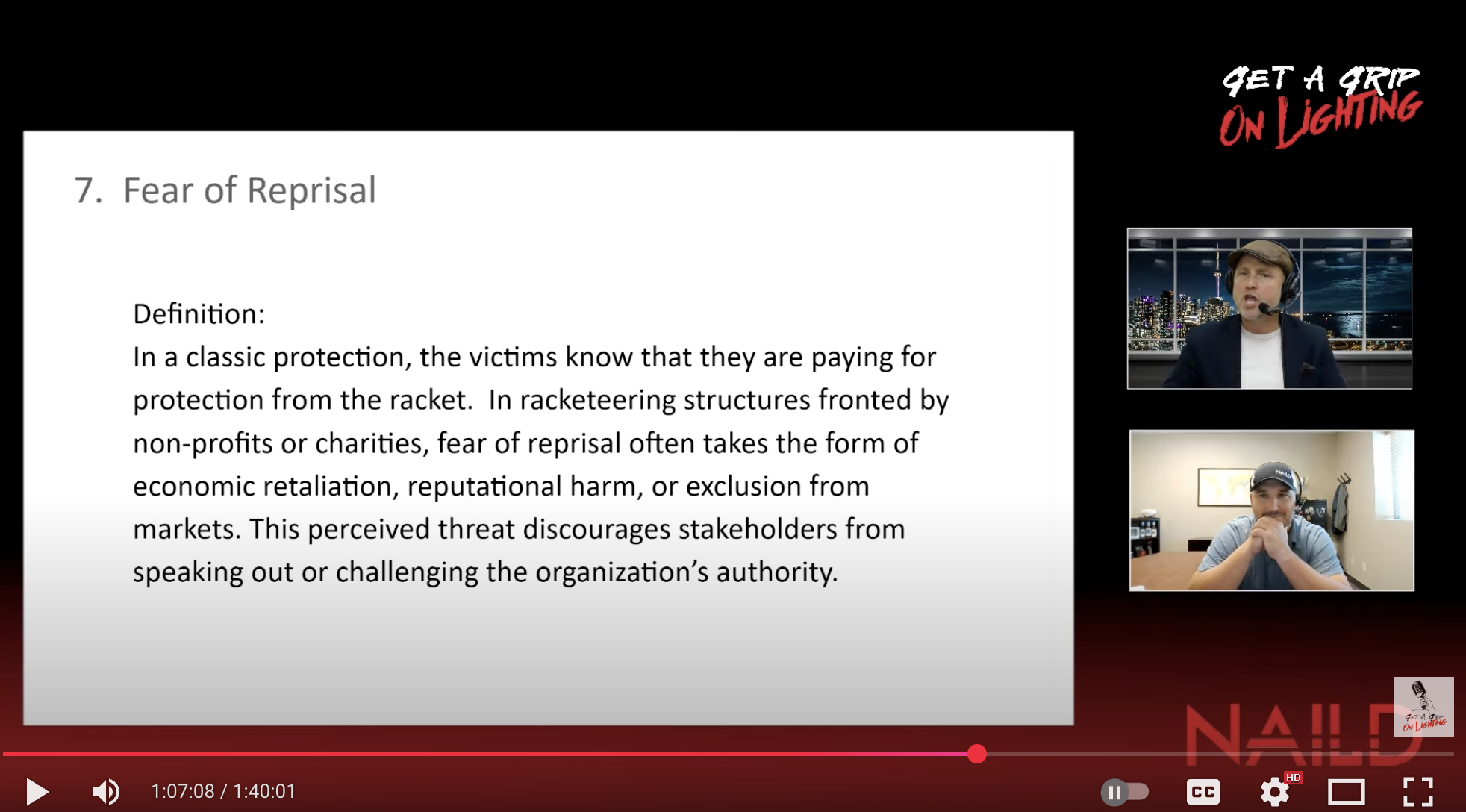
Fear of Reprisal
For the sake of brevity—and sanity—I won’t go through all of them, but I will point out number 7, Fear of Reprisal. Before playing a clip of a previous interview with Tina Halfpenny. Michael prefaces this video clip saying, “I want you to listen, not for exactly what she says here, but the power she has. She has so much power.”
(Quotes are cleaned up for the sake of clarity.)
Michael: “I remember the last time we spoke, you talked about some issues that you were having in terms of fraudulent certification…people were putting DLC on their boxes and they weren’t DLC.”
Tina: “It still happens.”
Michael: “How do you guys deal with that?”
Tina: “If they have products that are listed and if they are misrepresenting other products, we delist them.”
Greg: “All of their products and the company as well?”
Tina: Yes. If they are misrepresenting as being DLC qualified and they are not one of our manufacturers. There is not a whole lot that that we can do…we send letters from our lawyer saying you need to cease and desist.”
At the end of the clip, Michael stated, “So she’s able to really punish the United States lighting manufacturer, and actually I shouldn’t say that. David Steiner is really able to punish lighting manufacturers that he doesn’t like the way they roll…They have the ability to destroy your business.”
This is why your humble editor doesn’t like their tactics. Tina wants to punish the companies who are cheating (a good thing) and the hosts take a video clip and twists it to say they can destroy your business. That clip convinced me not to appear on Get-A-Grip again. If a years-old sound bite can be repurposed to a different point in an effort to make a guest look bad, I want no part of it.
Tone and Personal Attacks
There were many personal attacks throughout the video, something that your humble editor has never been a fan of.
In the above clip, Michael goes into his Italian accent, which is quite good, accusing David Steiner, President and CEO of D+R International, of being Fanucci from the movie The Godfather. You can watch that clip above.
Below are a few quotes (cleaned up) from Michael:
“…so, there’s only so much money to go around and the scoundrel David Steiner needs to get most of it for him…you’re a scoundrel, David. This is between me and you, buddy.”
“This is man to man, me and you buddy you’re a scoundrel and I know you are you’re a dirty scoundrel.”
“Sorry buddy it’s time to pay David Steiner he needs a second yacht he needs one for the Pacific and one for the Atlantic and a helicopter in between.”
“I don’t know who, what actor is gonna play you in this movie, David Steiner… ain’t gonna be Leonardo DiCaprio.”
“What happened was a bunch of guys went over to China and got everybody in China addicted to opium and then they sold them opium and so they they were selling opium to China. They got the whole country high as a kite, they’re making a fortune. OK David Steiner has got the utilities and the lighting industry addicted to rebates…we’re addicts. OK this guy’s got us hooked*** **** the pusher man.
The above are just some of the over-the-top statements. David Steiner did not addict the industry to rebates. Capitalism addicted us to rebates—and by the way, we are less addicted today than we were 5 years ago. At one point in the video, Michael questions whether Tina Halfpenny’s name is really Tina Halfpenny. Toward the end, Michael plays some clip from Superman where an actor says “Kneel before Zod.” It was so important that he played it twice. At this point, I stopped watching.
It is Past Time for the DLC to Make Systemic Changes and Extract far Less Money from our Industry
As much as I despise their approach, Michael and Greg bring up some very important points. They have done their homework and it is past time for the DLC to make systemic changes and extract far less money from our industry.
My 5-point suggestion is rather simple:
- Elect a Board of Directors from the lighting and utility industries. Companies that participate in DLC, either as a utility or a lighting manufacturer, should have the right to vote.
- Freeze all standards as they are for five years.
- Eliminate all third-party contractors. DLC can hire a few people from D+R and DLC should run their own program.
- Remove the per-SKU fees. Have manufacturers pay a small annual fee, regardless of number of products.
- Allow self-certification with a vigorous inspection program.
The above will make the DLC more responsive, transparent, and efficient, while exponentially lowering the costs to the lighting industry.
Go Deeper: