







Signify First Quarter Results Show Resilient Performance Amid Market Softness
Signify first quarter results highlight a company balancing declining sales with disciplined execution. The global lighting leader faced continued market softness across multiple segments in Q1 2026. Still, margins and cash flow remained resilient, supported by cost control and pricing strategies.
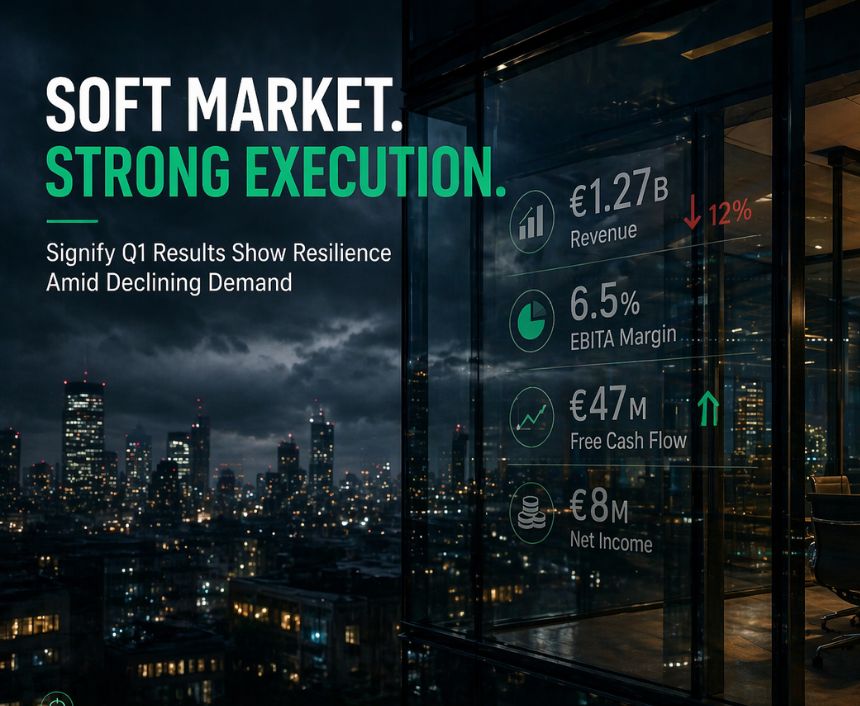
Sales for the quarter totaled €1.27 billion, a 12% decline year over year. Comparable sales dropped 5.1%, reflecting weaker demand in both Professional and Consumer markets. Currency effects, particularly the depreciation of the U.S. dollar, added further pressure.
Net income fell sharply to €8 million, compared to €67 million in Q1 2025. The primary driver was €63 million in restructuring costs tied to a broader €180 million cost reduction program announced earlier this year.
Margins and Cash Flow Demonstrate Discipline
Despite the revenue decline, Signify maintained solid profitability metrics. Adjusted EBITA came in at €83 million, with a margin of 6.5%. While down from 8.0% last year, the result reflects strong cost discipline in a lower-volume environment.
Gross margin remained above 40% at 40.6%. This stability was driven by effective pricing strategies and cost of goods management. Sequential improvement from Q4 suggests that operational adjustments are beginning to take hold.
Indirect costs rose to 35.1% of sales, up from 33.9% a year ago. This increase was largely due to under-absorption of fixed costs as production volumes declined. The dynamic is common in cyclical downturns and underscores the importance of the company’s restructuring efforts.
Free cash flow improved to €47 million, up from €40 million in Q1 2025. Improved working capital management offset lower operating income, demonstrating strong financial discipline during a challenging period.
Professional Segment Anchors Performance
The Professional segment remains Signify’s largest business and a key indicator for the broader lighting market. Sales declined 10.9% to €839 million, with comparable sales down 3.7%.
Weakness was most pronounced in the trade channel and public sector projects across Europe and the United States. However, there were pockets of strength. Indoor project activity in Europe improved sequentially, and emerging markets such as China and India delivered growth.
Connected lighting continues to be a bright spot. Growth in connected solutions helped offset declines in traditional product categories, reinforcing the long-term shift toward intelligent lighting systems.
Notably, the Professional segment improved its adjusted EBITA margin slightly to 7.3%, up 20 basis points. This reflects ongoing pricing discipline and cost management, even as volumes declined.
Consumer and OEM Reflect Market Adjustments
Consumer sales fell 11.5% to €276 million, with comparable sales down 4.6%. The decline was driven largely by inventory corrections in retail channels, which impacted sell-in volumes.
However, underlying demand appears more stable than the headline numbers suggest. Consumer sell-out remained solid, and growth in India partially offset weaker performance in other regions. Still, margins declined sharply to 5.7%, reflecting the negative impact of lower volumes.
The OEM segment, often an early indicator of broader industry trends, showed signs of stabilization. Comparable sales declined 4.8%, pricing pressure began to ease, and management pointed to early signals of recovery.
Structural Decline Continues in Conventional
The Conventional business continues its long-term decline. Sales dropped 23.5% to €71 million, with comparable sales down 17.9%.
Margins in this segment fell to 13.0%, reflecting higher manufacturing costs tied to site rationalization. Management expects profitability to improve in the second half of the year as these temporary factors unwind.
Workforce Reduction and Cost Actions
Signify reduced its workforce from approximately 29,700 employees to 26,000 year over year. The reduction is primarily tied to lower production volumes and factory workforce adjustments.
These actions align with the company’s €180 million cost reduction program. The restructuring is designed to improve efficiency and better align the organization with current demand levels.
Strategy and 2030 Vision
In parallel with cost actions, Signify is investing in long-term growth. The company launched its “Brighter Lives, Better World 2030” program, which focuses on expanding energy-efficient and connected lighting solutions.
Key targets include increasing “beyond illumination” revenues to 41% and delivering cumulative energy savings of 60 TWh for customers. The initiative also emphasizes circular products and reduced carbon intensity.
Outlook: Cautious but Controlled
Looking ahead, Signify expects challenging market conditions to persist through 2026. The company is not providing full-year sales guidance due to uncertainty across end markets.
However, it reaffirmed its adjusted EBITA margin target of 7.5% to 8.5% and free cash flow guidance of 6.5% to 7.5% of sales.
CEO As Tempelman emphasized a focus on disciplined execution and close collaboration with customers and suppliers. The company is also completing a strategic portfolio review to better position itself for future growth.
The Signify first quarter results present a clear picture. Demand is soft, but execution remains strong. The company is taking decisive action to manage through the cycle while continuing to invest in connected and sustainable lighting solutions.
Go Deeper: Signify Reports Mixed Results; Layoff Announcement
Signify CEO As Tempelman Focuses on Customers and Specifiers