







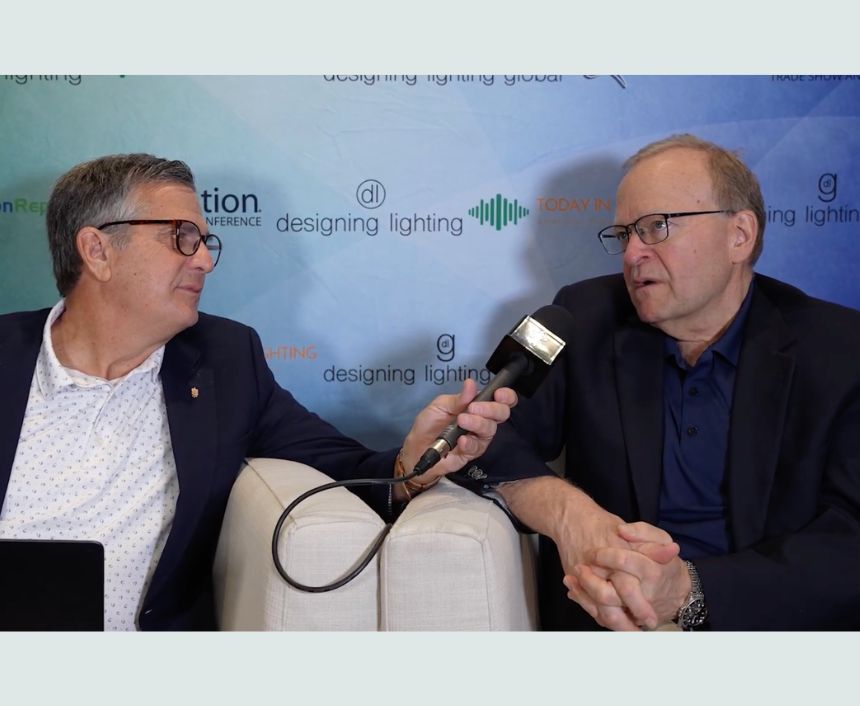
At LEDucation 2026, I sat down with Tom Leonard of Leviton to discuss how commercial lighting controls are evolving and what is driving the next generation of system design.
Energy Codes Drive Industry Change
Leonard emphasized that energy codes are no longer optional or loosely applied. They are now fully embedded into the design and operation of lighting systems.
He said the biggest shift is not the existence of code itself, but the widespread understanding and adoption of how to implement it effectively. Controls must now address a wide range of applications while remaining easy to design, install, and commission.
From Devices to Integrated Systems
Lighting controls have evolved significantly over time.
Leonard pointed out that the industry has moved from simple time clocks and relay-based systems to occupancy sensors and switching devices. Today, those individual components are no longer standalone solutions but part of a larger, integrated system.
Leviton’s approach focuses on creating a continuum, where single-point solutions can scale into full building or campus-wide systems using the same design philosophy and platform.
Measurement and Verification Becomes Essential
A major shift in modern lighting controls is the requirement for real-time measurement and verification.
Leonard explained that it is no longer acceptable to estimate energy savings. Systems must now measure and validate performance to meet both code requirements and owner expectations.
This capability ensures that lighting systems are not only installed correctly but are also delivering the intended energy reductions over time.
Simplicity Is Critical for Adoption
As systems become more advanced, ease of use has become a priority.
Leonard noted that most building owners do not have dedicated energy managers. As a result, lighting control systems must be intuitive and operate effectively without requiring specialized expertise.
The goal is to create solutions that work reliably in real-world environments while minimizing complexity for users.
Defining “Future-Ready” Systems
When asked what “future-ready” means, Leonard described it as flexibility over time.
Rather than locking customers into a fixed solution, future-ready systems allow for expansion, upgrades, and integration with additional technologies as needs evolve. This approach ensures that investments made today can continue to deliver value in the future.
A Broader View of Energy Management
The conversation also touched on emerging ideas around energy management, including the potential for utility incentives beyond traditional electricity providers.
Leonard noted that demand-side management strategies could extend to other utilities, creating new opportunities for efficiency and system optimization. While still developing, this concept reflects a more holistic view of how energy is managed across buildings.
Looking Ahead
As lighting controls continue to evolve, Leonard made clear that success will depend on balancing performance with practicality.
Systems must meet increasingly complex requirements while remaining accessible and easy to use. For companies that can deliver both, the future of lighting controls presents significant opportunity.
Go Deeper
Tom Lillie Reflects on Leadership, Growth, and Lessons from a Career in Lighting at LEDucation 2026
Beatrice Witzgall: AI, Smart Buildings, and Missed Opportunities in Lighting at LEDucation 2026