







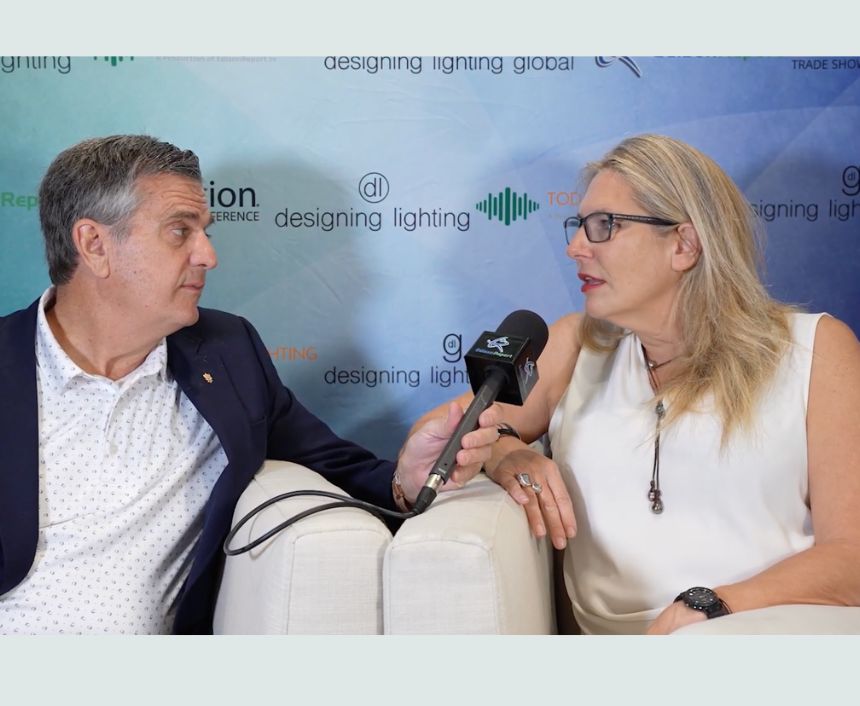
At LEDucation 2026, I sat down with Beatrice Witzgall, a German-trained architect and lighting industry expert, to discuss how artificial intelligence is beginning to influence the lighting industry and where the biggest opportunities still exist.
AI Adoption: Curiosity Meets Uncertainty
Witzgall described the current state of AI in lighting as a mix of curiosity and resistance.
She noted that while many professionals are interested in AI, there is still uncertainty about whether to change established workflows. Despite that hesitation, she believes the industry is entering a period of significant opportunity for those willing to explore new tools and processes.
Improving Efficiency Without Replacing Creativity
One of the clearest benefits of AI, according to Witzgall, is improved efficiency.
She explained that designers and reps often spend a large portion of their time managing emails, coordination, and administrative tasks. AI has the potential to reduce that burden and allow professionals to focus more on design and creative problem-solving.
While some fear job displacement, Witzgall emphasized that the core role of a lighting designer, shaping and enhancing space, will remain rooted in human creativity.
Early Use Cases Begin to Emerge
Although adoption is still in its early stages, Witzgall pointed to several promising applications already taking shape.
These include tools that help generate fixture schedules, streamline product selection, and match specifications with manufacturer offerings. She also referenced emerging platforms that can analyze a fixture schedule and suggest alternatives based on a representative’s product line.
While not yet fully mature, these tools signal where the industry may be heading.
Lighting’s Role in Smart Buildings
Beyond AI, Witzgall highlighted a broader opportunity, the integration of lighting into smart building ecosystems.
Drawing on her experience in building automation, she said lighting is often left out of conversations around autonomous buildings, energy systems, and broader digital infrastructure. She believes this is a missed opportunity for the industry to expand its influence and unlock new revenue streams.
Positioning lighting as part of a larger system rather than a standalone component could elevate its role in future projects.
Is Light and Health Still a Niche?
Witzgall also addressed the topic of light and health, noting that while it has gained traction, adoption remains limited.
She said the concept is most commonly applied in healthcare and certain educational environments, but has not yet become a widespread industry standard. One barrier is cost, along with the challenge of clearly demonstrating return on investment for clients.
A Regional and Evolving Market
Looking at the global lighting economy, Witzgall emphasized that trends vary significantly by region.
She noted that factors such as interest rates, construction cycles, and project delivery models all influence demand. In many cases, the industry is seeing a shift between new construction and retrofit work, along with increased adoption of design-build approaches.
Despite these variations, lighting remains a critical component across all markets.
A New Role in the Industry
Today, Witzgall works as a fractional consultant, helping companies navigate the digital landscape and identify go-to-market opportunities.
Her focus includes product positioning, digital transformation, and helping organizations better understand how to adapt to emerging technologies like AI.
Looking Ahead
As the lighting industry continues to evolve, Witzgall made clear that the biggest opportunities may lie beyond traditional boundaries.
Whether through AI-driven efficiency or deeper integration into smart buildings, the future of lighting will likely depend on how well the industry embraces change and how quickly it acts on opportunities that have yet to be fully realized.