








Is It Time for Companies to Revisit Their Signify EnabLED license agreements?
The ongoing litigation between Signify and ETI Solid State Lighting has prompted an interesting discussion throughout the lighting industry. Over the past few weeks, EdisonReport has reported on ETI’s proposed patent misuse defense and Signify’s response. And the Signify website shows more than 1,700 companies now participate in the EnabLED licensing program. Recently, we have heard a recurring question from several industry executives: “Is it time to revisit their Signify EnabLED license agreements?”
Some frame the question more bluntly, asking whether companies should renegotiate their royalty rates—or even stop paying altogether.
It is not a question your humble editor intends to answer. Companies sign contracts, and contracts matter. If Signify owns valid patents that companies practice, it deserves fair compensation for those inventions.
But the ETI litigation, combined with the natural evolution of any patent portfolio, does raise legitimate questions about how licensees should evaluate the value of those agreements going forward.
European patent attorney Henrik Villumsen has been a thoughtful sounding board as I have considered these issues. However, the substance of those conversations will remain private.
Calculating the Revenue Behind Signify’s EnabLED Program
During Signify’s recent Capital Markets Day, the presentation devoted considerable time to strategy, profitability, and future growth. During the portions I watched, the presenters did not discuss intellectual property licensing.
Yet Signify’s own 2025 Annual Report suggests the EnabLED business is substantial.
On page 32, the company reports that leasing intellectual property represents approximately 2% of revenue. Applying that percentage to the reported €5.765 billion in 2025 sales produces an estimated €115 million in annual licensing revenue.
That is a meaningful business. For years, licensing has been an attractive source of high-margin revenue while helping protect the company’s patent portfolio.
Signify has consistently maintained that enforcing its patents is also about fairness. Companies that voluntarily join the EnabLED program should not face a competitive disadvantage against manufacturers that simply choose not to pay.
That argument resonates with many licensees.
How Expiring LED Patents Alter the Valuation Landscape
The challenge is that patent portfolios are not static. Patents expire. Others are successfully challenged.
Some become commercially less valuable as technology evolves.
During his annual intellectual property webinar in May, attorney David Radulescu noted that Signify has filed no new U.S. EnabLED infringement lawsuits in the preceding year.
His presentation also highlighted several developments affecting the value of individual patents.
One example involved the ‘336 “CCT-adjustable” downlight patent, which was asserted against Menards. Following an inter partes review trial before the Patent Office, one independent claim was invalidated while another survived review. According to David, the practical licensing value of that patent declined dramatically because the remaining claim only covers a CCT switch, and not the entire downlight. Thus, the potential royalty base was significantly reduced (assuming the invalidity ruling survives appeal).
Other patents in the Menards litigation have already expired (4 of 6 asserted patents) or are approaching expiration in 2027 (1 of the remaining 2 patents).
Those developments naturally raise a business question for existing and potential future licensees.
Should companies periodically reassess whether the value they receive today matches the royalties they negotiated years ago?
The ETI Case Adds Another Layer
The ongoing litigation between Signify and ETI Solid State Lighting has added fresh attention to the EnabLED program.
Last month, EdisonReport reported that ETI argues it could not assert its proposed patent misuse defense until Signify produced approximately 90,000 pages of confidential licensing documents during discovery.
Signify, meanwhile, strongly disputes those allegations.
The company maintains that its licensing program is lawful, that portfolio licensing is a common industry practice, and that similar arguments have failed in prior cases.
The court has not ruled on ETI’s proposed defense.
Then There Is Lepro
Before anyone concludes that walking away from a license makes financial sense, the Lepro case deserves equal consideration.
Earlier this year, a Nevada jury awarded approximately $410,000 against Lepro after finding patent infringement covering more than eight years of sales. I attended a few days of the fascinating trial, everything I saw pointed to a strong Signify case.
The actual damages did not come close to exceeding what Lepro likely would have paid under a standard EnabLED license. However, that does not tell the full story about both Signify’s and Lepro’s decision to go to trial.
Pending before the court is Signify’s request to enhance the $410K damages due to Lepro’s willful infringement (e.g., by a factor of 2 or 3), which the jury also found. Even more significant, Lepro likely spent millions defending the lawsuit. Despite all of that expense, Lepro still does not have a license allowing it to practice Signify’s patents going forward. That outcome reinforces one of Signify’s central arguments: obtaining a license may ultimately be far less expensive than fighting in court. That of course depends upon whether the Court awards enhanced damages and/or attorney fees, which is still to be determined.
However, according to David’s presentation, Lepro offered before trial to pay the full amount of damages Signify sought because the cost of litigating exceeded the amount in dispute. David quotes Lepro’s argument: “Signify’s motion shows that it was willing to spend more than 10 times the amount of its compensatory damages claim to litigate this case. Even accounting for the possibility of enhanced damages, Signify was still willing to spend more than 3 times the maximum amount it could obtain in damages.” Signify rejected that offer.
Potential Math Behind a Target’s Decision to Defend
David also presented a slide on the “Potential Math Behind a Target’s Decision to Defend,” which he has agreed to allow me to publish here:
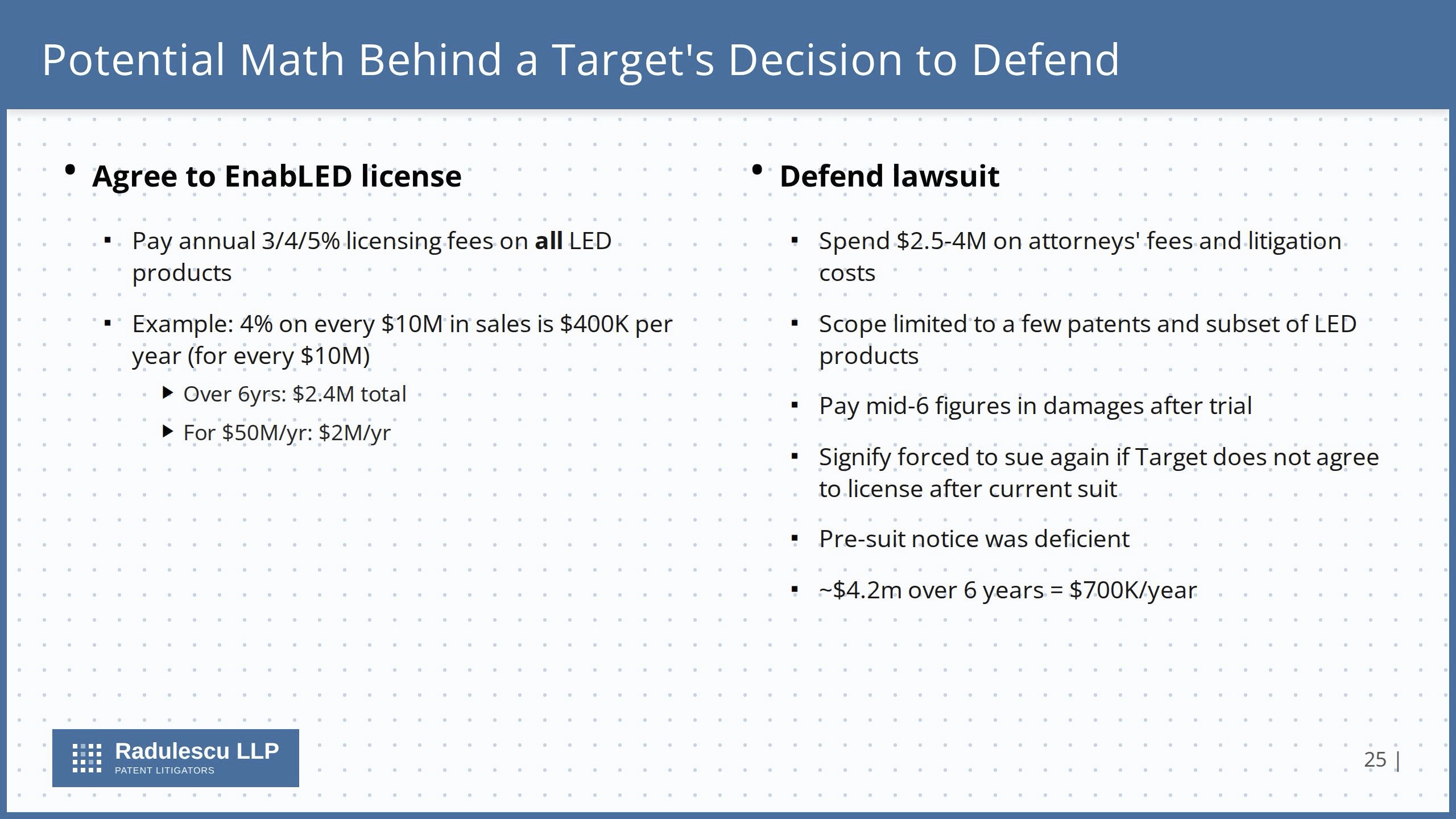
The slide demonstrates that assuming Lepro is not hit with substantial enhanced damages or attorneys’ fees on the pending motions, its decision to litigate was economically justified. Similarly, from Signify’s perspective, if litigation costs routinely exceed the damages at issue, it is fair to ask how many cases Signify is prepared to pursue under that model.
Questions Worth Asking
None of this means companies should stop paying royalties.
Nor does it mean companies must renegotiate every license.
But it does suggest that prudent business leaders periodically review long-term licensing agreements just as they review insurance policies, supplier contracts, leases, and software subscriptions.
Patent portfolios evolve. Individual patents expire. Others survive legal challenges. Courts and agencies add new patents.
The overall value of any portfolio changes over time.
With more than 1,700 companies now participating in the EnabLED program, many licensees may simply want to understand whether their agreements continue to reflect today’s patent landscape.
That seems like a reasonable question—not only for licensees, but perhaps for Signify as well.