





How AI Lighting Controls Are Transforming Smart Buildings

AI lighting controls

How AI Transforms Lighting Controls: From Natural Language to Intelligent Buildings

By Dan Litvin, President/Co-Founder, PureTek Group

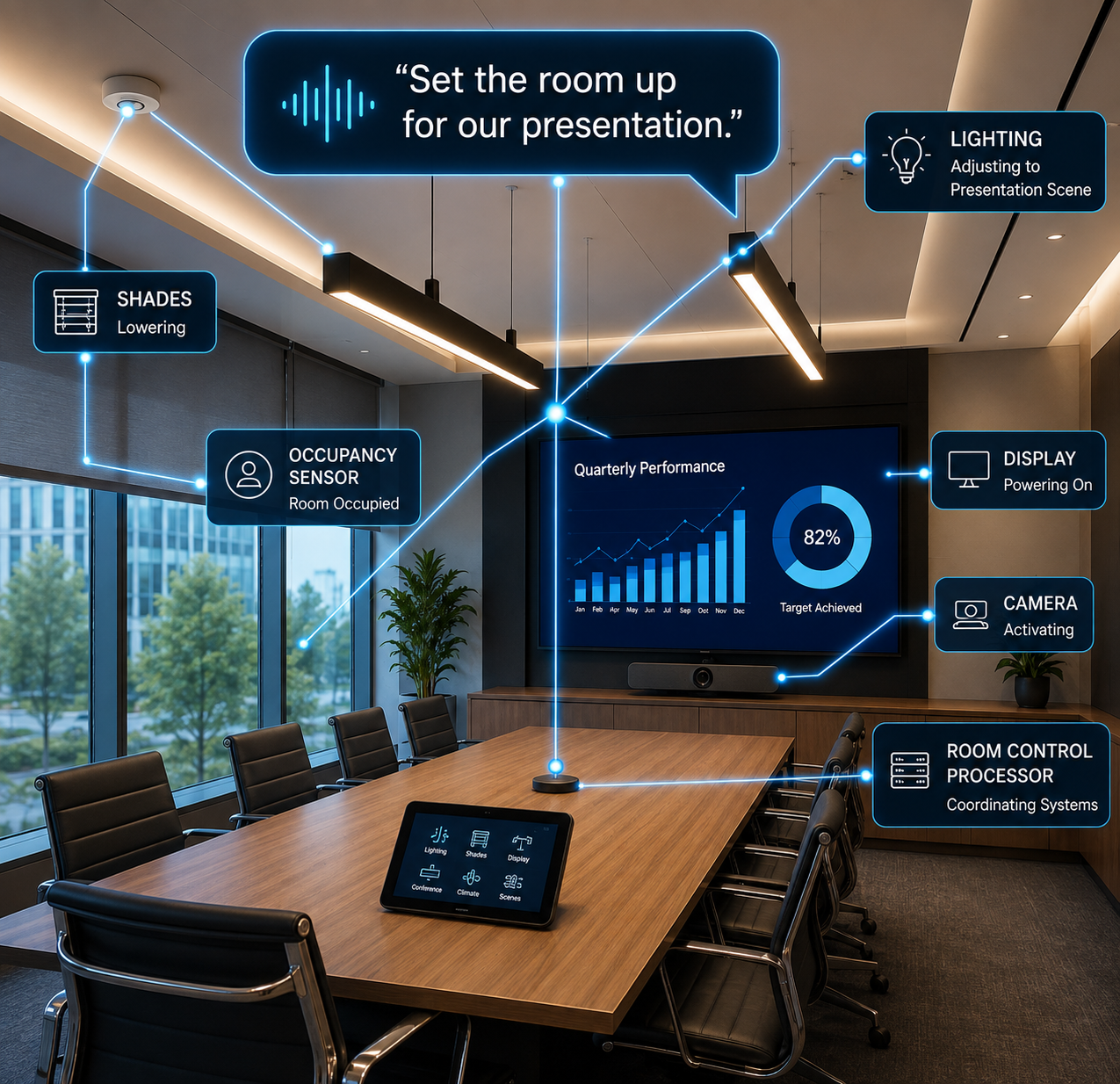
Imagine walking into a conference room 10 minutes before an important client presentation and saying, “Set the room up for our presentation.”

Immediately, the lights brighten. Next, the shades lower to reduce glare. The displays power on, and the videoconferencing system prepares for the scheduled meeting. Before your guests arrive, the room is ready without anyone touching a keypad or opening an app.

Although the experience feels effortless, the technology behind it is remarkably complex. Multiple building systems must interpret your request, determine your intent, verify every action, and communicate with one another. Until recently, delivering that experience required extensive programming.

Today, advances in artificial intelligence (AI) are changing that equation. AI lighting controls can interpret natural language and coordinate multiple building systems automatically. Understanding that process helps explain both the opportunities and the engineering challenges behind intelligent buildings.

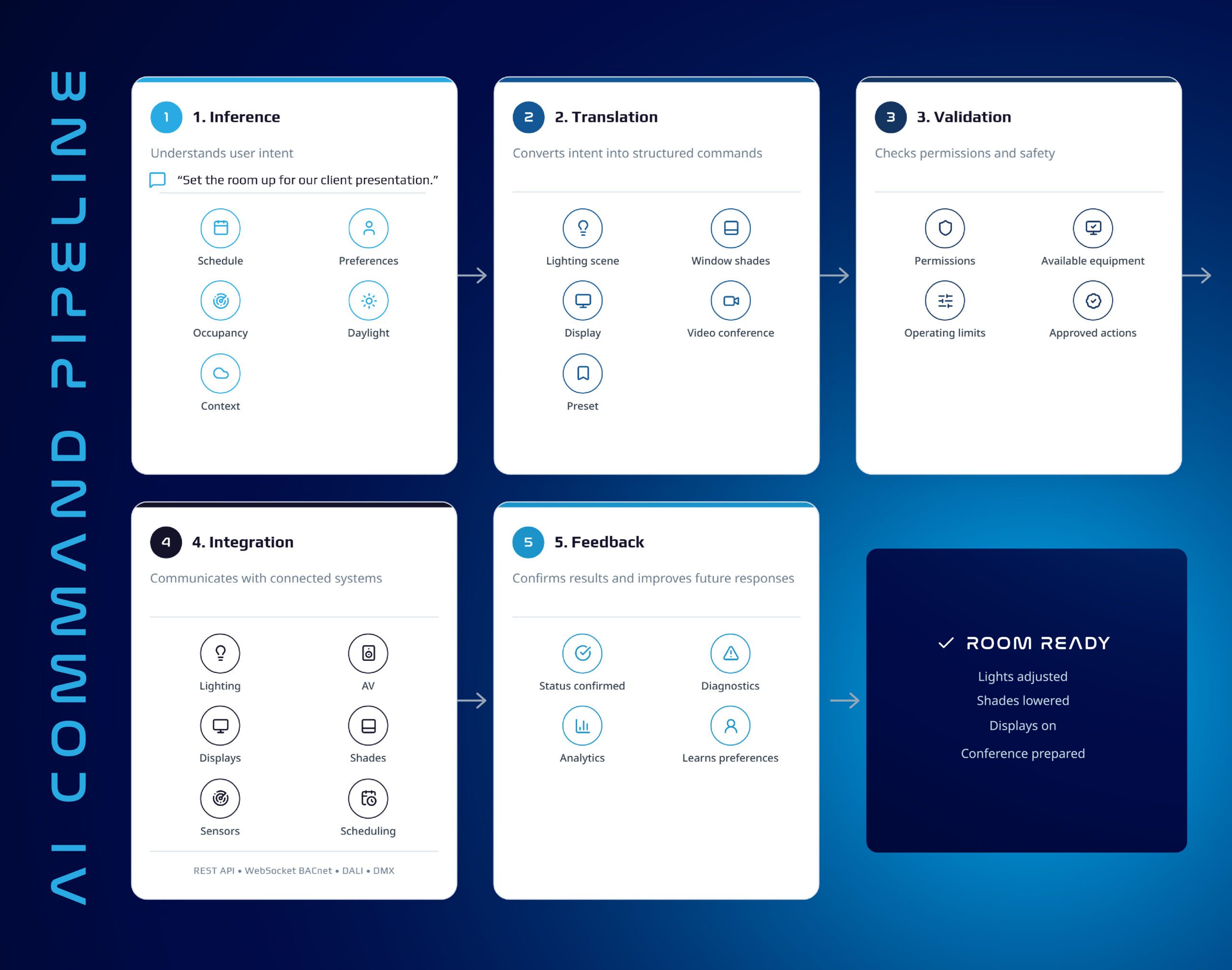
AI Inference: Understanding the User’s Request

Traditional lighting control systems expect specific inputs. Someone presses a button, triggers an occupancy sensor, reaches a daylight threshold, or recalls a programmed scene. In contrast, “Set the room up for our client presentation” describes a desired outcome rather than a command.

Before the system can respond, it must infer what the user actually means. Does “presentation” require a predefined lighting scene? Should the room be brighter than normal? Is sunlight creating glare on the displays? Will remote participants join the meeting?

Context provides the answers. Occupancy sensors, daylight sensors, scheduling software, user profiles, historical operating data, weather services, and connected-system APIs all contribute information. Together, they allow the AI to make an informed decision instead of simply executing a fixed command.

Consequently, an AI lighting control system requires much more than access to ChatGPT, Claude, or another large language model. It must understand installed devices, available commands, system topology, industry standards, and application-specific terminology. A purpose-built model also runs faster and more efficiently, especially when inference occurs locally and users expect an immediate response.

Translating Natural Language into Lighting Control Commands

Building systems don’t understand conversation. Instead, they respond to structured commands.

After interpreting the request, the AI converts the desired outcome into actions the control platform can execute. Those actions may include recalling the presentation scene, lowering the shades, powering the displays, activating the conferencing system, and maintaining circulation lighting.

Next comes an important design decision. Should the AI simply recall commissioned scenes, or should it communicate directly with individual devices?

Some projects treat AI as a “ghost in the machine.” Under that approach, it recalls scenes and presets created during commissioning. Other projects allow the AI to adjust individual lighting zones, color temperature, shades, and additional building systems within carefully defined limits.

Neither strategy fits every project. Instead, the right approach depends on the application, the occupants, available computing resources, and the level of testing completed during commissioning.
Behind the Prompt for AI in ControlsValidation Keeps AI Lighting Systems Safe

Even the best language model should never control a building without validation. This engineering layer separates an impressive demonstration from a dependable building control system.

Validation verifies every requested action before execution. It knows which lighting zones belong to the room, which devices are online, what operating limits apply, and what each user may change.

For example, the system rejects requests for fixtures that don’t exist. Likewise, permission rules prevent guests from changing corridor lighting outside the room. If a request exceeds an approved lighting level, the control platform either limits the adjustment or asks for clarification.

These safeguards matter because large language models occasionally hallucinate or misunderstand intent. Fortunately, designers don’t need perfect inference. Instead, they need reliable guardrails that prevent an incorrect interpretation from becoming an incorrect physical action.

Manual controls still deserve a place in the room. A wall station or slider may remain the fastest way to fine-tune lighting for a first-time visitor. Over time, those adjustments become valuable feedback that helps the AI learn individual preferences.
Integrating AI with Building Automation Systems

Once the system validates an action, it still has to carry it out. At that point, AI hands the request to the building’s control infrastructure.

A local control server may communicate with a lighting processor through a REST API, WebSocket connection, BACnet interface, or a manufacturer-specific protocol. From there, the lighting processor sends commands to fixtures using DALI, DMX, or another lighting protocol.

Lighting is only part of the story. The same server can also communicate with motorized shades, audiovisual processors, occupancy sensors, scheduling platforms, HVAC equipment, and other connected technologies. As a result, a single request can coordinate multiple building systems at once.

Importantly, AI does not replace those systems. Instead, it serves as an intelligence layer above them. Existing controllers continue performing the tasks they were designed to do, while AI provides context, coordination, and decision-making.

That philosophy drives platforms such as unRAVL AI. Rather than offering only conversational control, these platforms understand how multiple technologies interact. More importantly, they coordinate those systems around the user’s intent instead of treating each one independently.

Feedback Helps AI Improve Over Time

Sending a command is only the beginning. A successful system must also confirm that the requested action actually occurred.

Feedback can come from several sources. Networked devices may report their operating status through APIs. Sensors can verify lighting levels or occupancy. In some situations, the system may simply ask the user whether the room now behaves as expected.

For example, did the shades reach the requested position? Did the lighting controller successfully recall the presentation scene? Do light sensors confirm the expected illumination levels? Each answer helps verify that the system performed correctly.

Feedback also improves long-term performance. Suppose an executive consistently increases the presentation scene by 10 percent before every meeting. Eventually, the AI can recognize that pattern and begin applying the preferred setting automatically.

As a result, the system becomes more than intelligent. It becomes personal.

AI lighting controlsEdge AI vs. Cloud AI for Lighting Controls

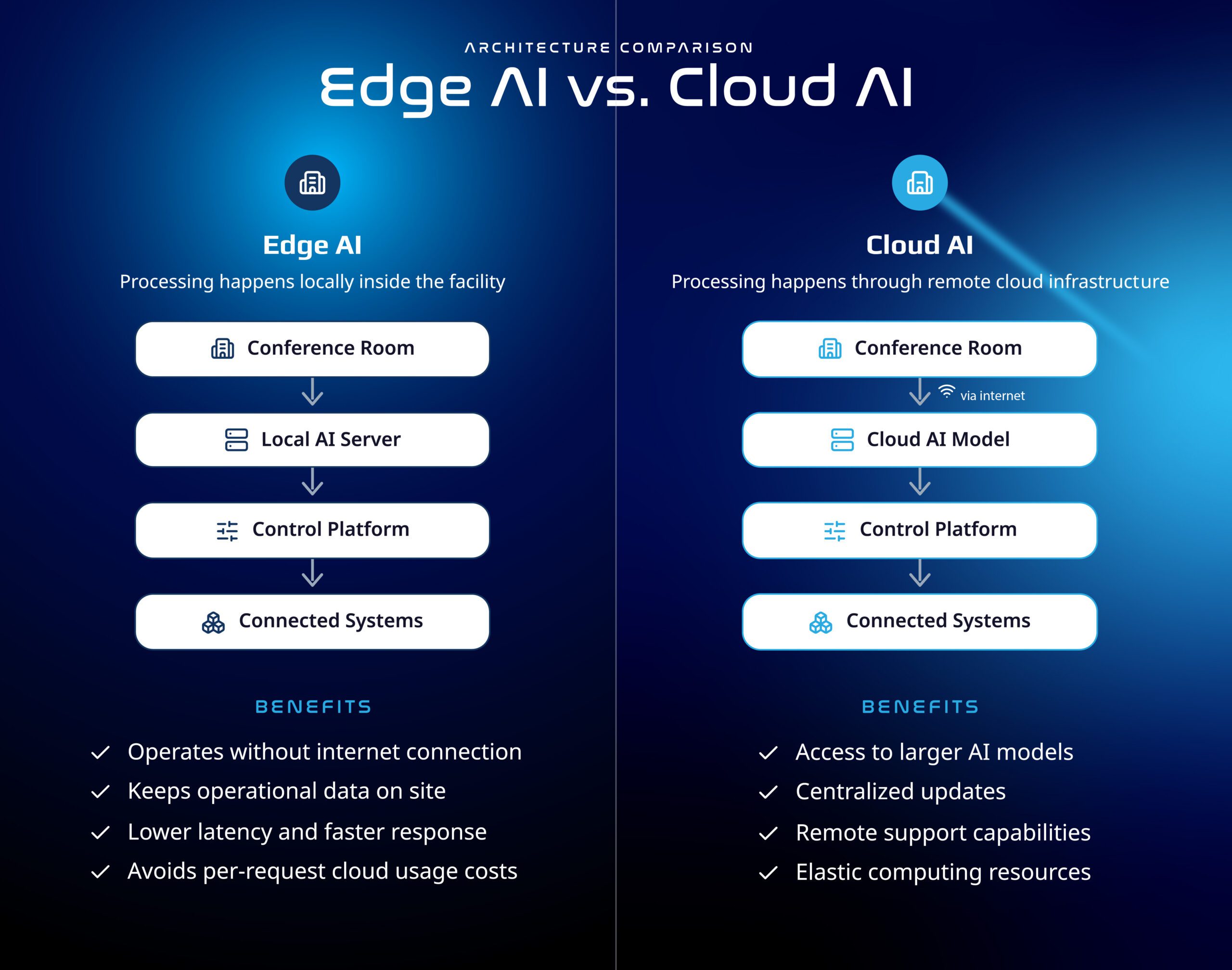
One of the biggest design decisions involves determining where the AI should operate. Today, most systems process requests either on the edge or in the cloud.

Edge AI

With edge processing, both the AI model and operational data remain inside the building. That approach offers several practical advantages.

First, the system continues operating even if the internet connection fails. Second, sensitive building data stays on-site, reducing privacy concerns. Finally, owners avoid paying cloud AI fees every time someone issues a request.

Of course, every approach involves tradeoffs. Local servers require a larger upfront investment and provide less computing power than cloud platforms. In addition, software updates and remote support may require more effort.

Cloud AI

Cloud processing offers a different set of strengths. Building owners gain access to larger AI models, virtually unlimited computing resources, centralized software updates, and remote management.

Cloud platforms also simplify access to outside information. Weather forecasts, enterprise scheduling systems, occupancy analytics, and other online services become readily available.

Those benefits come with important considerations. Cloud systems depend on a reliable internet connection. Subscription costs may increase over time. Cybersecurity, IT governance, and compliance requirements also become more complex.

Ultimately, no single architecture fits every project. A private conference room, a K-12 school, a healthcare facility, and a global corporate campus all have different priorities. The project’s requirements—not the latest technology trend—should drive the decision.

How AI Changes the Role of Lighting Integrators

Artificial intelligence will not eliminate system integrators. Instead, it changes where they create value.

Historically, integrators spent much of their time programming individual actions and control sequences. Going forward, they will spend more time designing the overall intelligence architecture.

That responsibility includes determining what information the AI can access, which devices it can control, how systems communicate, where deterministic controls should override AI decisions, and how permissions are managed.

Model training also becomes part of the process. Integrators must decide how the AI is grounded, how it validates requests, and how it responds when confidence is low. Those decisions require engineering judgment rather than programming alone.

Meanwhile, AI commissioning tools will continue improving. They may generate programming automatically, discover devices, map networks, verify sequences, and identify edge cases much faster than today’s workflows.

Even so, successful projects will still depend on experienced professionals. Lighting expertise, systems integration, commissioning, and human-centered design remain essential skills. AI changes the work, but it does not replace the people who understand how buildings operate.

The Human Experience Still Matters Most

The best AI lighting control system may ultimately be the one occupants notice the least.

People should focus on their presentation, their meeting, their students, their patients, or simply the work in front of them. Technology should quietly manage the complexity behind the scenes while still providing familiar manual controls whenever they are needed.

In the end, the goal isn’t to create buildings that feel more technological.

The goal is to create buildings that feel more intuitive.

When artificial intelligence disappears into the background, occupants stop thinking about lighting controls, conference systems, shades, and sensors. Instead, they experience spaces that respond naturally to their needs.

That’s when AI truly delivers on its promise.