






Senate Committee Advances LIT Act, Drawing Opposition From NEMA
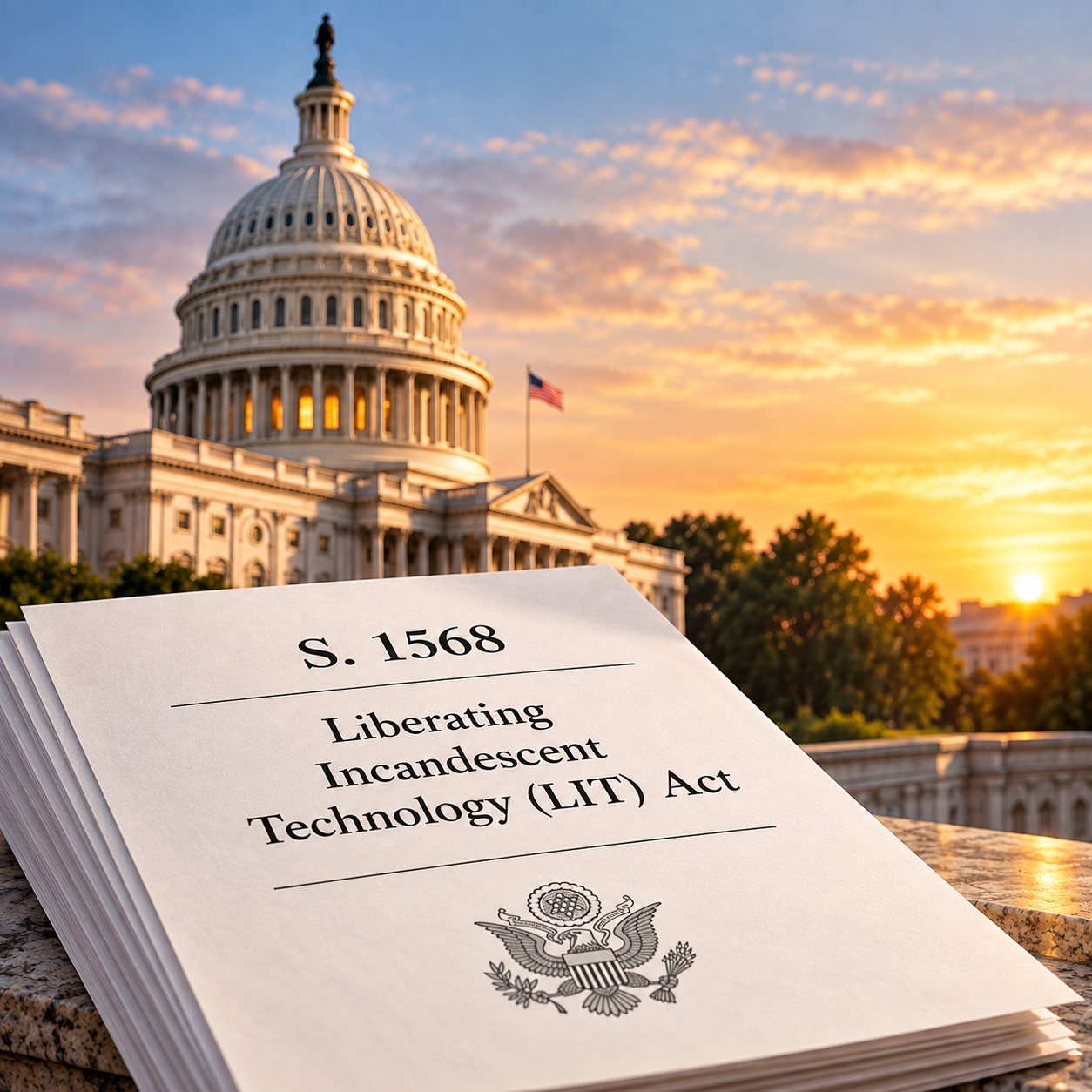
The Senate Energy and Natural Resources Committee has approved the Liberating Incandescent Technology (LIT) Act (S. 1568), a bill that would remove lightbulbs from the Department of Energy’s appliance standards program and repeal federal lighting efficiency rules. The National Electrical Manufacturers Association (NEMA), which represents the nation’s lighting manufacturers, says it is concerned about the move.
What the LIT Act Would Do
Repeals DOE Lighting Efficiency Rules
Committee Chairman Mike Lee (R-UT) introduced the LIT Act on May 1, 2025. It would remove “general service lamps” from DOE’s Appliance Standards program and repeal three related regulations. Those rules, issued in 2022 and 2024, were meant to raise the minimum efficiency for general service lamps, first to 45 lumens per watt and then to 120. The 2024 rule takes effect in 2028.
Sponsors and the House Companion
Lee’s original cosponsors were Sens. Jim Justice, Tom Cotton, Eric Schmitt, John Curtis, and Bill Hagerty. An identical House bill, H.R. 3341, has been referred to the House Energy and Commerce Committee.
The Case for the Bill
Lee has framed the bill as a matter of consumer choice, arguing the efficiency regulations are about controlling people rather than saving the planet. DOE has also testified before the committee in support of the bill.
NEMA’s Response: “This Significant Investment and Progress Could Be Undermined”
NEMA Senior Vice President of Government Affairs Will Hupman said the association is concerned about the committee’s approval. In a statement, he pointed to the work that got the industry here.
Decades of Progress Toward LEDs
“With congressional direction, support and more than two decades of research at U.S. national laboratories, America’s lighting manufacturers have transformed their products and manufacturing processes to meet growing demand for more efficient and affordable electric lighting, particularly light-emitting diodes (LEDs). These advances have delivered hundreds of billions of kilowatt-hours in energy savings for American households and businesses, helping lower utility costs while reducing strain on the nation’s electrical grid.”
Risks to Energy Savings and the Grid
“Today, the electroindustry is concerned that this significant investment and progress could be undermined. Repealing the U.S. Department of Energy’s lighting standards, as the LIT Act would do, could erode the energy savings consumers have come to expect, increase demand on an already challenged electric grid, and create uncertainty for manufacturers that have invested heavily in developing and producing more efficient lighting technologies.”
Product Quality and Safety Concerns
“If signed into law, the LIT Act would trigger significant business uncertainty and could lead to the American market getting flooded with low-quality, underperforming, and potentially unsafe products that have not been subjected to appropriate safety testing and certification.”
NEMA said it will keep working with Congress “to demonstrate both the value of LED technology and how rolling back standards harms business certainty and eliminates energy savings.”
What Comes Next for the LIT Act
The bill still needs to clear the full Senate and the House. The Senate leaves soon for recess, so don’t expect floor action right away. For a lighting industry that has spent years building around efficiency standards, the question is whether the momentum in committee turns into a floor vote.