







The AI Surge: Reinventing the Lighting and Electrical Industry
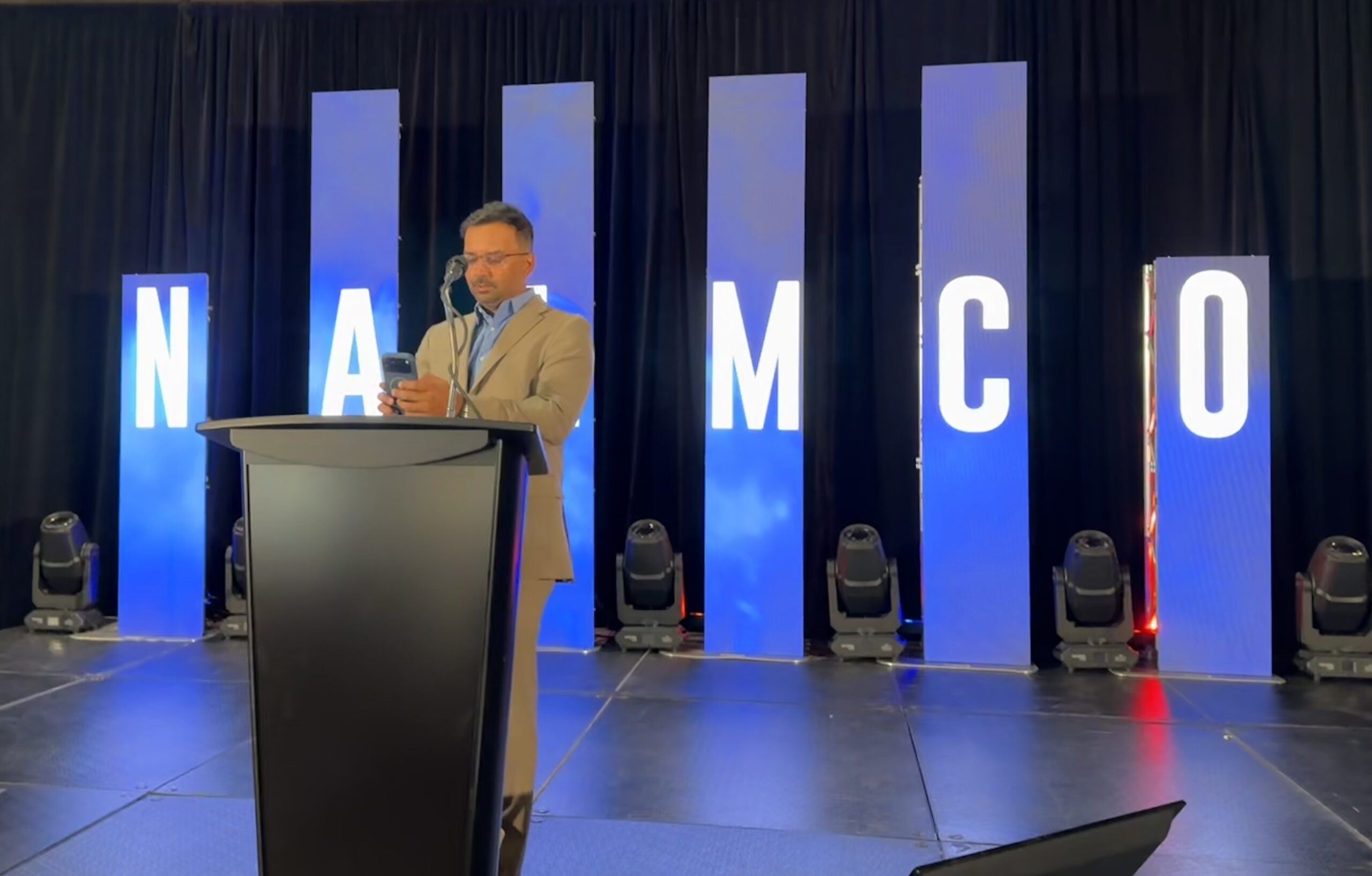
Artificial intelligence has moved beyond a distant vision and is now transforming the lighting and electrical industry, revolutionizing how work is planned, quoted, and executed across the entire value chain. At NALMCO’s 72nd Annual Convention, in Des Moines, during the keynote session “The AI Surge: Reinventing the Lighting and Electrical Industry,” Taresh Grover, CEO and Co-Founder of Pull Logic, showcased how AI is currently streamlining operations, boosting forecasting accuracy, and sharpening decision-making for manufacturers, distributors, and contractors.
Taresh, who has spent nearly two decades in the lighting industry, noted that the biggest opportunities no longer lie in fixture innovation. “We’ve reached maturity in product design. The next wave of transformation is about process—how we audit, design, specify, and manage our projects,” he said. His company, Pull Logic, uses AI to tackle these process challenges by combining data from multiple sources to make real-time, intelligent recommendations.
Manufacturers: Using AI to See Around Corners
Manufacturers are often hindered by one persistent challenge: forecasting. Many still rely on historical sales data to plan production and inventory, which can lead to overstock or shortages when large projects close unexpectedly. However, Taresh described how AI can dramatically change that through connected systems.
He explained that an AI agent integrated with ERP and CRM platforms can scan hundreds of active quotes, analyze probability of closure, and generate an updated demand forecast. “If a manufacturer has 50 reps quoting across the country, AI can combine all of that information and forecast precisely what needs to be built and when,” Taresh said. Consequently, companies can reduce both production waste and costly delays.
Pull Logic is already demonstrating this technology with its AI crossover tool. The system instantly matches competitor SKUs to a manufacturer’s catalog, verifies real-time availability, and recommends equivalent products. As a result, early deployments, including one with MaxLite, have shortened quote turnaround times and allowed sales teams to respond faster and more accurately.
Distributors: From Static Inventory to Predictive Stocking
For distributors, AI provides visibility that was previously impossible. It can analyze branch-level data, customer buying patterns, and seasonal trends to identify products that are moving slowly or at risk of obsolescence.
“A branch manager can ask the system which products need to move quickly, and the agent will return a list of SKUs with no upcoming demand,” Grover said. Moreover, the tool can recommend how to liquidate those items before they become end-of-year write-offs.
AI can also optimize warehouse placement. By mapping shipping times from different distribution centers to thousands of customer zip codes, the system identifies the best stocking locations to meet one- or two-day delivery commitments while minimizing freight costs. Therefore, distributors can improve service levels and lower carrying expenses simultaneously.
Quoting is another area where AI makes an immediate impact. Integrated assistants can monitor real-time stock levels, flag out-of-stock items, and automatically suggest substitutes. In turn, customers receive accurate proposals more quickly and distributors maintain their reputations for reliability.
Contractors: Smarter Scheduling and Proactive Selling
Among all segments, contractors may see the greatest benefit from AI. Taresh noted that many contractors still rely on manual scheduling and reactive communication when shipments are delayed. “An AI agent can automatically detect a fixture delay, check crew schedules, and reassign teams before downtime occurs,” he said. In this way, companies move from reacting to problems to preventing them.
AI can also help contractors protect margins by recommending equivalent fixtures when availability or pricing changes. Furthermore, another powerful use case is proactive marketing. An AI system can track every completed retrofit, calculate when fixtures are likely to reach end-of-life, and alert the sales team to reach out 30, 60, or 90 days before replacements are due. It can even generate proposals and email templates automatically, ensuring consistent communication.
On the sales side, AI can scan project databases such as ConstructConnect or Dodge to surface opportunities that match a contractor’s capabilities. “It’s like having a virtual business development manager that works 24 hours a day,” Taresh said. Consequently, contractors can focus their sales efforts where success is most likely.
The Next Evolution in Audits and Proposals
Grover also outlined what he sees as the next major step forward, AI-assisted audits. In the near future, a field technician could take a photo of a fixture, and AI would identify the type, wattage, and performance characteristics. It would then cross-reference that data with the contractor’s catalog and instantly generate a replacement recommendation and ROI analysis. This capability, he suggested, would make audits faster, more accurate, and far less labor-intensive.
Trust, Security, and a Measured Approach
One audience member raised concerns about data sharing and security, especially when connecting systems across multiple companies. Taresh emphasized that Pull Logic’s AI agents are built as closed, secure systems that operate within a customer’s own firewall. “This isn’t about sending your data to a public model like ChatGPT,” he explained. “These are private agents that live within your environment.”
He also advised companies to begin small. “Pick one problem, maybe forecasting or quoting, and prove it out,” he said. “Train your teams, validate the results, and scale from there.” In addition, Grover cautioned that the biggest barrier to AI adoption isn’t technology, it’s change management. “AI can’t fix bad data. Clean data and user training are where success starts.”
A Practical Roadmap Forward
The session underscored that AI is not replacing people, it is enabling them to make better decisions faster. Manufacturers can begin by cleaning their CRM data and testing an AI-driven forecast. Distributors can apply AI to optimize branch inventory and quoting. Contractors can use it to keep projects on schedule and identify their next sales opportunities.
Ultimately, Grover summarized it best: “AI isn’t just another tool. It’s a teammate that helps you see the future before it happens.”
Go Deeper into AI: AI in Lighting Design: Creators, Challenges, and Protecting the Craft