








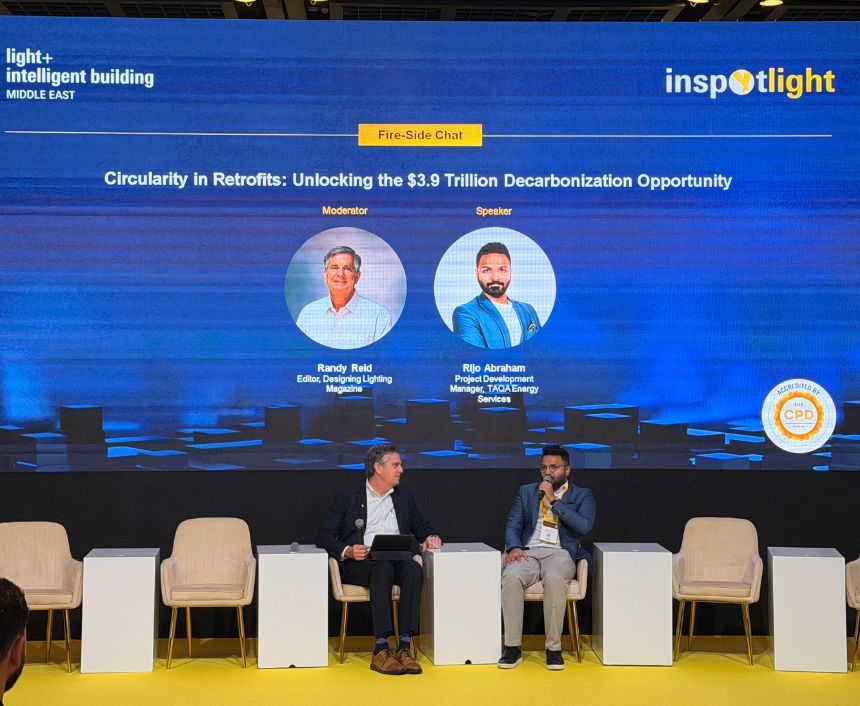
At Light Middle East I sat down with Rijo Abraham for a fireside chat on a topic that doesn’t always get the attention it deserves: building retrofits, circularity, and their role in decarbonization. The session was titled “Circularity in Retrofits: Unlocking a $3.9 Trillion Opportunity,” and the number alone tells you why this matters.
Rijo has spent more than 15 years working in energy efficiency and sustainability, managing large-scale retrofit programs across multiple building systems. I started by asking him a simple question: Why are retrofits such a critical piece of the energy transition right now?
Why Retrofits Can’t Be Ignored
Rijo pointed to a stat from the World Economic Forum that should stop anyone in this industry in their tracks: by 2050, about 80 percent of the buildings that will exist are already built. That means new construction, while important, can’t get us to our carbon goals on its own.
Retrofits, he explained, address both sides of the carbon equation: operational carbon, which comes from running a building day to day, and embodied carbon, which is tied to materials and construction. New buildings bring a heavy embodied carbon burden, while retrofits reduce emissions without starting from scratch.
With 2030 targets looming, the message was clear: If we’re serious about decarbonization, retrofits have to move from “nice to have” to “non-negotiable.”
Removing the Biggest Barrier: Decision Risk
We then talked about performance-based retrofit models, something Rijo has worked with extensively. These models often remove upfront capital costs entirely, with investments paid back through guaranteed energy savings.
What surprised me was his perspective on the real obstacle. In his experience, most building owners don’t actually have a funding problem. They have a decision-making problem. The uncertainty around performance, savings, and disruption slows everything down.
Performance contracts change that. Energy Service Companies (ESCOs) take on the financial and performance risk, which dramatically speeds up approvals. On paper, it really can be as simple as signing an agreement and letting the savings pay for the project.
When Energy Is Cheap, What’s the Incentive?
In places like the UAE, electricity costs for commercial users are relatively low. So I asked the obvious question: If energy is cheap, why bother retrofitting?
Rijo’s answer was that energy savings are only part of the story. Retrofit projects also deliver asset upgrades, long-term maintenance, guaranteed performance, and improved building value. In many cases, those benefits outweigh simple utility cost reductions.
It’s not just about paying less for energy. It’s about modernizing buildings and extending their useful life.
Circularity: What Happens to the Old Equipment?
This is where the conversation really got interesting. As retrofits accelerate, we’re replacing a massive amount of equipment—lighting fixtures, HVAC systems, controls. The uncomfortable question is: Where does all of it go?
Too often, the answer is the landfill.
Rijo made the case that circularity needs to be built into retrofit strategy, not treated as an afterthought. Reuse, refurbishment, and recycling should be part of the plan from the beginning, not something we consider once the dumpsters arrive.
Lighting, Retrofits, and Modularity
Sitting under legacy fixtures at the venue, we talked specifically about lighting retrofits. Many buildings have already gone from metal halide to CFLs and now to LEDs, often using fixtures never designed for those technologies.
Ideally, Rijo said, the industry should be moving toward modular lighting, where components can be replaced without throwing out entire luminaires. In reality, wear and compatibility issues still force full fixture replacements in many cases.
Lighting matters because it accounts for roughly 25 percent of a building’s energy use and directly impacts HVAC loads. Any serious retrofit strategy has to look at lighting as part of the larger building ecosystem.
Regulations, Data, and AI
In the Middle East, circularity is largely guided by standards rather than strict regulations, leaving implementation up to building owners. Encouragingly, Rijo sees growing awareness and more proactive behavior, especially among owners thinking long-term.
We also talked about data and AI. Buildings already generate enormous amounts of data, but much of it is siloed or underutilized. The real opportunity lies in structured data feeding intelligent systems that can optimize lighting, HVAC, and occupancy in real time.
That’s where AI becomes meaningful, not as a buzzword, but as a tool to reduce waste and improve performance.
The Rebound Effect
One cautionary note was the rebound effect. When systems become more efficient, people often use them more. Lights that once ran three hours a day suddenly run all day because they’re “efficient.”
Technology alone doesn’t solve that. Rijo stressed the importance of education, operational discipline, and clear expectations with building owners.
Looking Ahead
When I asked Rijo what circularity in the Middle East might look like five years from now, his answer stuck with me: One building’s waste becomes another building’s resource. With better data, collaboration, and smarter systems, materials can stay in circulation longer instead of being discarded.
The takeaway from this fireside chat was simple. Retrofits aren’t the underdog anymore. They’re one of the fastest, most effective ways to reduce carbon, improve buildings, and rethink how we use resources.
And if we get circularity right, the impact goes far beyond energy savings.
Go Deeper: