






Director Review Restores Key Claims in Signify’s ’336 Patent; Signify IPR Claims Restored
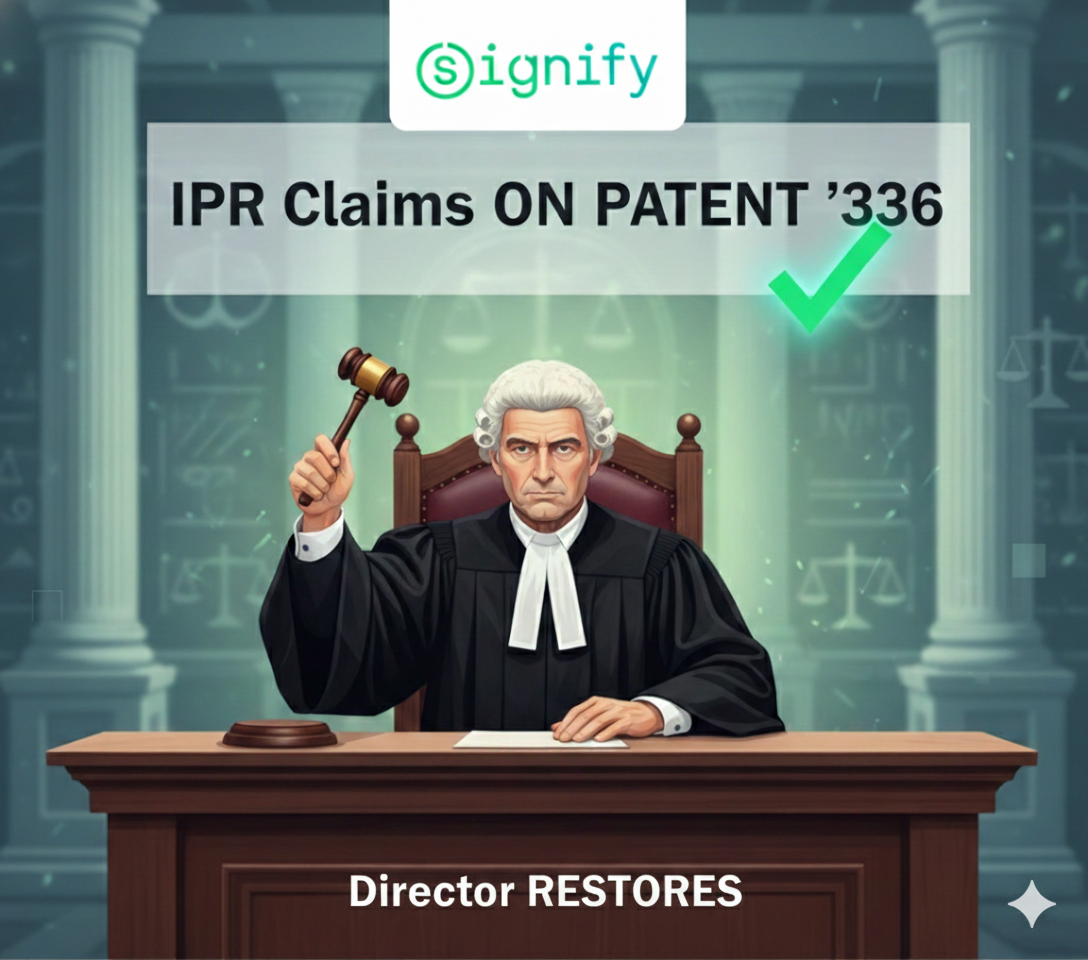
The U.S. Patent and Trademark Office has issued an important decision in the ongoing inter partes review involving Signify and Luminex International. The ruling restores two patent claims that had previously been found unpatentable.
On 5 February 2026, the Director issued a Delegated Director Review that reversed part of the Patent Trial and Appeal Board’s Final Written Decision. As a result, claims 13 and 15 of Signify Patent No. 10,299,336 are no longer deemed obvious over the Reiff reference and are now back in force.
Why Claims 13 and 15 Matter
EdisonReport has covered the Luminex IPR repeatedly over the past several years. In a September 2025 article, your humble editor specifically highlighted claims 13 and 15 as central to the case.
Those claims address the physical structure of a switch used in tunable or multi-source lighting products. In particular, they require that an electrical coupling feature be “disposed on the body” of the switch. That language proved decisive.
Because these claims go directly to how a switch is constructed, they have practical relevance for many lighting products on the market today.
What Changed in the Director Review
Initially, the PTAB concluded that claims 13 and 15 were obvious over the Reiff reference. However, Signify challenged that conclusion through a request for Director Review.
The Director agreed with Signify.
Specifically, the decision found that the petitioners relied on new arguments and new evidence introduced for the first time in their reply briefing. Those arguments attempted to redefine what constituted the “body” of the claimed switch and where the coupling feature resided.
That approach crossed a procedural line.
Under Federal Circuit precedent, a petitioner may clarify an existing argument in a reply. However, a petitioner may not introduce a new theory of unpatentability after institution. According to the Director, that is exactly what happened here.
Once the improperly introduced reply arguments were removed, the remaining record no longer supported a finding of obviousness. As a result, the petitioners failed to meet their burden of proof.
The Outcome
Based on that analysis, the Director ordered the following:
• Director Review was granted
• The portion of the Final Written Decision invalidating claims 13 and 15 was vacated
• All other aspects of the PTAB’s decision remain unchanged
In short, claims 13 and 15 survive.
Why This Decision Matters Beyond This Case
This ruling serves as a clear reminder that IPR procedure matters as much as technical substance.
Petitioners must present their full theories in the original petition. When gaps appear, they cannot be patched later through reply briefing. Attempting to do so carries real risk, as this case demonstrates.
At the same time, the decision highlights an effective strategy for patent owners. By carefully policing reply arguments and pressing procedural limits, patent owners can successfully defend claims even when technical issues appear close.
Implications for the Lighting Industry
The ’336 patent has played a central role in multiple disputes involving tunable-white and multi-source lighting products. Restoring claims 13 and 15 strengthens Signify’s position going forward.
It also reinforces a familiar theme in lighting-industry IP disputes: details matter. Claim language matters. Procedural discipline matters. And IPRs remain an unforgiving forum for incomplete arguments.
This decision does not end the broader conflict between the parties. However, it clearly shifts momentum on an important piece of the patent landscape.