






Why the Signify Lepro Patent Trial Happened in the First Place
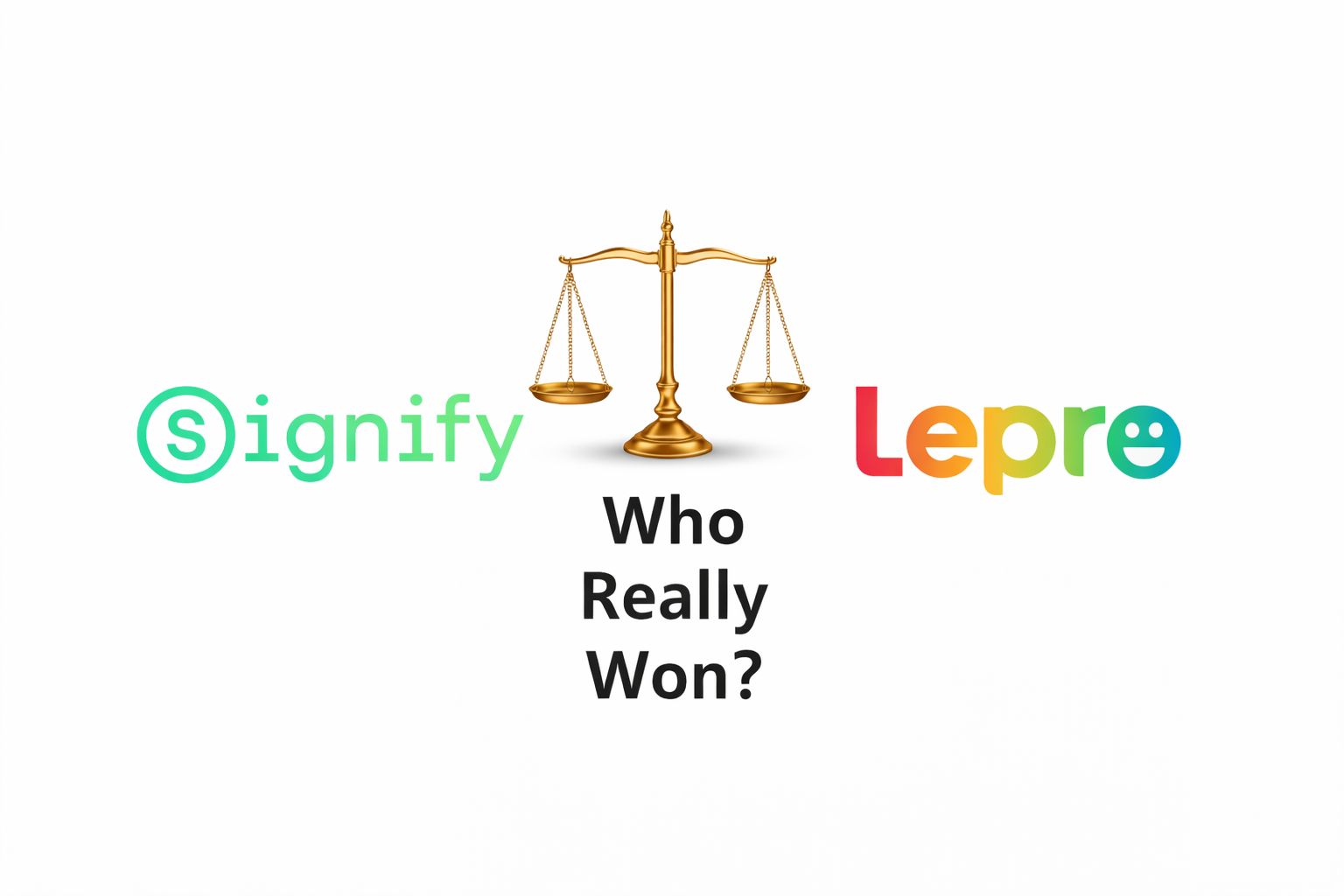
At its core, the Signify–Lepro patent trial was about two very different calculations.
For Lepro, the case came down to math.
For Signify, it was about sending a message.
Specifically, the question for Lepro was simple: is it cheaper to fight—or even lose spectacularly—a patent case than to pay royalties? For Signify, the question was broader: what happens if a company ignores intellectual property obligations altogether?
Ignored Warnings Set the Case in Motion
During the trial, Signify attorney Aaron Rugh explained why this case moved forward when many others never reach a courtroom. According to Rugh, Lepro was the only company that Signify contacted about potential intellectual-property issues that never responded.
The record showed that Signify began reaching out as early as 2017. On 3 June 2017, Signify sent a certified letter to Ji Wu of Home Ever, Inc., doing business as Lighting Ever, at 1810 E. Sahara Ave., Suite 704, Las Vegas. The letter went unanswered. Your humble editor visited that address, I found no trace of Lepro—or any lighting company—operating there.
In addition, Signify sent emails to [email protected], an address publicly listed on Lepro’s website in November 2018. Evidence from the Wayback Machine confirmed that this same email address appeared on the site at the time the notices were sent.
In short, Signify documented years of attempted contact. Lepro chose silence.
Infringement Was Never the Real Question
After sitting through two full days of testimony, it became clear that infringement itself was not seriously in doubt. Instead, the trial centered on willful misconduct and the size of the damages award.
From the outset, Signify framed the case carefully for the jury. Rather than presenting itself as the world’s largest lighting company seeking royalties from a smaller competitor, Signify positioned itself as the steward of a licensing ecosystem with more than 1,700 licensees. The message was that Signify was in court to help their licensees.
The message was direct: companies that play by the rules should not be undercut by those that ignore them. That framing resonated with the jury and helped set the tone for the final verdict.
Why the Signify Lepro Patent Trial Happened: The Royalties Mattered
Signify remains the undisputed leader in lighting intellectual property. No other company in the industry comes close. Under its EnabLED licensing program, the highest standard royalty rate is 5 percent.
However, that rate applies to licensees. Lepro was not one.
Lepro’s attorneys repeatedly emphasized that no licensee pays more than 5 percent. Yet the jury still awarded a 6 percent royalty on one patent and 6.5 percent on another. That outcome underscored a key point: licensed cooperation and willful infringement are not treated the same way.
Lepro’s Financial Calculation
Financially, the outcome may not be devastating for Lepro.
During the trial, testimony revealed that Lepro touted global sales of $100 million in 2020 at the Consumer Electronics Show in January 2026. Using a rough average royalty rate of 4 percent, that would equate to $4 million per year globally.
However, damages in this case apply only to U.S. sales. A reasonable estimate puts Lepro’s U.S. revenue at $10 million or less. If Signify recovers $410,000 in base damages and the court applies treble damages, the total could reach approximately $1.2 million, although that figure is unlikely.
Add an estimated $500,000 in legal fees, and the total cost to Lepro likely stays under $2 million.
Even after losing in decisive fashion, Lepro may still come out ahead financially.
Signify’s Calculation Was Never About Profit
From Signify’s perspective, the math looks different.
If damages total $1.2 million—which is optimistic—and legal fees approach $500,000, the net recovery would be under $1 million. Moreover, it is unlikely that Signify will pursue Lepro across multiple jurisdictions to recover royalties on non-U.S. sales.
In purely financial terms, going to trial was not especially profitable.
That reality highlights the real purpose of the case.
The Message Signify Wanted to Send
For Signify, this trial was about enforcement, not revenue. The size of the infringer did not matter. The scale of the infringement did not matter. What mattered was demonstrating that ignoring Signify’s patents has consequences.
Lepro is a relatively small player in the U.S. market. By pursuing the case to verdict—and winning on every issue—Signify sent a clear message to the rest of the industry.
The expectation is straightforward: respect intellectual property or expect enforcement. In that sense, this trial was less about Lepro and more about every company watching from the sidelines.
Signify’s hope, quite clearly, is that this public result encourages more manufacturers to enroll in the EnabLED licensing program rather than test the limits of enforcement.
Go Deeper:
Signify v. Lepro: Trial Set for January 2026 in Las Vegas
Lepro Motions Highlight Signify’s Trial Strategy
The Signify Lepro Trial Continues for Day 2
Signify vs Lepro Patent Trial: The Great Aluminum Foil Debate