






How Cooper Lighting Plans to Drive Signify’s North American Growth
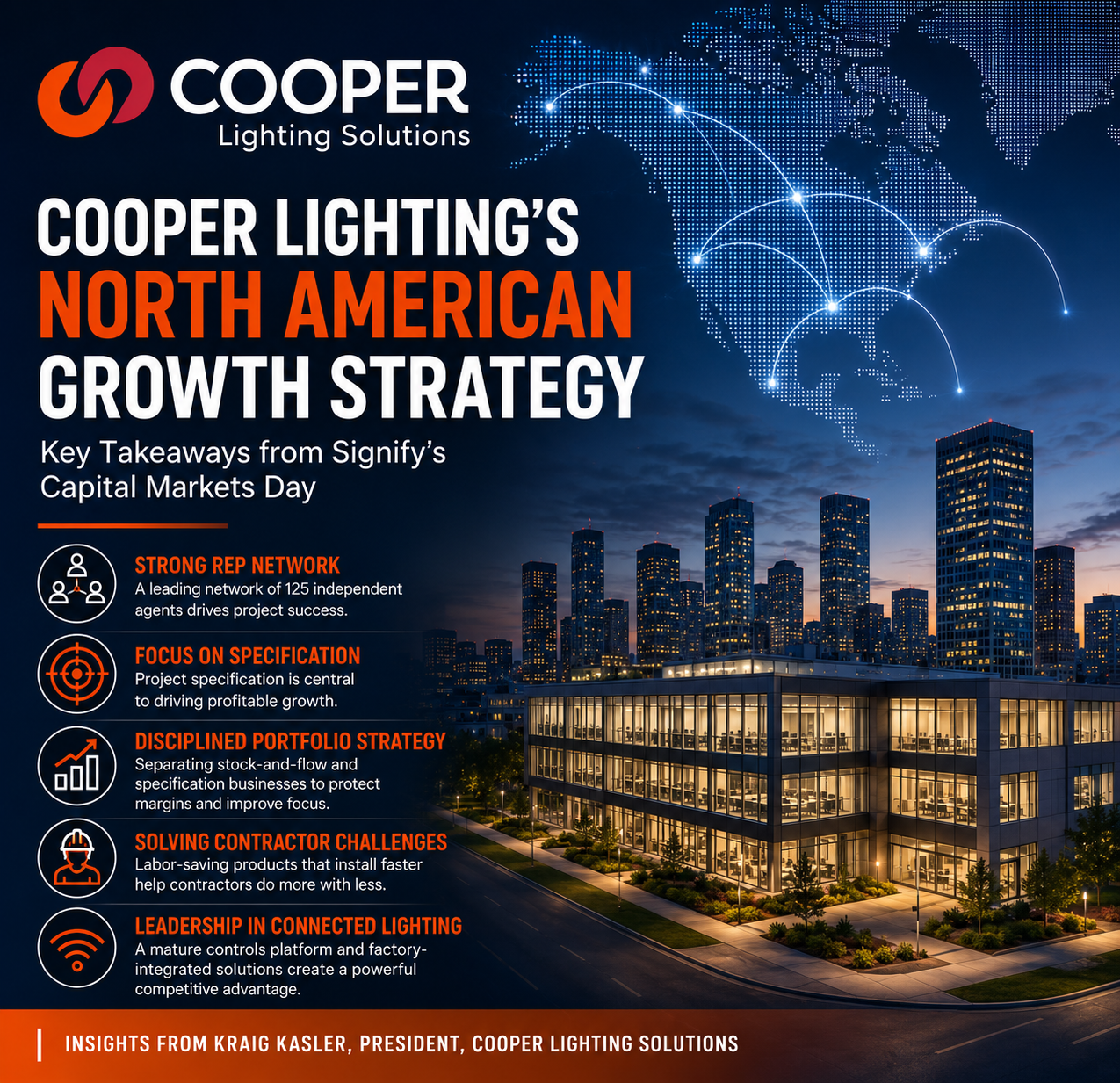
During Signify’s Capital Markets Day, Kraig Kasler, President of Cooper Lighting Solutions, outlined the company’s growth strategy for North America.
Kraig described North America as a $10.5 billion lighting market that is both highly concentrated and highly profitable. The four largest manufacturers account for more than 60% of total sales.
Despite post-pandemic market softness, inflation, and tariff uncertainty, Cooper has continued to outpace the market while improving profitability. His five-part strategy aims to strengthen Cooper’s No. 2 market position, capture share from smaller competitors, and challenge the market leader.
Explaining the Independent Rep Network
One of the presentation’s highlights came when Kraig explained North America’s independent manufacturers’ representative system to the international audience.
For attendees accustomed to direct sales organizations, the North American rep model can be difficult to understand. Kraig offered one of the clearest explanations I’ve heard.
He emphasized three key advantages:
- Pure motivation. Independent agents operate on commission and succeed only when they win projects and generate sales.
- Share of wallet. Cooper Lighting typically represents 50% to 60% of an agency’s business, making it the anchor line for the rep firms.
- Competitive barrier. Long-standing relationships with specifiers, contractors, and distributors create a formidable defense against low-cost overseas competitors trying to enter the project market.
Kraig summarized the network this way:
“We have a leading agent network of 125 agents strong, each with their own teams being successful in the local market. We have 10 different channels to market and these relationships are deeply important to us and our agents.”
He never identified those 10 channels. Your humble editor would certainly like to see that list.
Specification Remains the Opportunity
Kraig made it clear that project specification remains central to Cooper’s strategy. Yet Kraig’s presentation also highlighted an interesting contrast between Cooper Lighting Solutions and Genlyte Solutions.
Signify is actively seeking to restore Genlyte to its historic strength in the specification market.
From the perspective of our sister publication, designing lighting (dl) magazine, we regularly cover major architectural projects across North America. Cooper Lighting and Color Kinetics products appear in some of those projects. By comparison, Genlyte products rarely appear in the high-profile architectural projects we feature.
That contrast suggests Signify still has considerable work ahead if it expects Genlyte to regain its former position.
Separate Businesses, Separate Strategies
Kraig described an important organizational change.
Rather than managing North America as a single business, Cooper now separates its transactional “stock-and-flow” business from its specification business. Each operates with its own profit-and-loss structure. That approach allows Cooper to run a lean, cost-efficient model for high-volume products while protecting the higher margins generated through specification projects.
Solving Contractors’ Biggest Problem
Winning the stock-and-flow business requires more than competitive pricing. Kraig argued that today’s biggest challenge is the shortage of skilled electrical labor.
Because contractor time is increasingly valuable, Cooper is designing products that install faster and require less field commissioning. Saving labor on every fixture creates a competitive advantage that many contractors are willing to pay for.
Connected Lighting Creates a Competitive Advantage
Connected lighting may be Cooper’s strongest long-term opportunity.
Today, intelligent lighting controls already account for roughly one-third of Cooper’s revenue.
Kraig explained that developing a complete wired and wireless controls platform requires a decade or more of engineering investment. Companies must also keep pace with constantly changing North American energy codes.
Few manufacturers have the financial resources to make that investment.
Cooper already has.
As energy codes increasingly require individual luminaire control, Kraig believes Cooper’s mature controls platform gives the company a significant competitive advantage. He argued that the most efficient solution is to integrate sensors and controls directly into the luminaire at the factory. By contrast, systems that require contractors to assemble and commission separate components in the field add labor, complexity, and cost.
Because controls are often specified before the luminaires themselves, success in connected lighting often extends to the entire fixture package.
Final Thoughts
Across all three Capital Markets Day presentations, Signify delivered a consistent message: focus resources where the company has the greatest opportunity to win. As Tempelman provided the vision, while Kraig demonstrated how that strategy will play out in North America. If Signify succeeds in returning to sustainable growth, Cooper Lighting Solutions appears positioned to play one of the company’s most important roles.
Go Deeper: Signify Strategy Bets on Growth in Connected Lighting
SESCO’s John Palk Comments on Signify’s Plan
Signify Capital Markets Day: CEO Plans to End Revenue Decline