







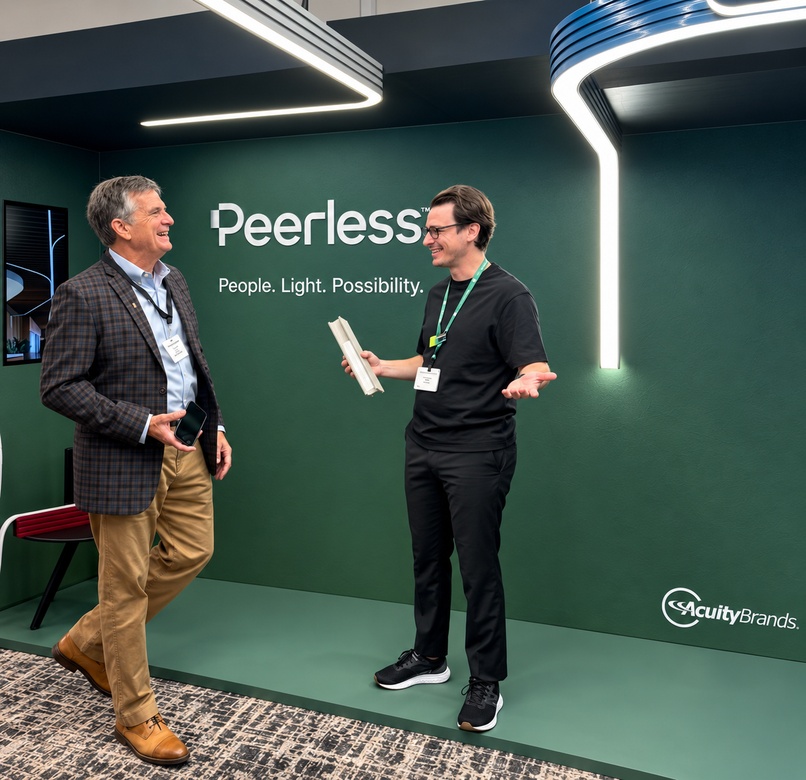
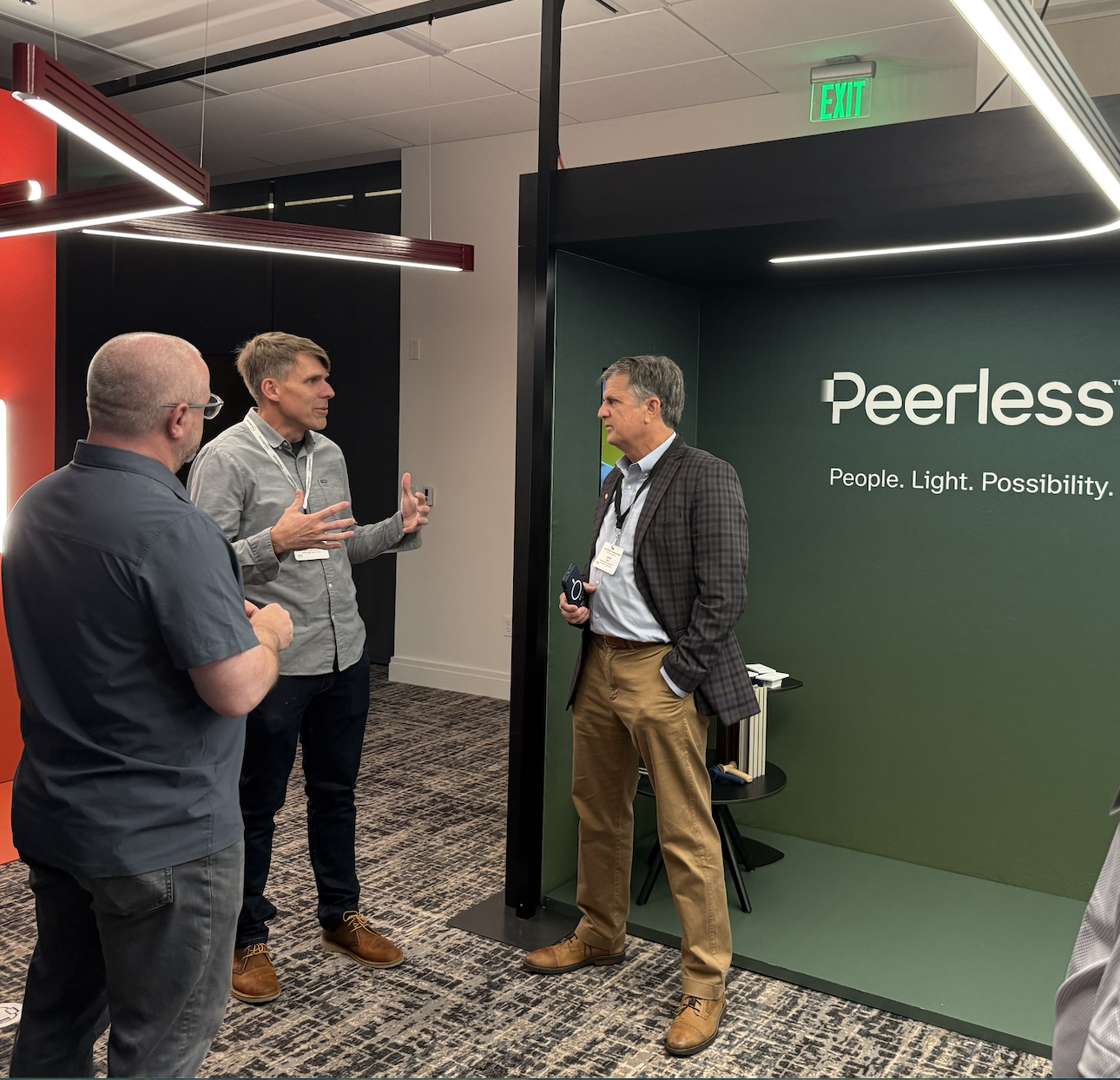
Peerless made a smart decision at IALD Enlighten Americas in Austin: it rented a suite instead of using a conventional tabletop. The setting created a more immersive, powerful experience—and gave me time to understand two very different introductions: Peerless Aptitude and Acuity Cadence.
The first was Aptitude, a configurable architectural linear platform. Guillaume Aubé, Design Manager at A-Light/Acuity Brands, demonstrated sliding mechanical connections, pivoting sections, and “highway junctions” that allow designers to develop intersecting arrangements.
The details were thoughtful. A common extrusion approach supports different mounting configurations. Replaceable LED strips, cuttable at one-inch intervals, address serviceability. Meanwhile, a flexible silicone lens maintains a continuous line through curves, and can be installed in the field.
Designers gain creative flexibility, installers have room to adjust, and maintenance teams can replace a damaged section rather than discard an entire fixture. Aptitude was impressive, and the suite gave its mechanical details room to shine.
But what really captured my interest was Cadence.
The Designers Who Disappeared
To explain why, I need to return to Denver.
During IES26, The Lighting Conference, a few key lighting designers disappeared for part of the day. Eventually, I learned they had gone to Acuity’s Denver office for a private demonstration.
Then came the detail that sharpened my curiosity: they had signed nondisclosure agreements. What was worth drawing those designers away from the conference? And what required that level of secrecy? I did not push. If someone signs an NDA, I am not going to ask them to violate it.
In Austin, the mystery finally had a name: Cadence. Acuity had launched the approach at its NEXT meeting a few weeks earlier.
My conversation with Christopher Sorensen, Senior Director of Engineering – Specialty Lighting Group, finally provided the explanation I had been waiting for.
Acuity Cadence: Rhythm by Design™
Cadence carries the tagline “Rhythm by Design.” As Chris explained it, the approach connects compatible luminaires with controls that coordinate color temperature and intensity throughout the day.
The intention is to make that progression automatic, operating in the background while people use their spaces.
I asked Chris whether he considered the approach more biophilic or circadian. Our discussion explored both the physiological considerations and the psychological experience of light changing around us.
The goal, he explained, is to create spaces that feel comfortable, intuitive, and connected to the passage of time.
That led to an idea I found particularly compelling: think about the lighting design as a time-lapse rather than a static image. Designers establish how a space evolves throughout the day–and night.
The Key Is in the Controls
For me, the most important part of our conversation concerned controls—and cost.
Chris described familiar resistance to circadian lighting: complicated controls, difficult commissioning, and an assumption that the project will become substantially more expensive.
Cadence seeks to address that resistance by building on compatible Acuity luminaires and the nLight controls infrastructure a project may already include.
When nLight enters a project for code compliance, much of the foundation is already there. Consequently, the conversation becomes one about extending that investment with the appropriate programming and time-based sequence.
Chris emphasized avoiding a separate controls system that adds another layer of cost and complexity.
That is the business proposition that caught my attention. Compatible luminaires and commissioning still carry costs, but using an established controls platform makes the overall approach more manageable.
Don’t Be Afraid of Cooler Light
Our conversation became especially interesting when we discussed color temperature.
Chris described warmer, lower-intensity light in the morning and evening, with cooler, higher-intensity light during the middle of the day.
I asked whether that could mean reaching 6000K or 6500K. The discussion challenged a reluctance I frequently encounter among designers: discomfort with cooler light.
Chris encourages designers to reconsider that reaction, particularly with good color rendering and a changing environment.
Cadence’s published specifications identify a standard rhythm range of 2700K to 6500K, with 90-plus CRI. However, Chris explained that a designer need not automatically choose the coolest endpoint. Color preference, intensity, and the desired spectral contribution must work together.
The important point was the relationship among those decisions.
Intensity Matters, Too
I also wanted to understand whether Cadence attempted to reproduce exactly what was happening outdoors.
Chris clarified that it does not use cameras or sensors to translate the sky into indoor color values. Instead, it follows a programmed progression inspired by natural light.
He emphasized that changing CCT alone is insufficient. Intensity must change with it.
That distinction deserves attention. A warm-to-cool transition may communicate the passage of time, but circadian-supportive design requires consideration of spectrum, intensity, timing, duration, and the light reaching occupants.
Our conversation kept returning to coordination: the luminaires, their output, and the sequence must work together.
Automatic Without Taking Away Control
Automation was another point I pressed.
A changing timeline has limited value if someone must continually operate the controls. Chris explained that the sequence runs automatically while allowing occupants to make adjustments for activities such as presentations.
Afterward, the system can return to its timeline according to the programming. That prevents a temporary intervention from indefinitely replacing the intended sequence.
He used the example of a hotel environment, where very warm electric lighting can contrast sharply with large daylight views. Cooler daytime light could feel more natural, followed by a warmer setting as evening arrives.
The transition was what interested me most. A fixed scene cannot respond to both conditions in the same way.
A Website Worthy of a Great Product.
The special website is extremely well done. You can visit here:
Most circadian systems change light. Cadence™ reveals time….Light that subtly shifts, breathes, and evolves throughout the day, creating environments that feel intuitive, natural, and alive.
In Denver, a few key lighting designers slipped away from IES26, signed NDAs, and went quiet. I knew something was behind that door, but not what. In Austin, sitting across from Chris Sorensen in the Peerless suite, the door finally swung open.
The secret had a name, a tagline, and a reason for all that silence: Cadence.
Go Deeper: Three Parties, Two Hats, One Memorable Night in Austin