







Part One of a Three-Part Follow-up to the 25 Most Influential People in Lighting
Presented by EdisonReport and Pompeo Group
The disposable luminaire. The overlit project. The assumption that brighter means safer. These practices may feel familiar today, but some of lighting’s most influential voices believe future generations will ask why we accepted them.
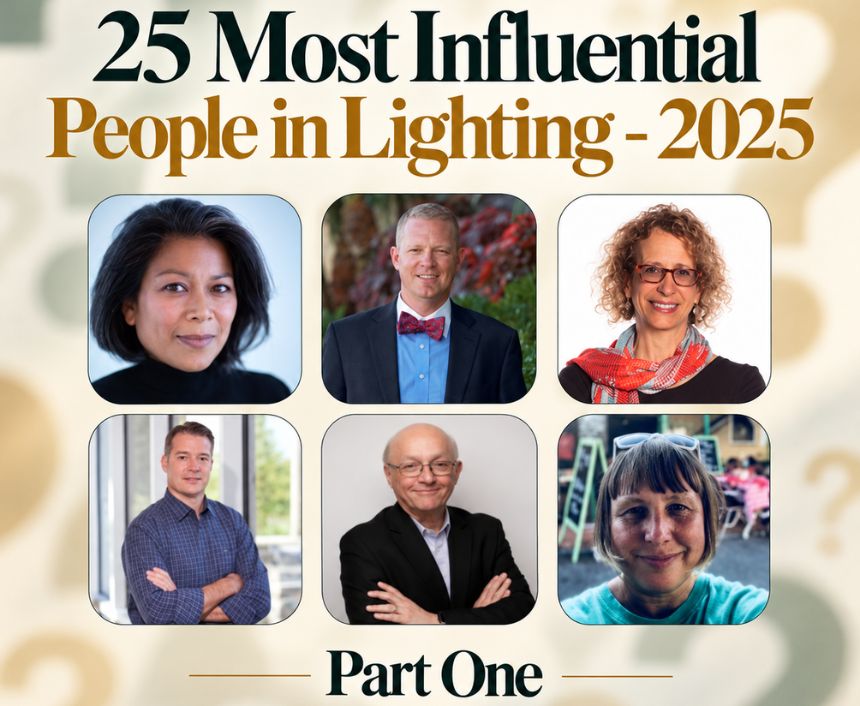
Earlier this year, EdisonReport and Pompeo Group collaborated on the 25 Most Influential People in Lighting—2025, an initiative conceived by Paul Pompeo, President of Pompeo Group, recognizing lighting professionals who have made significant contributions to our industry.
Building on that recognition, Pompeo invited the honorees to participate in a three-part follow-up series exploring the industry’s assumptions, practices, and opportunities for change. Nineteen of the original 25 honorees shared their perspectives.
The LIGHTING25 honorees were selected by an independent committee consisting of three highly respected lighting professionals: Charles Stone, Nancy Stathes, and Jean Jacques.
This first installment asks: “What is something our industry widely accepts today that future generations of lighting professionals may one day question?”
The 19 responses below challenge assumptions about products, design, purchasing, professional development, and the purpose of illumination itself.
Several contributors acknowledge that change has already begun. Their concern is whether the industry will move far enough—and fast enough.
Will Disposable Lighting Become Indefensible?
Some of the strongest responses concern what happens before a luminaire reaches a project and after its useful service ends. The contributors ask the industry to consider material flows, repairability, and the consequences of replacement.

Leela Shanker
Sustainability Director, Design Lab, WAP Sustainability
We’re already starting to question where the life of our designs start and end. In the future, I expect it will be common practice to treat our product and spatial designs as less discrete project choices, and more a continuum of material and energy flows that can have beneficial impacts for a wider circle of stakeholders beyond the immediate client.

John Palk
President and CEO, SESCO Lighting
I’d say it’s the concept of the “throw away fixture”. We have come from decades of simply being able to just replace components and retrofit fixtures. Today we have products which have been created that have to be discarded due to a lack of product serviceability design! While considered “throw away”, this is not a long-term sustainable practice. Many manufacturers and designers are seeking out ways to create sustainable and serviceable fixtures that can be maintained for decades.

Andrea Hartranft, FIALD
Principal, Hartranft Lighting Studios
This is a hard question! All of the answers that come to mind I think are already being questioned. With that in mind, I would say that that landfill design, while already a concern of lighting professionals, will be more widely disparaged by owners as well. Swappable parts will be expected to be available and affordable.
Together, these responses suggest a broader definition of product value. Efficiency matters, but so do service life, replacement parts, and the ability to preserve an installation.
Has LED Reached Its Full Potential?
Other contributors question whether the industry has fully explored LED technology – or adequately addressed the compromises accompanying its adoption. Their responses span physical form, long-term performance, and biological considerations.

Jeff Parker
CEO, Luminii
Miniaturization and modularization. Today, we still design many luminaires around the constraints of legacy light sources rather than the possibilities of LED technology. As miniaturization and modularization continue to evolve, I believe future designers will rethink not only how luminaires perform, but what they need to look like in the first place!

Randy Burkett, FIALD, FIES, LC
Principal, Reed Burkett Lighting Design
The current LED. There is simply not enough attentiveness to overall LED performance and veracity in long-term applications! Thermal management, power stability, fixture integrity, control compatibility, disposal…all of these are still works in progress. LED luminaires will continue to evolve.

Sharon Stammers
Co-founder, Light Collective
LED [laughs]! We moved very quickly into using LEDs ubiquitously without knowing the long-term health effects of it on humans, flora and fauna.
These observations raise different questions rather than establish one verdict on LED. Jeff sees design possibilities still waiting to be realized. Randy emphasizes performance across an installation’s life. Sharon questions the speed of adoption relative to understanding its wider effects.
Why Do We Keep Adding More Light?
The relationship between illumination, darkness, and perceived safety drew several responses. Contributors challenged excessive brightness, uncontrolled operation, and the tendency to treat darkness as a deficiency.

Martin Lupton
Co-founder, Light Collective
I think it is the use of light sources cooler than 3000K in an exterior environment – 4000K LEDs are so widespread in street and urban lighting and, as the knowledge about their impact becomes more commonly known, I hope that it will be questioned more widely in the near future.

Christina “Tina” Halfpenny
Executive Director and CEO, DesignLights Consortium
Future lighting professionals should question installations of uncontrolled lighting, both indoor and outdoor, to better address excessive brightness, blue light content, and the silos separating lighting design from integrated energy management strategies.

Acharawan Chutarat, PhD
Lecturer, King Mongkut’s University of Technology Thonburi
I think future lighting professionals will ask why people prioritize use of color and brightness over quality of meaningful and sustainable lighting design.

Ruskin Hartley
CEO, DarkSky International
They will question the concept that brightness equals safety. We treat darkness as something to defeat rather than design with, forgetting that the dark-adapted eye often sees more than a dazzled one.

Christopher Knowlton, MBA, CAE
CEO, International Association of Lighting Designers
Our quiet acceptance of light pollution and round-the-clock illumination as markers of safety and prosperity. Most civic and commercial lighting still treats darkness as a problem to be eliminated. Future generations, living more directly with the ecological and human health consequences, may look back on today’s default brightness levels as a convenience we normalized long after the evidence turned against us.

Amy Oliver, CPM, FRAS
Public Affairs Officer and Light Pollution Scientist, Smithsonian
Everywhere I go in the world, I see dozens of over-lit projects from every generation. But as we learn more about energy and dark sky science, and people turn toward a more natural ethos, those projects are going to hopefully appear less frequently.
The recurring challenge is one of restraint and purpose. How much light does a space need? Where should it go? When should it operate? These contributors want those questions to carry more weight in everyday decisions.
Are We Measuring and Valuing the Right Things?
Two responses challenge the criteria used to specify and evaluate lighting. One questions the orientation of the measurement plane. The other questions the priority given to price.

Mariana Figueiro, PhD
Professor, Department of Population Health Science and Policy, Icahn School of Medicine at Mount Sinai
Horizontal illuminance as a design criterion. We are vertical species, so we need vertical illuminance! But we specify based on standards that provide us with recommended light levels on the work plane.

Colleen Harper, MPA, CAE
CEO and Executive Director, Illuminating Engineering Society
Today we still accept that lighting is judged primarily by cost rather than human health outcomes. Future professionals will question light’s biological impact, not just its price.
Their answers invite a closer examination of what a successful installation should accomplish – and whether the measures used to approve it capture that intent.
Why Is Delivering Lighting So Complicated?
The conversation also reached the infrastructure powering lighting and the commercial process used to purchase it. These responses anticipate a theme we will explore more directly in next week’s installment: unnecessary complexity.

Naomi Miller
Lighting Scientist Emerita, Pacific Northwest National Laboratory
Our stodgy high-voltage electrical distribution systems in buildings.

Lauren Dandridge, LC, IES
Strategic Partnerships and Brand Development Lead, LINX Lighting + Controls
One day, designers of all kinds will laugh at how unnecessarily complicated it is to purchase lighting! [laughs] I strongly hope that the next generation of tradespeople will simplify the process—-for everyone’s benefit.
Both responses challenge the industry to reconsider systems that professionals navigate daily. Technical progress in the luminaire does not automatically simplify the infrastructure or transactions surrounding it.
Can the Profession Sustain Its Own Ambitions?
Two contributors turned their attention to the people delivering the work. Their concerns address the economics of design and the preparation of future leaders.

Chip Israel, FIALD, FIES, LEED AP, LC
Founder and CEO, Lighting Design Alliance, a Salas O’Brien Company
Why are we so passionate about making every project perfect? Every award-winning project loses money. Lighting designers constantly try to educate their ownership and design teams, only to have their recommendations value-engineered out later. Without national support, this enthusiasm could dissipate over time, and lighting would become a basic commodity.

Lee Brandt, IALD, MIES, CLD, LC
Senior Principal, HLB Lighting Design
Today we emphasize technical skills and project-based mentorship and perhaps not enough leadership training and legacy. Future generations may question whether we placed enough focus on developing judgment, adaptability, and emotional intelligence alongside design expertise.
Chip’s concern about project profitability connects with Lee’s emphasis on leadership. Sustaining the profession requires attention to its business practices and its people, alongside the quality of its designs.
Why Does Lighting Arrive Later?
The final response challenges the sequence of design itself.

Rogier van der Heide
Lighting Designer and Global Design Executive, Atelier Rogier van der Heide
I think that future lighting professionals will question the concept that lighting begins after architecture has been designed! Future generations may treat light, material, space and time as one continuous act of design.
Rogier’s answer brings several threads together. Decisions about light influence materials, energy, experience, maintenance, and the use of space. Treating those decisions as an integrated responsibility could change much more than when a lighting designer joins a project.
Paul’s opening question asks us to look at today’s practices through tomorrow’s eyes. The answers suggest that progress will depend on what we preserve, what we reconsider, and which familiar habits we are willing to change.
Next week, we bring that examination into everyday practice with Part Two: “What is one aspect of modern lighting practice that has become more complicated than it needs to be?”