








Sustainability Spotlight vs. Sales Slump: Is Signify Missing the Mark?
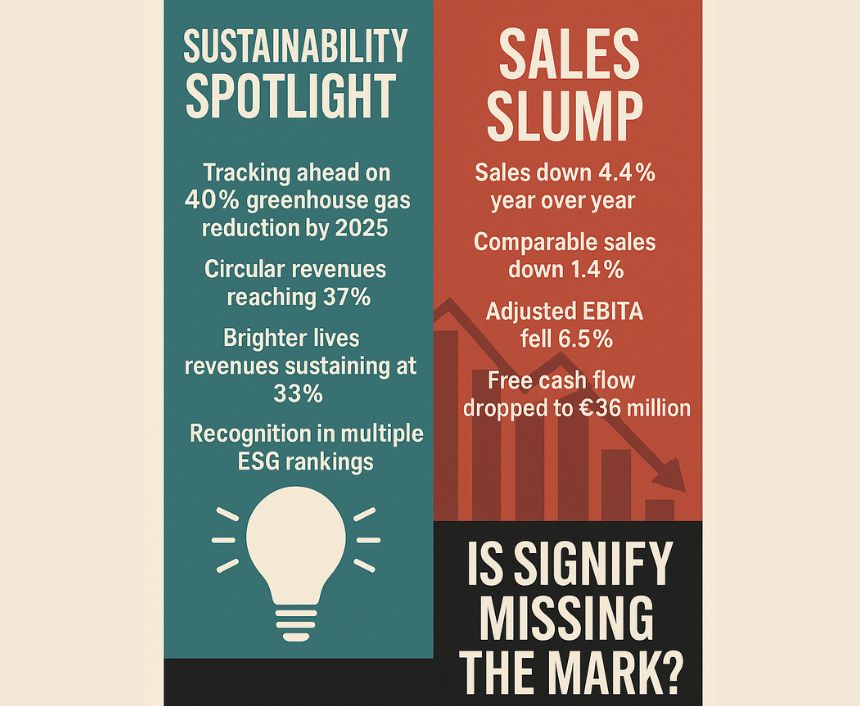
Signify’s Q2 FY2025 press release emphatically showcases an array of environmental and social credentials:
- Tracking ahead on 40% greenhouse gas reduction (2019 baseline) by 2025, outpacing the pace required by the Paris Agreement.
- Circular revenues reaching 37%, surpassing the 2025 goal of 32%.
- Brighter lives revenues sustaining at 33%, again above the 32% target.
- The percentage of women in leadership holding at 27%, short of its own 2025 ambition of 34%.
- Recognition in multiple ESG rankings: Corporate Knights Europe 50, CDP Supplier Engagement A-List, MSCI AA, EcoVadis Platinum, and more.
Yet in the same breath, Signify reports sales down 4.4% year over year, with a 1.4% decline in comparable sales. Adjusted EBITA fell 6.5%, margins slipped slightly to 7.8%, and free cash flow dropped sharply to €36 million from €51 million in Q2 2024.
Sales and Profit Weakness Overshadow ESG Gains
While Signify loudly advertises its sustainability wins, its underlying business continues to weaken—highlighting a disconnect between ‘feel-good’ metrics and financial reality. Investors typically reward companies that deliver solid sales growth and profit consistency—but Signify’s Q2 results offer little solace on either front.
Investors Aren’t Rewarding the Green Cred
If you invested in Signify on 25 July 2021, that investment would have shrunk by about 50% as of yesterday’s closing price. As I write this article, Signify’s stock price is down 12% today.
Despite the company’s high-profile focus on sustainability and ESG metrics, the market has not responded favorably. Investors appear more concerned with earnings and growth than environmental progress. Any investor hoping environmental leadership would translate to market premium appears to have been disappointed.
Bottom Line: Sustainability Is a Plus—but Not a Substitute
-
Signify’s sustainability and leadership initiatives are impressive—but not translating into financial returns.
-
This serves as a reminder: ESG matters—but must be balanced by sales, margins, and investor returns.
-
A serious business recovery strategy should prioritize operational performance and growth, while maintaining sustainability as a complement—not as a core selling point absent results. It will be interesting to see the new CEO’s philosophy when As Tempelman takes over in September.
Final Thought
Your humble editor values sustainability and welcomes the growing diversity in leadership across our industry. We commend Signify’s commitment to a greener future, increased diversity, and circular economy principles. But at the end of the day, environmental accolades don’t fill the top line—and investors rightly demand financial discipline and profitability growth. Without stronger sales and earnings performance in upcoming quarters, all the branding buzz won’t justify the stock’s tepid price behavior.