







IoT Innovations Sues Signify Over Hue, WiZ and Interact Technology
Six-patent lawsuit targets connected lighting, wireless networking, AI and smart-home products. The IoT Innovations Signify Lawsuit has drawn significant attention in the tech industry.
Signify is facing another patent infringement lawsuit—its second significant defensive patent case to surface in less than two weeks.
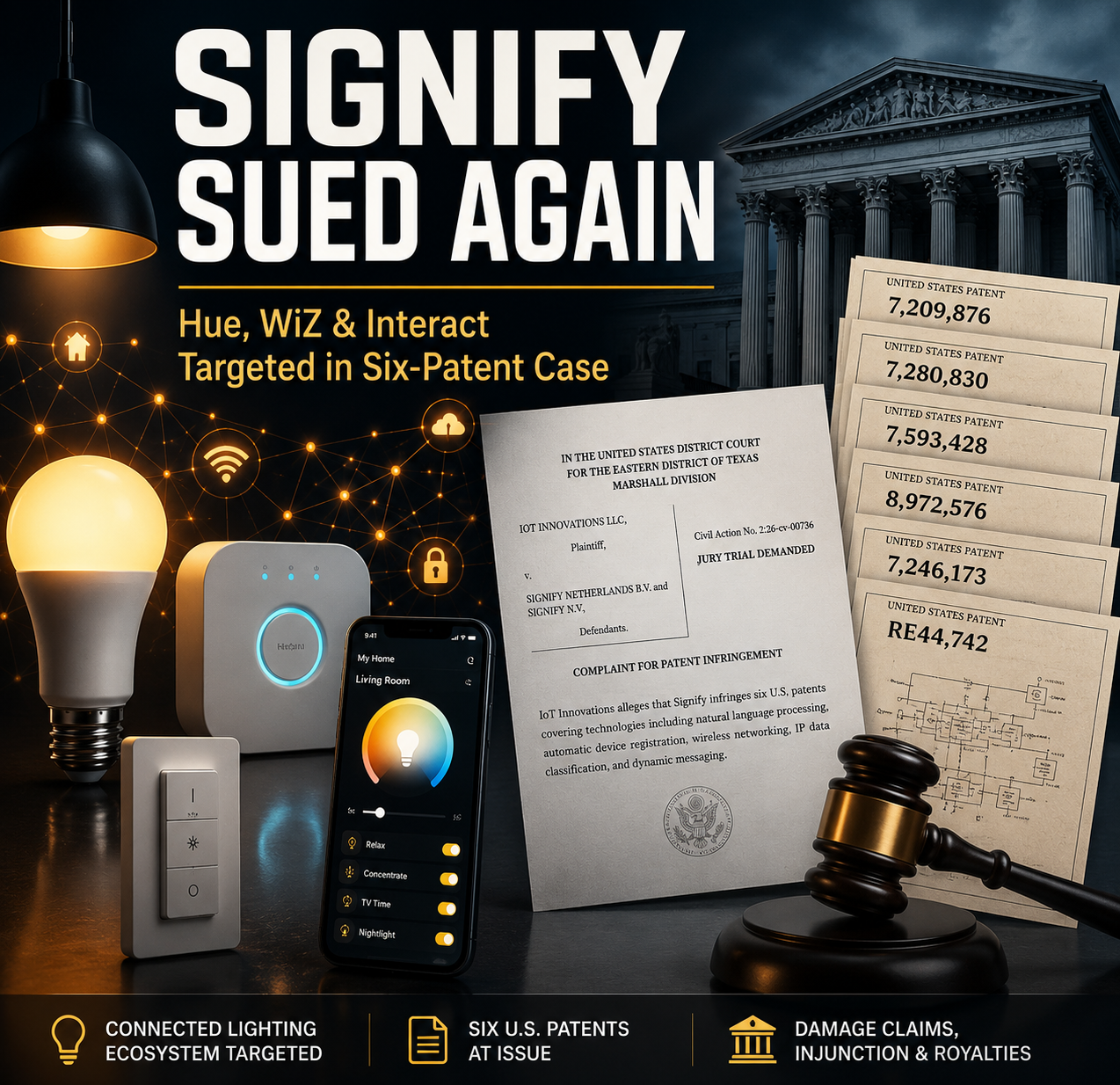
IoT Innovations LLC filed suit against Signify N.V. and Signify Netherlands B.V. on 23 AUG 2026 in the U.S. District Court for the Eastern District of Texas, Marshall Division. The case is IoT Innovations LLC v. Signify Netherlands B.V. et al., Case No. 2:26-cv-00736.
The lawsuit is notable for both its breadth and its targets. IoT Innovations asserts six U.S. patents involving technologies ranging from natural-language queries and wireless device registration to network communications and dynamic messaging.
Even more interesting for the lighting industry, the accused Signify products include a wide range of connected-lighting technologies under Philips Hue, WiZ and Interact.
For years, Signify has been one of the lighting industry’s most aggressive defenders of intellectual property. EdisonReport has extensively covered its litigation against companies including ETI Solid State Lighting and Lepro.
Now, however, Signify finds itself on the other side of the courtroom.
Six Patents at Issue
IoT Innovations alleges infringement of six patents:
- U.S. Patent No. 7,209,876 — System and Method for Automated Answering of Natural Language Questions and Queries
- U.S. Patent No. 7,280,830 — Automatic Registration Services Provided Through A Home Relationship Established Between A Device And A Local Area Network
- U.S. Patent No. 7,593,428 — involving multiple-checksum-protected data packets
- U.S. Patent No. 8,972,576 — involving relationships between wireless devices and network servers
- U.S. Patent No. 7,246,173 — Method And Apparatus For Classifying IP Data
- U.S. Patent No. RE44,742 — Dynamic Message Templates And Messaging Macros
These are not traditional lighting patents covering optics, LED packages or luminaire construction. Instead, they concern the increasingly important digital infrastructure behind connected lighting.
That distinction makes this case worth watching.
Hue, WiZ and Interact Are in the Crosshairs
The list of accused products is extensive.
IoT Innovations identifies Signify’s Interact Builder App and its Bulbi AI-powered chatbot, along with the Philips Hue App, Hue Bridge and Hue Bridge Pro. The complaint also identifies Hue cameras, contact sensors, motion sensors, smart bulbs, table lamps, smart plugs, switches and doorbells.
On the commercial side, the complaint reaches into Interact. It identifies several Interact gateways, the Interact Pro mobile application, Interact Ready luminaires, wireless sensors and switches, and other network infrastructure.
Then there is WiZ.
The complaint names WiZ smart plugs, cameras, bulbs, LED strips, TV lights, portable lights, floor lights and table lamps. IoT Innovations also attempts to encompass prior versions and related hardware, software and functionality within its definition of the “Accused Products.”
In other words, this isn’t a dispute centered around one lamp or luminaire. It reaches into a substantial portion of Signify’s connected-lighting ecosystem.
AI Adds an Interesting Twist
One claim caught my attention because of the lighting industry’s rapidly growing interest in artificial intelligence.
The complaint specifically identifies the Signify Interact Builder App, describing it as an AI-powered application that provides technical support and personalized guidance through an integrated chatbot.
IoT Innovations argues that Signify’s technology infringes its ‘876 patent involving automated answers to natural-language questions.
That makes this lawsuit more than another connected-lighting patent dispute. It potentially reaches into the emerging intersection between lighting, AI and natural-language interfaces.
That intersection will only become more important as lighting manufacturers add AI tools to their controls and building-management platforms.
An EdisonReport Article Even Made the Complaint
There was another detail in the filing that certainly caught my attention.
IoT Innovations cites EdisonReport.
The complaint spends considerable time establishing why it believes the Eastern District of Texas has jurisdiction over Signify. As part of that argument, it points to Genlyte Solutions’ new distribution warehouse in Irving, Texas.
The filing specifically cites our 7 JUL article, Genlyte Solutions Opens Irving, Texas Warehouse.
IoT Innovations argues that the warehouse demonstrates an investment by the Signify corporate group in Texas-based distribution infrastructure.
Your humble editor never expected that writing about a new lighting warehouse would someday become part of a federal patent complaint, but here we are.
IoT Innovations Alleges Willful Infringement of One Patent
The most aggressive allegations involve the RE44,742 patent, which covers dynamic message templates and messaging macros.
IoT Innovations alleges direct, induced and contributory infringement. It further alleges that Signify has a practice of not reviewing competitors’ patents and characterizes the company as having been “willfully blind” to its patent rights.
Those are allegations—not findings by the court.
IoT Innovations goes further and alleges that Signify’s infringement of the ‘742 patent was willful, intentional or in conscious disregard of its rights.
That distinction matters because IoT Innovations is asking the court for treble damages based on alleged willful infringement of that patent.
IoT Innovations Wants Damages—and an Injunction
IoT Innovations has demanded a jury trial.
The company seeks damages for alleged infringement of all six patents. For the ‘742 patent, it also requests a permanent injunction or, alternatively, an ongoing royalty.
In addition, IoT Innovations asks the court to find infringement of the ‘742 patent willful and award treble damages. It also seeks interest, attorneys’ fees and costs.
No determination of infringement has been made. These are allegations contained in the complaint, and Signify will have the opportunity to respond.
Another Role Reversal for Signify
The timing is fascinating.
On 17 AUG, EdisonReport reported that Dense Matrix sued Signify over technology associated with Interact Indoor Navigation and Trulifi.
Now Signify faces another infringement lawsuit, this time involving six patents and an even broader collection of connected products.
Meanwhile, Signify continues pursuing its own patent cases. Earlier this month, we reported that Signify sued Artika. And just yesterday, EdisonReport published our firsthand account from the ETI-Signify Markman hearing in Georgia.
Signify also scored a major jury victory against Lepro earlier this year, although the post-trial financial battle became almost as interesting as the verdict itself.
The picture emerging is unusual.
Signify remains perhaps the lighting industry’s most prominent enforcer of intellectual property. But as lighting becomes increasingly connected, software-driven and AI-enabled, Signify’s own products also operate in technology areas covered by patents originating well outside traditional lighting.
That creates a very different IP landscape.
And judging by the activity of the past few weeks, the lighting industry’s patent battles are nowhere near over.