








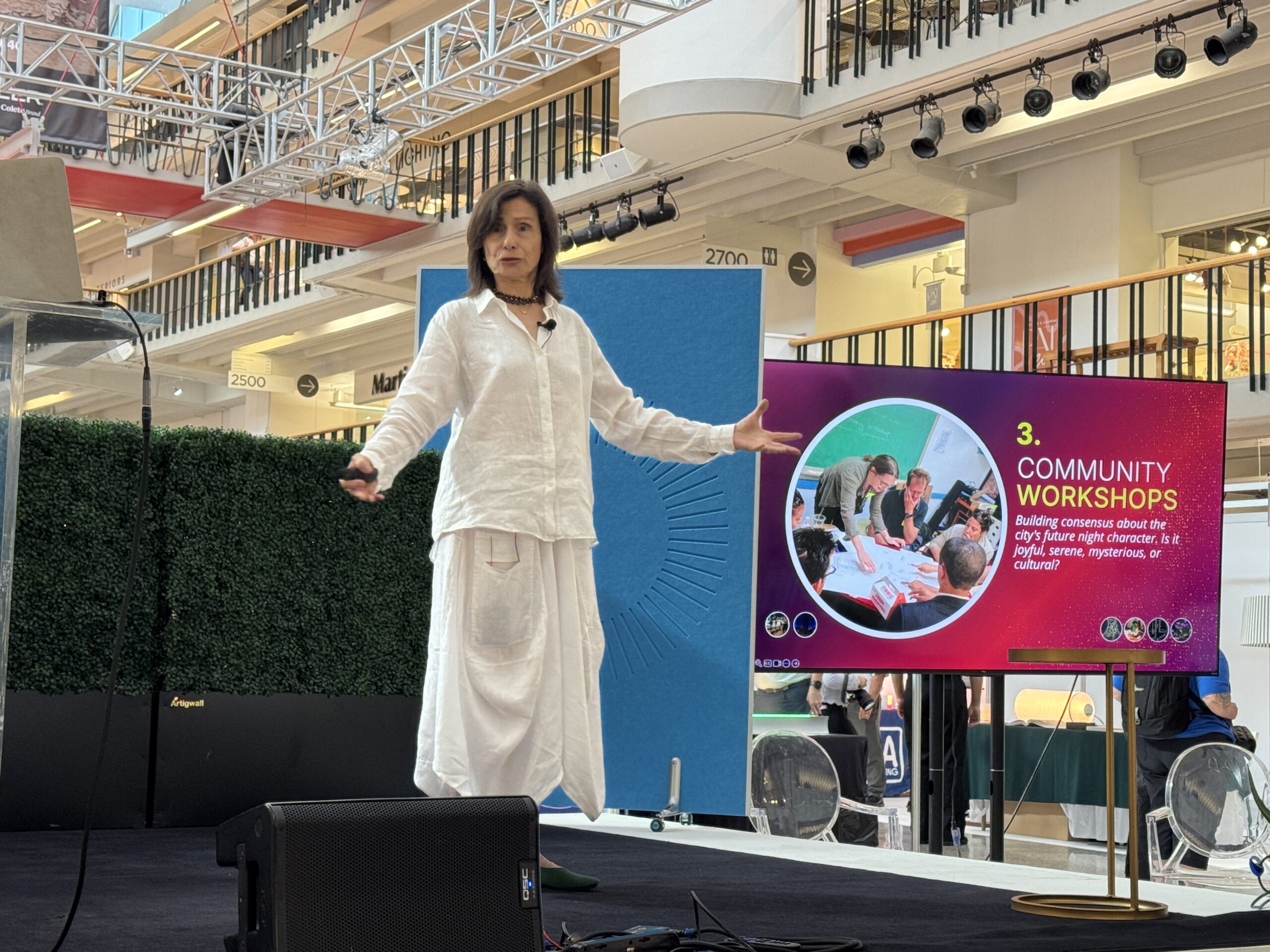
Nighttime Lighting Design: Leni Schwendinger on Designing for People
At ArchLIGHT Summit, Leni Schwendinger challenged the lighting community to think beyond visibility and illumination—and to consider how better nighttime design can make cities safer, healthier and more human.
“Are you afraid of the dark?”
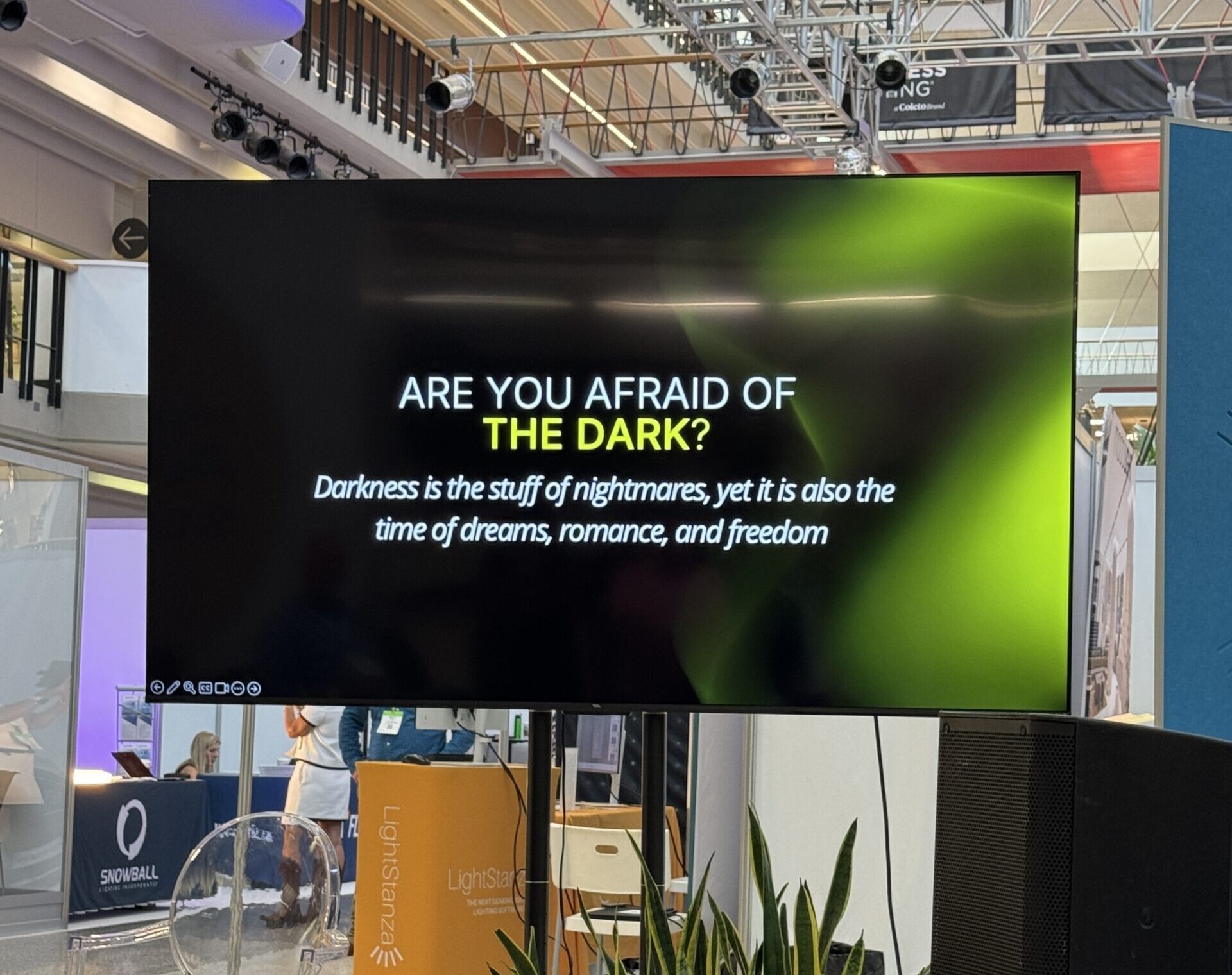
Leni Schwendinger opened her keynote at ArchLIGHT Summit with a question that sounded simple. It was anything but.
Darkness, she explained, occupies a complicated place in the human imagination. It can represent fear, danger and uncertainty. Yet nighttime is also associated with romance, dreams, music, dancing, creativity and rest. For millions of people, it is also simply when they work.
That tension was at the center of Leni’s presentation, Humanizing the Night: A Practical Vision for Safer, More Vibrant, Illuminated Cities. Rather than treating nighttime lighting as a matter of placing luminaires along streets and meeting prescribed light levels, she urged designers to think about the much larger experience of cities after dark.
Her message to the lighting community was clear: nighttime represents an enormous, and still largely unexplored, design opportunity.
A Different Kind of Client
Leni, an artist, designer and urbanist whose work has focused on cities after dark for more than two decades, encouraged lighting designers to broaden their definition of the client.
For many designers, the client might traditionally be an architect, developer, property owner or municipality. Leni sees another group deserving equal attention: the people who actually occupy the city at night.
That includes night-shift workers, healthcare employees, transit users, women walking alone, restaurant workers, delivery drivers and people simply trying to get home safely.
She cited research indicating that fear of crime has a real effect on how people use cities, particularly women and lower-income urban residents. Whether or not a dangerous situation actually exists, poor visual information can intensify a person’s perception of danger.
“The lack of visual information or legibility causes the mind to invent dangers,” she explained.
That word—legibility—was especially important.
The goal is not necessarily to pour more light onto a sidewalk. Instead, people need enough visual information to understand their surroundings. Where does the path lead? Who else is nearby? Is there an exit? Can I see the face of the person approaching me? What is happening beyond the immediate pool of light?
When those visual cues disappear, imagination often fills the gaps.
And imagination at night does not always assume the best.
 Safety Is More Than Illuminance
 Safety Is More Than Illuminance
For lighting professionals, Leni’s argument challenges one of the easiest assumptions to make about nighttime safety: that brighter automatically means safer.
Her presentation suggested something more nuanced.
Lighting is part of a larger nighttime ecosystem involving transportation, land use, public spaces, business activity, social behavior and community participation. A brightly illuminated street that remains empty and uninviting may not feel nearly as safe as a thoughtfully illuminated public space filled with people.
In other words, successful nighttime design depends on more than footcandles.
Leni repeatedly brought the discussion back to the people using these environments. Women working late shifts were one example. A healthcare worker leaving a hospital late at night may have to cross a large parking area or wait alone for transportation. Her experience of that environment is fundamentally different at midnight than it would be at noon.
That difference deserves design attention.
Women’s safety in public spaces, Leni emphasized, is a worldwide issue. Walking, waiting for public transportation and moving between workplaces and parked cars can become entirely different experiences after dark.
The lighting industry has an opportunity to help solve those problems, but only if it begins by asking different questions.
The Nighttime City as Social Infrastructure
Leni also connected nighttime design with another growing societal concern: isolation.
The COVID-19 pandemic accelerated habits that kept people at home, but many of those behaviors did not disappear when restrictions ended. Working from home, ordering food and entertainment on demand and communicating digitally have made it easier than ever to remain inside.
The result can be fewer spontaneous interactions and less participation in public life.
Cities after dark offer an antidote.
Sidewalks, parks, plazas, restaurants, cultural venues and entertainment districts can become places where people meet, walk, exercise and reconnect with one another. But people will only use those spaces if they feel comfortable entering and moving through them.
Lighting therefore becomes part of what might be considered a city’s social infrastructure.
Leni described nighttime as a potential “place of care, connection and celebration.”
That is a very different way of describing exterior lighting.
It moves the conversation beyond poles, optics and wattage and into questions about sociology, psychology and urban life.
For lighting designers, that may also expand the boundaries of the profession. Designers who understand the night can participate earlier in conversations involving planning, transportation, public health, tourism and economic development.
Climate Change Makes the Night More Valuable
One of the more unexpected parts of Schwendinger’s presentation involved climate.
As cities contend with hotter summers and increasingly severe heat events, nighttime may become more important as a usable public realm.
The reason is obvious once she points it out: night is cooler.
During extreme heat, daytime outdoor activity can become difficult or even dangerous, particularly in dense urban environments affected by the heat-island effect. Parks, walking routes, recreation and social activities may increasingly shift toward evening and nighttime hours.
That shift presents another challenge for cities—and another opportunity for lighting designers.
If people increasingly rely on nighttime hours for exercise, transportation and social activity, cities need to be designed accordingly. Leni believes lighting professionals should be part of conversations about climate resilience and adaptation rather than arriving after those decisions have already been made.
Her advice was essentially to get involved now.
Transportation planners, tourism officials, public agencies, landscape architects and lighting designers all have a role in creating cities that function differently after sunset.
Designing for the People Who Are Already There
One strength of Leni’s presentation was her focus on people whose nighttime experience is often overlooked.
The traditional image of a nighttime economy may revolve around restaurants, bars, theaters and entertainment districts. But cities operate all night long.
Nurses arrive for shifts. Maintenance crews work. Drivers transport goods. Security personnel patrol buildings. Restaurants clean their kitchens. Transit employees move people across the city.
For these workers, nighttime is not recreation. It is everyday life.
Leni argued that attractive places to walk, wait, pause and recuperate can benefit these workers enormously. It is an approach that shifts nighttime planning away from exclusively supporting nightlife and toward supporting everyone who occupies the city after dark.
This is where lighting can become genuinely human-centered.
A successful nighttime environment might provide visual clarity without excessive brightness. It can reveal faces, destinations and pathways while preserving the character of the night. It can encourage people to stay rather than hurry through. Most importantly, it can communicate that someone thought seriously about the person using that space at 11 p.m., 2 a.m. or 5 a.m.
A Larger Role for Lighting Designers
Leni began her talk by asking the audience whether they were afraid of the dark.
By the end, the more interesting question may have been what lighting professionals intend to do about it.
The conventional response to darkness has often been simply to add light. Leni is proposing something far more ambitious: understand the night first.
That means knowing who is there—and who is missing because they do not feel comfortable coming. It means studying how people move, where they hesitate, what they can see and what remains hidden. It also requires looking at transportation, climate, commerce and social behavior as part of the nighttime experience.
Then design.
For a profession that frequently talks about human-centric lighting, Leni offered a considerably broader definition of what “human-centric” might actually mean.
It is not simply lighting people better. It is designing the night around them.
Go Deeper: ArchLIGHT Summit Education: Beyond the Show Floor
ArchLIGHT Summit: Strong Start and WILD Welcome