







Signify Seeks Triple Lepro Royalty Rates as Costs Mount
Signify Lepro royalty rates could rise sharply if a Nevada federal court grants Signify’s latest request. The company seeks to triple ongoing rates, recover additional damages, and add interest to the jury’s $410,544 verdict. However, even its highest calculated recovery would remain well below the legal fees it previously sought to recover.
The renewed motion, docketed on 30 October 2026, follows an August ruling that upheld the verdict but denied Signify’s requests for attorney fees and enhanced damages. At the same time, the court allowed Signify to renew other requests with more evidence and updated calculations.
Signify has now submitted that analysis. The amounts in the latest motion are requests for the court to consider, not new awards.
Signify Seeks Royalties Up to 19.5%
Signify seeks ongoing royalties on products found to infringe three patents that, according to the motion, remain unexpired.
| Patent | Rate used at trial | Requested ongoing rate |
|---|---|---|
| U.S. Patent No. RE 49,320 | 6.5% | 19.5% |
| U.S. Patent No. 7,348,604 | 6.0% | 18.0% |
| U.S. Patent No. 8,063,577 | 1.0% | 3.0% |
Each requested rate is three times the corresponding trial rate—a 200% increase. However, these are separate patent rates. They do not automatically combine into one rate for every Lepro product.
Signify argues that the verdict changed the parties’ bargaining positions. It points to Lepro’s continued sales, competition across retail channels, and the value of the patented technology as reasons for higher rates.
The company also contends that the products would remain profitable under its proposed rates. However, parts of the financial analysis are redacted in the filing.
Alternatively, Signify asks the court to approve a smaller increase if it declines to triple the rates.
How the Latest Motion Differs
EdisonReport’s February report on Signify’s attorney-fee request examined its effort to recover more than $4.3 million in legal fees. Your humble editor attended much of this trial in person. Our April coverage followed the growing post-trial dispute.
The court later denied attorney fees and declined to triple the damages award. It also rejected Lepro’s request to overturn the verdict or obtain a new trial.
By contrast, this motion seeks payment for sales outside the jury’s calculation, interest, and royalties for continued infringement. Tripling an ongoing royalty rate is different from tripling the jury’s award for past damages.
Klite Sourcing Could Change the Damages
Signify requests $23,197 in additional damages: $2,197 for previously omitted sales and $21,000 for continued sales through 31 August 2026.
However, the amount depends largely on a dispute involving Klite, a Chinese company in which Signify says it holds a 51% stake.
Lepro’s position is that certain Klite-sourced products should be excluded based on patent exhaustion or an implied license. In practical terms, the dispute concerns whether those purchases already carried the rights needed to resell the products without another royalty payment.
Signify argues that Lepro has not provided enough evidence linking specific U.S. sales to qualifying Klite purchases.
If the court accepts the Klite exclusions, Signify’s alternative request falls to $3,399. As a result, supplier records and proof of product origin could have a direct effect on the award.
Interest Could Exceed the Jury Verdict
Signify’s largest proposed addition is interest for the period before judgment.
The company requests $416,071, using an annual rate of 8.75%, compounded quarterly, from the asserted dates of first infringement. That interest alone would slightly exceed the $410,544 verdict.
Alternatively, Signify calculates $153,779 using estimated quarterly sales periods. It also seeks interest after judgment at an annual rate of 3.472%.
The court must still decide which calculations, if any, to approve.
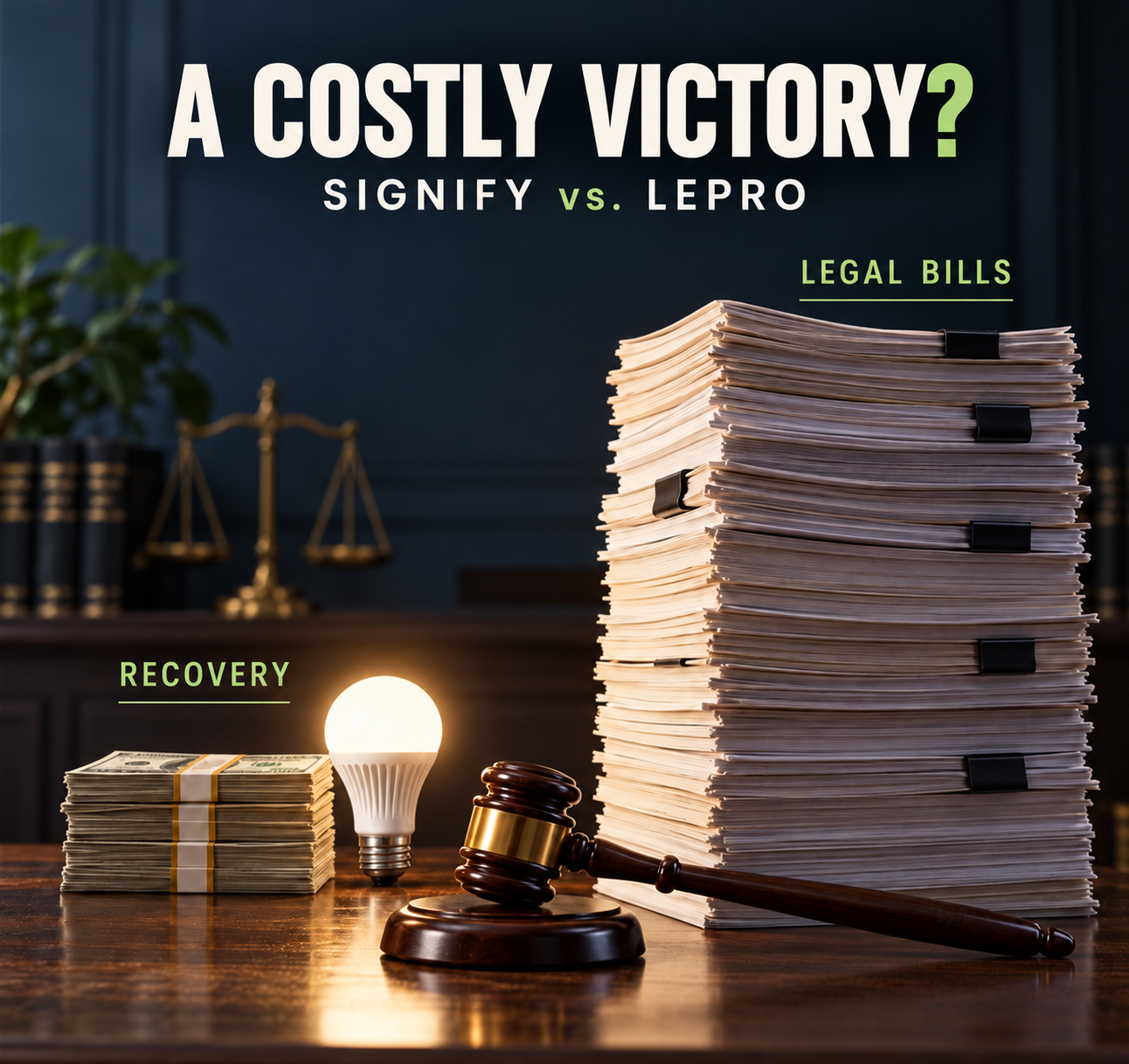
Recovery Still Trails the Legal Bill
The financial gap remains substantial even if Signify receives the higher amounts.
The August order identifies $4,326,019.88 in requested attorney fees. Signify also originally sought $231,689.24 in litigation costs, bringing those reimbursement requests to approximately $4.56 million.
U.S. District Judge Jennifer A. Dorsey denied attorney fees but awarded $190,315.89 in costs. Those expenses are separate from the jury’s damages award.
The table below combines the existing awards with the alternative amounts in Signify’s renewed motion.
| Component | Lower requested scenario | Higher requested scenario |
|---|---|---|
| Original jury damages | $410,544.00 | $410,544.00 |
| Litigation costs already awarded | $190,315.89 | $190,315.89 |
| Additional damages requested | $3,399.00 | $23,197.00 |
| Interest before judgment requested | $153,779.00 | $416,071.00 |
| Interest after judgment calculated through 22 October* | $13,598.00 | $20,008.00 |
| Combined recovery | $771,635.89 | $1,060,135.89 |
These totals use the motion’s stated interest calculations on damages and additional damages. Further interest, including interest on the cost award, and ongoing royalties would be additional.
Thus, the higher scenario would leave a gap of approximately $3.27 million against the attorney-fee request alone. Compared with the original combined fee-and-cost requests, the gap would be approximately $3.50 million.
A Courtroom Win With a Substantial Financial Gap
EdisonReport’s trial coverage examined Signify’s patent-specific damages case. The latest filing shows why winning the verdict did not settle the full financial dispute.
Based on the figures now available, the calculated recovery would fall well short of Signify’s reported litigation expenditure. However, those figures do not establish its final loss. The fee request is not a complete accounting of all spending, and further legal work, interest, and ongoing royalties could change the balance.
The case may also support Signify’s broader patent-enforcement and licensing efforts. That potential value is separate from the direct recovery, and the filings reviewed do not assign it a dollar amount.
For now, Signify has preserved its courtroom victory. Whether it can close the financial gap remains an open question.