







The Futility of Fighting Signify’s Patent War Machine
ETI and Liton have stepped into the legal ring with Signify, challenging the lighting giant over its sweeping patent claims. While their actions may appear courageous, industry veterans recognize the likely outcome: prolonged litigation, steep legal bills, and eventual settlements that favor the patent holder.
A Counterclaim and a Settlement Request
In a 28 July article published on EdisonReport, ETI filed a counterclaim disputing the validity and scope of several patents asserted by Signify. Meanwhile, Liton recently requested an early court-ordered settlement conference. However, Signify quickly pushed back, calling the parties “diametrically opposed,” and leaving little hope for productive discussions—at least for now.
These moves signal growing determination on both sides. Yet to many in the lighting world, the pattern is all too familiar: legal battles escalate, resources drain, and resolution comes only after significant damage has been done.
Henrik Villumsen: “Even If You Win, You Still Lose”
Danish attorney Henrik Villumsen has advised lighting companies on intellectual property issues for decades. I’ve spoken with him numerous times over the years about what it takes to challenge Signify in court. His advice has always been the same: settle early, if possible.
He recently offered this perspective on the ETI and Liton cases:
“As I have said many times before: taking out 1, 2, even 10 Signify patents, which in itself will cost years and millions of USD. Won’t help. Even if you win, Signify has many more patents, and creates hundreds of new ones each year.”
That’s the problem in a nutshell. Even if companies succeed in invalidating or defeating a few claims, Signify can—and often does—assert dozens more. With a massive legal apparatus and thousands of active patents, the company simply waits out its opponents.
The Power of Scale
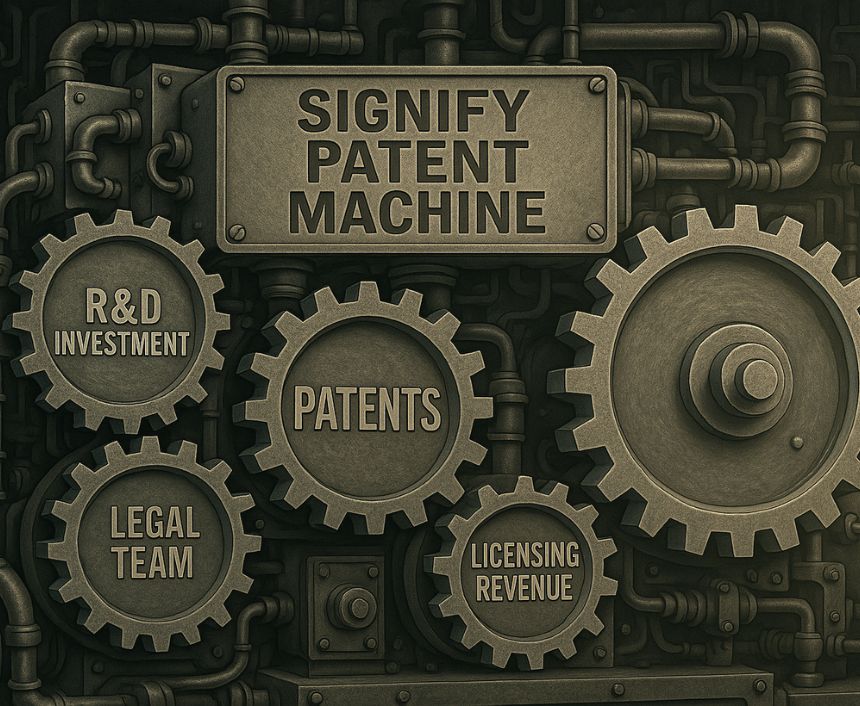
This is why so many insiders refer to Signify as a “Patent Machine.” The company reinvests about 5% of its revenue into R&D each year, resulting in hundreds of new patent filings annually. These patents feed into its EnabLED licensing program, which reportedly includes more than 1,700 licensees.
While Signify doesn’t break out licensing income separately in its financial statements, it’s widely believed that the program generates hundreds of millions in revenue. That revenue, in turn, funds more patents and more legal actions—creating a feedback loop that’s difficult for any competitor to disrupt.
Litigation Fatigue Is Real
Most companies that try to resist eventually wear down. The costs add up. The business distractions grow. And the legal strategy that seemed bold at the start often gives way to a quiet licensing deal behind closed doors. Even companies with good cases struggle to maintain momentum when each win is met with yet another lawsuit.
This isn’t to say that defending against overreaching patents lacks merit. The industry benefits when companies push back and establish limits. But for smaller firms—or even mid-sized manufacturers—the sheer imbalance of resources makes lasting success almost impossible.
Principles vs. Practicalities
For ETI and Liton, the decision to fight may come from principle or a desire to gain leverage in future negotiations. But the odds remain heavily stacked. As Villumsen explained, “Even if you win… you still lose,” because the next wave of patents is already on the way.
In this context, legal budgets may be better spent on negotiation rather than litigation. Taking out one patent—or even ten—won’t slow Signify’s strategy. Settling may not feel like a win, but it could be the only path back to doing business.