









Jared in Disguise (With Glasses)
Being IES president is demanding enough. Then comes the annual conference, where the president is expected to get on stage—several times—and somehow look polished while delivering speeches filled with names, titles, awards and other details that absolutely cannot be messed up.
At least, that’s how I remember it.
Don’t Screw It Up
In 2002, when I was IES president, then-IES Executive Director Bill Hanley handed your humble editor a large binder containing several speeches I was expected to deliver during the conference.
His instructions were simple: “Read it verbatim, and don’t screw it up with your own words.”
Bill knew me well.
And that’s pretty much what we did. Bill read his scripts. I read mine. We looked down at the paper, found our place and tried not to lose it. There were no surprises, and most importantly, there was very little opportunity for the IES president to become creative.
Fast-forward almost a quarter of a century to last week’s IES26: The Lighting Conference.
Things have changed.
Colleen Harper Doesn’t Need a Script
IES CEO and Executive Director Colleen Harper spoke on stage several times throughout the conference. I watched her closely. No notes. No script.
Colleen knows the Society and the material so well that she could simply look at a slide and speak from her detailed knowledge of the subject. It was impressive, but I could understand how she did it. This is her full-time job, and she lives this material every day.
Then I watched IES President Jared Smith.
Jared is different. He has a full-time job outside the IES, and his role as president is volunteer. Yet he wasn’t using a script either.
During one of his presentations, I sat in the front row and watched him speak for about 15 minutes. He never looked down.
He also wasn’t looking at the monitor to see the slides. Instead, he maintained continuous eye contact with the audience. His head moved naturally from left to right and from one section of the room to another.
At first, I assumed he had memorized the speech. I know Lance Bennett has a photographic memory, so perhaps Jared had one too.
Then Jared reached some tricky names. Long names. The kind with enough syllables that I would have destroyed even reading them syllable by syllable phonetically.
Jared never looked down. Something wasn’t adding up.
Then I Figured It Out
There was a teleprompter.
I just couldn’t see it.
It was in his glasses.
Jared doesn’t normally wear glasses, so this wasn’t some 1960s song, Judy in Disguise (with Glasses.) Perhaps Clark Kent would be a better analogy. The glasses were part of his presentation system. His speech appeared directly in front of his eyes as he addressed the audience.
And it worked.
I saw Jared give two lengthy speeches during IES26, and he nailed both of them. Unless you knew what to look for, you would assume he was simply standing on stage speaking from memory.
Jared later let me try the glasses.
That’s when things went downhill.
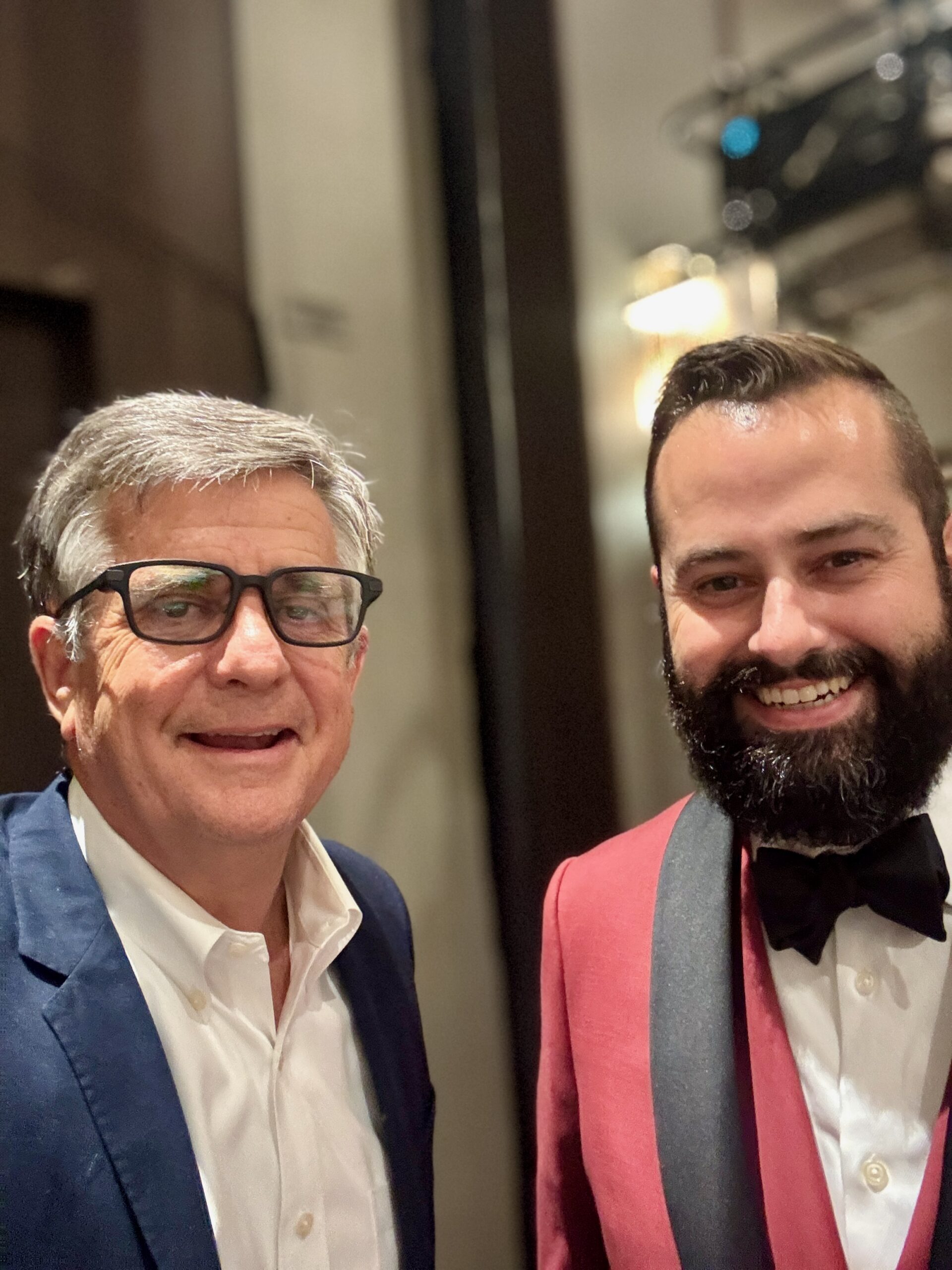 Your Humble Editor Tries AI Glasses
The glasses use AI to listen to the speaker’s voice and advance the text accordingly. As Jared speaks, the words scroll in front of him. If the system gets hung up, a ring on his finger doubles as a controller, allowing him to move the text forward or backward.
It sounded simple enough.
Then I put them on.
I fumbled through it terribly. In fact, I got a little dizzy.
Jared explained that the trick is to move your head naturally while keeping your eyes focused on the words.
Right.
Move my head, but don’t move my eyes.
After more than 30 years of public speaking, apparently I have finally discovered a technology capable of making me worse at it.
No way. It’s not for me. Give me the binder.
What Would Bill Hanley Think?
The whole experience made me think about Bill.
Bill Hanley was many things, but an early adopter of new technology was not one of them. I can only imagine what he would think if he could look down today and see an IES president standing on stage reading a speech generated through a tiny display inside a pair of AI-powered glasses while controlling it with a ring on his finger.
Actually, I don’t have to imagine very hard.
I think Bill would look at Jared’s glasses, look at the ring, shake his head and hand him a three-ring binder.
Then he would offer the same advice he gave me in 2002: “Stick to the script—and don’t screw it up.”
Read more: