







If You Can’t Explain It, It Won’t Be Used
At IES26 in Denver, Sam Koerbel delivered a powerful message about lighting design communication and what happens when it breaks down between specification and installation. The problem, Sam argued, isn’t necessarily that other members of the project team don’t value lighting. Often, they simply don’t understand the reasons behind the decisions lighting professionals make. His premise was simple: “If you can’t explain it, it won’t be used.”
Sam, founder of Lytei, presented Storytelling for Technical Credibility: How to Get Your Work Adopted. He explained how lighting professionals can translate technical expertise into language that owners, architects and contractors understand. More importantly, the message needs to be simple enough for others to repeat when the lighting designer is no longer in the room.
The Room After You Leave
Lighting professionals understand spectrum, optics, distribution, metrics, controls and performance. However, knowing the right answer doesn’t necessarily mean controlling the final decision.
Sam described this problem as the “translation gap.” People who change a lighting design often don’t have the same context as the person who created it. They may remember a number or specification without understanding why it was there.
“Correct is not the same as understood,” Sam said. “You can be completely right and still lose the outcome.”
Having spent 10 years as a lighting sales representative, Sam recalled sitting in job-site trailers where decisions were made without the lighting designer present. That experience shaped one of his strongest points: “This talk is about the room after you leave.”
The challenge, therefore, is making sure the people in that room understand enough about the lighting intent to protect it.
Cost Is the Language Everyone Speaks
Eventually, almost every project conversation reaches a language everyone understands: money.
Sam didn’t portray budgets or value engineering as the enemy. Costs, schedules and trade-offs are part of construction. The danger comes when cost is easy to understand, while the value of lighting is difficult to explain.
“It’s your job to speak that language just as fluently as you speak the technical language of lighting design,” he said.
Lighting can be especially vulnerable because its cost may represent a relatively small portion of the overall project. Yet even a small change can have an outsized impact on the finished environment.
“Substituting light rarely destroys a project,” Sam explained. “It just changes the experience.”
The building still opens, and people still occupy it. However, the space may become harsher, flatter, less comfortable or less adaptable. Occupants probably won’t say the lighting design intent was compromised. They’ll simply sense that something isn’t quite right.
Lighting Professionals Must Speak Two Languages
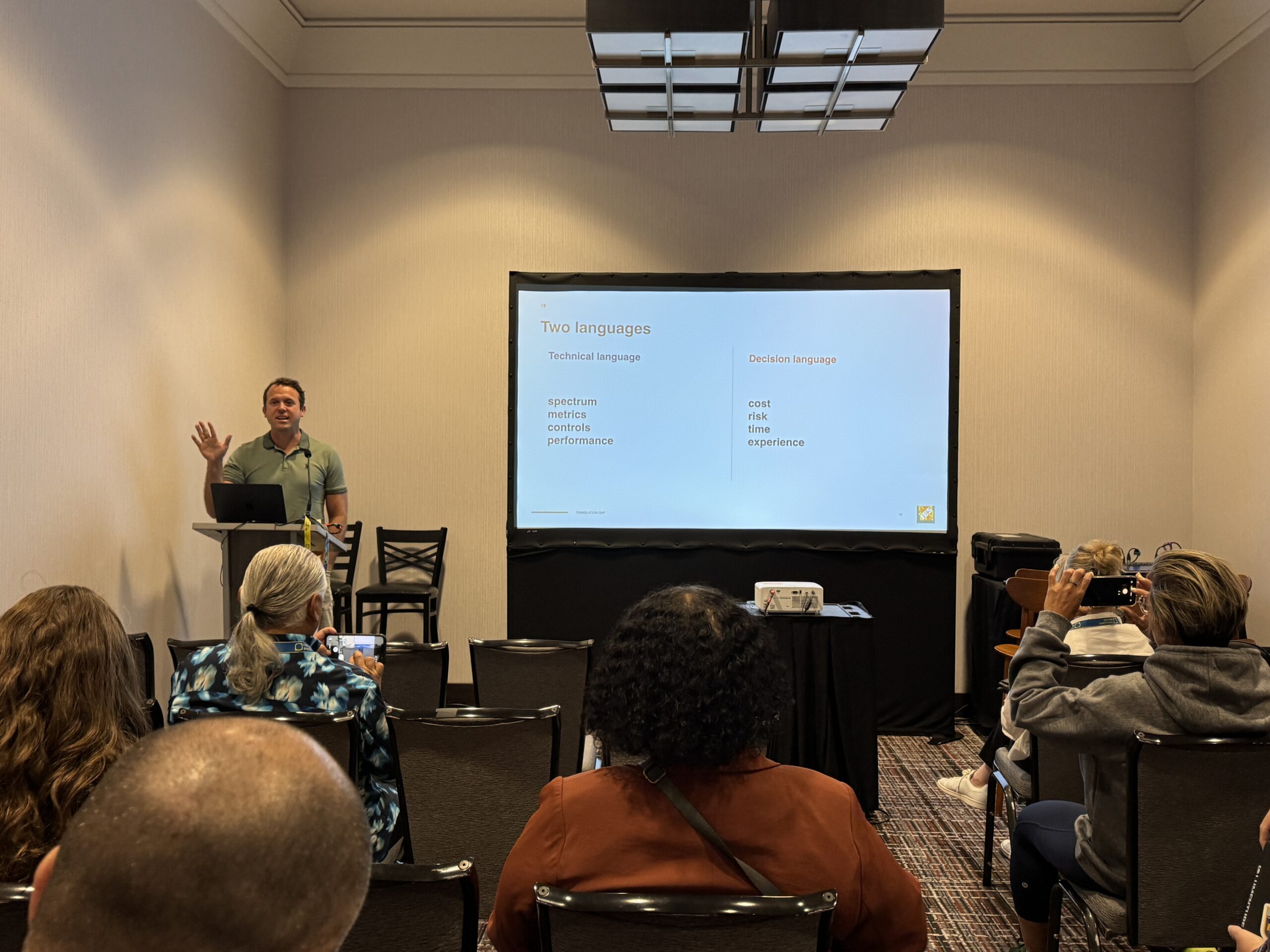
This led to the heart of Sam’s presentation. Lighting professionals need to speak two languages.
The first is technical: spectrum, metrics, controls and performance. The second is how project decision-makers think: cost, risk, time and experience. The answer isn’t to abandon technical language. Sam stressed that lighting will only become more technical. Instead, designers must build a bridge between the two languages.
“If cost is clear and value is vague, cost wins,” he said.
Likewise, when a substitution is simple to explain but the original design intent is complicated, the substitution has an advantage. Sam emphasized that translation isn’t about “dumbing down” lighting science. Instead, it’s about making its value understandable and usable.
Sam offered a practical framework for translating technical lighting information:
Why → What → Proof → So What → Now What
Start with Why. Before discussing a fixture, metric or control system, explain why the decision matters to the person using the space.
Then explain What you recommend and provide Proof through standards, metrics, calculations, mockups, research or experience.
Next comes So What. What happens if the recommendation is ignored? Will there be glare and will people struggle with a task? Will the atmosphere or functionality of the space change?
Finally, explain Now What. Tell the project team what should happen next. Also explain when they should return to the lighting designer before making a change.
Sam demonstrated the framework with both metrics and controls. Instead of simply specifying a light level, explain the task that level supports. Similarly, don’t present lighting controls only as a code requirement. Explain how the space needs to change throughout the day.
“Controls aren’t just compliance,” he said. “Compliance may be a requirement, but experience is always the reason.”
Making Lighting Design Intent Survive
Sam closed with three questions designers should ask themselves: Who has to repeat this? What gets simplified? What decision must this protect?
If an architect, contractor, project manager or rep must carry the designer’s message into another meeting, the explanation needs to survive in that person’s words.
“If they can’t repeat it, they can’t protect it.”
Sam even suggested adding a plain-language column to fixture schedules. Designers could use that space to explain why certain elements matter and identify those that should never change without revisiting the original design intent.
That may have been the most useful takeaway from the session. The lighting industry spends enormous energy improving metrics, standards, controls and technical knowledge. Sam’s argument wasn’t that lighting professionals should become less technical. Instead, they need to become better translators.
The people sitting in the room after the lighting designer leaves may genuinely want to protect the design. First, they have to understand what they’re protecting—and why it matters.