






58 Products Define the IES26 Progress Report
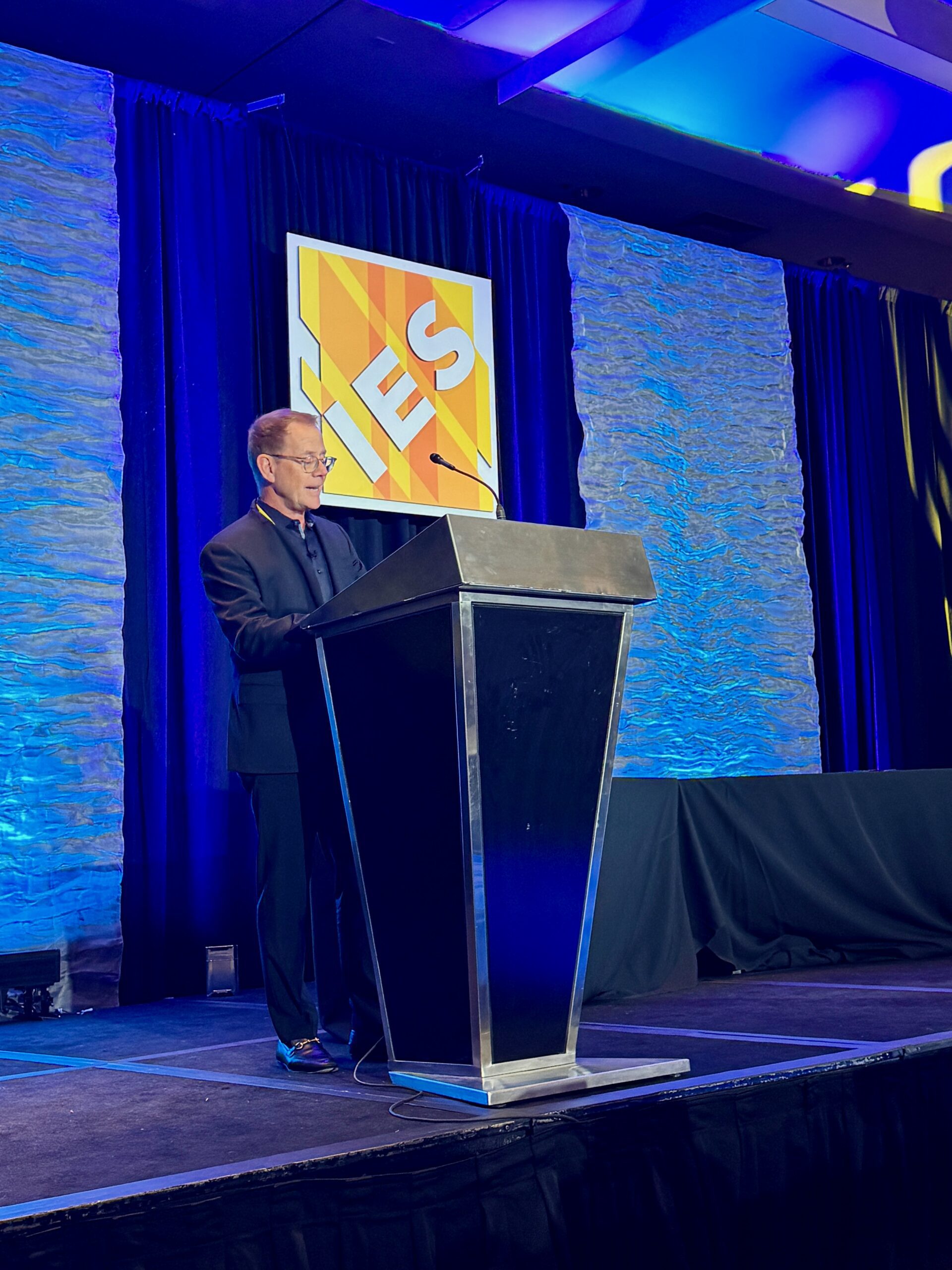
As I wrote in my previous article, the 2026 IES Progress Report was back on stage at IES26, and the audience clearly welcomed its return. But behind the humor and skits was the real purpose of the Progress Report: recognizing meaningful advances in lighting.
Progress Committee Chair Gregg Adams said this year, the committee recognized 58 products and publications. Rather than simply presenting them one after another, the committee organized the selections around eight industry trends. I thought this was a smart way to present the report because it offered a broader look at where lighting technology is heading.
Eight Trends in Lighting
The 58 selections fell into these eight trends:
- Intelligence Enters the Fixture — 6 products
- The Protocol-Agnostic Building — 7 products
- One SKU, Many Answers — 6 products
- Printing Light — 4 products
- Color You Can Dial — 7 products
- Lighting for the Human Body — 4 products
- Engineering the Envelope — 21 products
- The Knowledge Layer — 3 products
Engineering the Envelope was by far the largest category, accounting for 21 of the 58 selections. However, the other categories reveal how quickly lighting continues to expand beyond traditional luminaire performance. AI, controls, interoperability, field selectability, color and human-centric applications all had a presence in this year’s report.
Cooper Lighting Leads the Product Count
Cooper Lighting Solutions had the most recognized products, with eight. Acuity Brands followed with five. The Illuminating Engineering Society itself had four publications recognized.
The companies and organizations with multiple selections were:
- Cooper Lighting Solutions — 8
- Acuity Brands — 5
- Illuminating Engineering Society — 4
- ILLUMUS — 3
- LEDVANCE LLC — 3
- RAB Lighting — 3
- BubblyNet — 2
- Current — 2
- DMF Lighting — 2
- The Lighting Quotient — 2
Of course, quantity doesn’t necessarily tell us which products were the most innovative. Several individual products caught my attention for very different reasons.
Products That Caught My Attention
TAMAN — Urban Lighting Design Platform: This AI-powered platform calculates lighting needs and recommends fixtures. It earned a place in the Progress Report for bringing artificial intelligence directly into the lighting design process.
Acuity Brands — TLS ODP Twist-to-Lock Outdoor Sensor: This outdoor sensor provides remote functionality and can be programmed while powered or unpowered. The committee recognized its flexibility and the intelligence it brings directly to the fixture.
Acuity Brands — EAX Area Luminaires: The EAX family combines switchable CCT, adjustable lumen output and four field-selectable distributions. One luminaire can therefore address multiple applications while reducing the number of SKUs required.
Aleddra Lighting — LumiBé Table Lamp with BrainGuardian: The LumiBé takes emerging research related to rhythmic light and incorporates it into a real-world table lamp. The committee cited its novel approach to moving preliminary research toward a practical application.
DMF Lighting — True 1 Downlight: DMF’s True 1 was recognized as the industry’s first true 1-inch adjustable, low-UGR, high-lumen downlight. It packs significant performance into a remarkably small aperture.
The Lighting Quotient — Tambient ONA Task Luminaire: The committee described Tambient ONA as the industry’s first task-lighting solution with automatic circadian entrainment. It combines localized illumination with a human-centric lighting approach.
The Lighting Quotient — elliptipar S420: The S420 wallwash luminaire earned recognition for what the committee described as best-in-class output and adjustability.
GigaTera Lighting — SFC-RTS G4 Remote Aiming System: This system allows users to aim luminaires remotely. The committee recognized the remote aiming capability as unique within the industry.
LEDVANCE — High Temperature UFO High Bay: This new high bay offers three selectable CCTs and two selectable wattages. Perhaps more noteworthy is its ability to operate in temperatures up to 176°F (80°C), making it suitable for demanding high-temperature environments.
Progress Isn’t Limited to Products
Two IES publications also caught my attention, reminding us that progress in lighting isn’t limited to hardware.
IES — LP-30-26: Specifying Color Rendition: This new publication expands the framework surrounding TM-30 Annex E and provides additional guidance for specifying color rendition.
IES — RP-30-25: Lighting Museums: The updated recommended practice adds new content addressing lighting controls, along with expanded guidance on the design process, preservation and risk management.
Taken together, the 58 selections show just how broad the definition of progress has become. A new optical system or higher-performing luminaire can still represent meaningful progress. But so can AI-powered design software, remote aiming, smarter controls, greater field adjustability and new guidance on how lighting professionals specify and apply light.
That may be the most interesting takeaway from the 2026 IES Progress Report: progress in lighting is no longer happening just in the luminaire. It is happening in the controls, software, standards, specifications and intelligence surrounding it.
Read the complete list here:
Go Deeper: