






A new Signify patent lawsuit has landed in Delaware federal court, with an interesting role reversal. Signify is defending against an infringement claim.
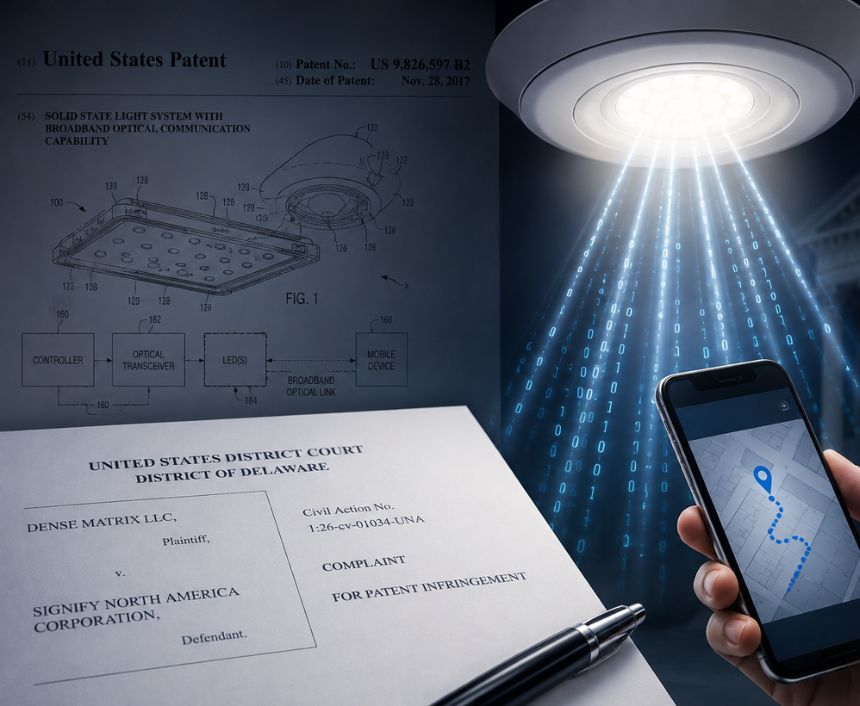
Dense Matrix LLC, a New Mexico-based company headquartered in Albuquerque, filed the lawsuit on 13 August, 2026. The case is in the U.S. District Court for the District of Delaware (Case No. 1:26-cv-01034-UNA).
Dense Matrix alleges that Signify infringes U.S. Patent No. 9,826,597, titled Solid State Light System with Broadband Optical Communication Capability. The patent was issued in November 2017 from an application filed in 2015.
Your humble editor has a bit of history with LiFi. In 2018, LumEfficient, a company I later sold in 2025, became the first company to exhibit LiFi at a major U.S. lighting trade show. I was so convinced LiFi was going to take over the world that I put my own money behind the technology. My enthusiasm greatly exceeded my forecasting skills. I lost my entire investment, a decision Mrs. Reid still occasionally—and quite unnecessarily—reminds me about.
Who Is Dense Matrix?
Dense Matrix was not one of the players in the early LiFi days. It appears to operate as a patent assertion entity (PAE) rather than a manufacturer of lighting or LiFi products. PatSnap describes the company as a PAE without a primary product or service offering. Instead, its patent portfolio appears to be its principal business asset.
This isn’t Dense Matrix’s first litigation involving the ‘597 patent. In August 2025, the company filed separate patent infringement lawsuits against LiFi companies pureLiFi and Oledcomm in the Eastern District of Texas.
Both cases ended without a court ruling on infringement. Dense Matrix voluntarily dismissed its case against pureLiFi with prejudice in March 2026. Its case against Oledcomm was later dismissed without prejudice before Oledcomm filed an answer.
That history makes the Signify case especially interesting. Signify has aggressively protected and monetized its own intellectual property over the years. Now, a patent assertion entity is accusing Signify of infringing technology related to connected lighting.
What the Signify Patent Lawsuit Accuses
The complaint targets Signify’s Interact Indoor Navigation platform and its Trulifi LiFi product line, including the Trulifi 6002 and 6800 series.
An accompanying claim chart explains how Dense Matrix believes the products infringe its patent. According to the filing, Trulifi-enabled luminaires use visible light communication (VLC) to transmit data at speeds up to 250 Mbps. The technology can be retrofitted or incorporated into Philips and Color Kinetics fixtures.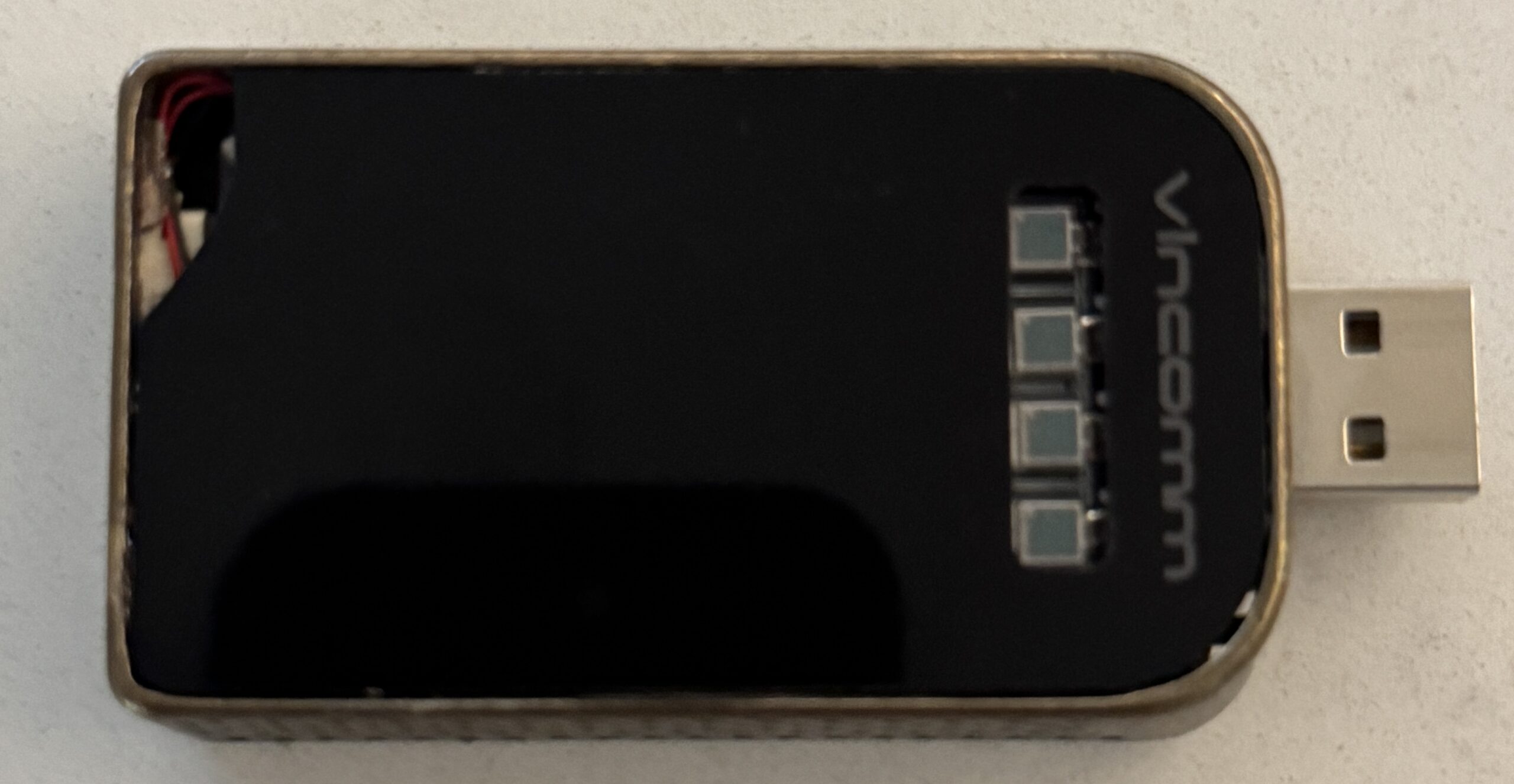
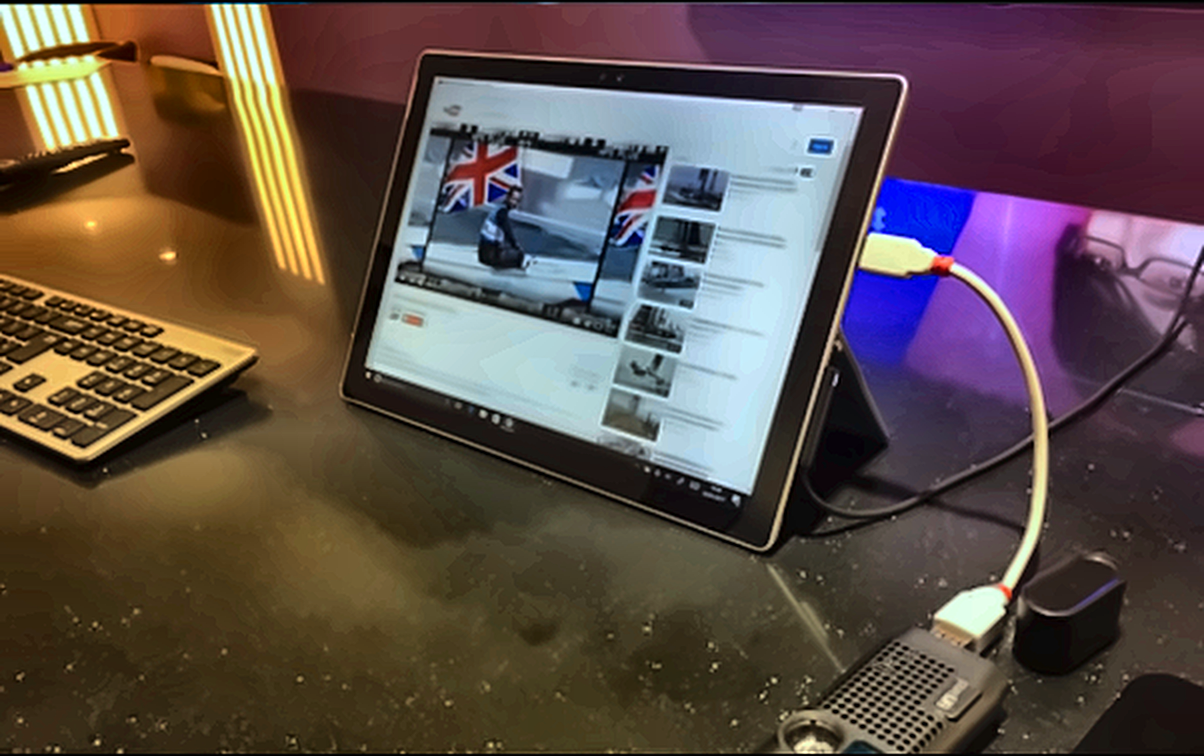
A USB Lumi stick from VLNcomm, 2019
The system also uses USB access keys, controllers and access points. According to the complaint, these technologies can support indoor positioning accurate to approximately 30 cm.
Dense Matrix argues that this architecture falls within claims of the ‘597 patent. Those claims cover LEDs coupled to a standard electrical connector, an optical transceiver and a controller. They also cover a mobile device receiving geographic position data through a broadband optical network.
Dense Matrix Claims Direct and Induced Infringement
The Signify patent lawsuit alleges both direct and induced infringement.
Dense Matrix claims Signify directly infringed the patent by making, using, selling and importing the accused products. For its induced infringement claim, Dense Matrix points to Signify’s own marketing materials.
Those materials include indoor navigation webpages, Trulifi product literature and press releases dating to 2019. Dense Matrix argues that Signify used these materials to direct customers to use the technology in a way that infringes the patent.
What Dense Matrix Is Seeking
Dense Matrix is asking the court to find that Signify infringed the ‘597 patent. It also seeks damages under 35 U.S.C. § 284, along with interest.
In addition, Dense Matrix wants the court to declare the case “exceptional” under § 285. Such a finding could allow Dense Matrix to recover attorneys’ fees. The company has also demanded a jury trial.
Brian E. Lutness of Silverman, McDonald & Friedman in Wilmington, Delaware, represents Dense Matrix. Isaac Rabicoff of Rabicoff Law LLC in Chicago is also representing the company.
Signify Has Not Yet Responded
The Signify patent lawsuit remains in its earliest stages. Signify has not yet filed a response, and the court has not issued a scheduling order as of this writing.
The case is noteworthy not only because of the technology involved, but also because of the parties’ positions. The lighting industry is accustomed to seeing Signify enforce its substantial patent portfolio against other companies.
This time, the patent enforcer finds itself on the other side of the table.
It’s also noteworthy because, if LiFi became a financially successful technology over the past decade, I somehow missed that story. Should Dense Matrix succeed in making money from LiFi patents, Mrs. Reid will undoubtedly remind me that there was money to be made in LiFi after all—I just wasn’t clever enough to find it.