







Waco Jury Slashes Damages Previously Awarded in LED Tube Patent Case
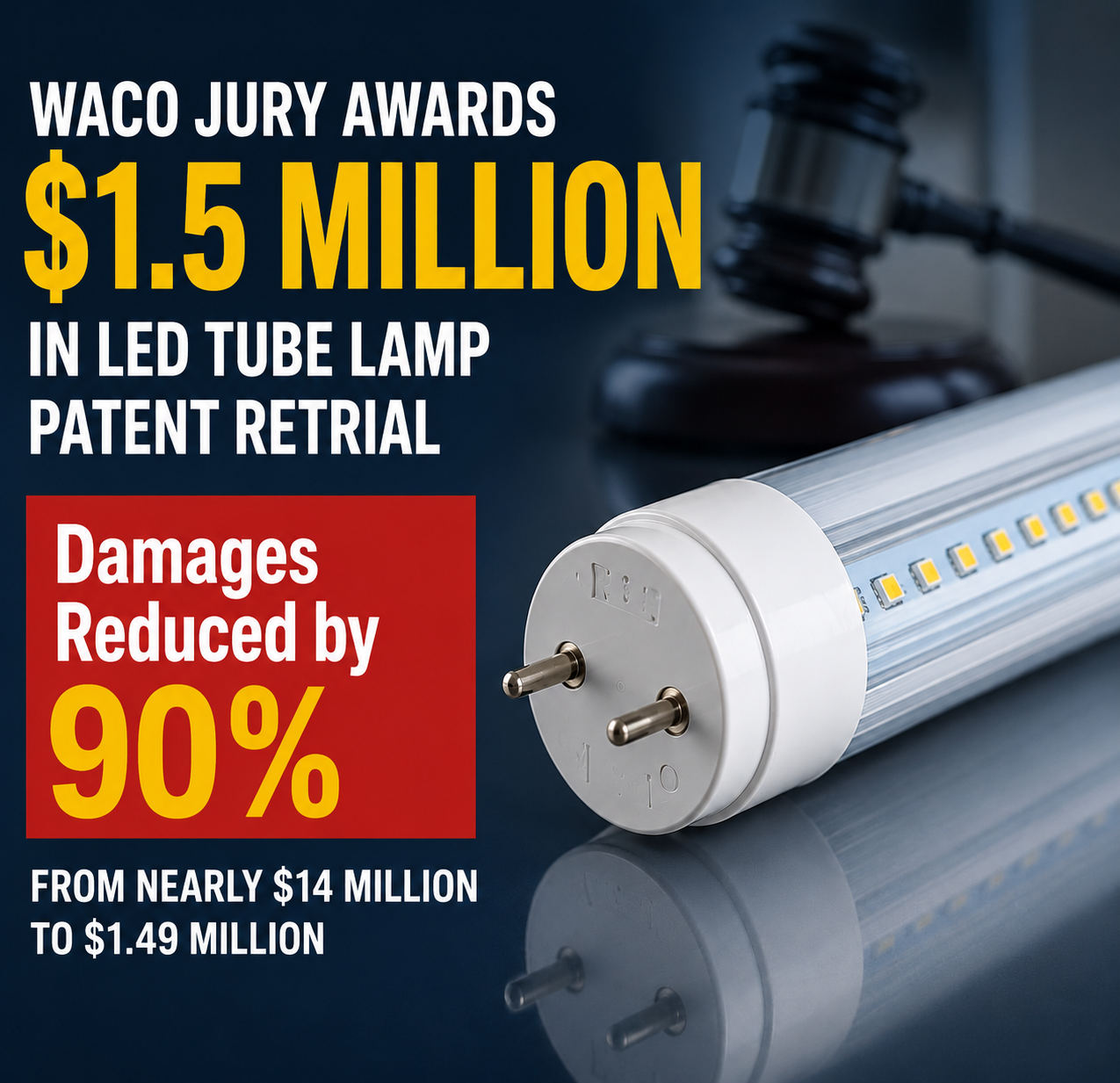
A federal jury in Waco, Texas, has awarded approximately $1.49 million in damages in one of the lighting industry’s longest-running patent disputes.
The jury found that CH Lighting Technology Co. and Shaoxing Ruising Lighting Co. owe $1,465,145.60 to Jiaxing Super Lighting Electric Appliance Co., Ltd. and Obert, Inc. The jury also awarded $27,369.64 against distributor Elliott Electric Supply. Together, the awards total about $1.49 million.
The new verdict is far smaller than the nearly $14 million awarded in 2021. The U.S. Court of Appeals for the Federal Circuit later vacated part of that judgment. The court then ordered a new trial on damages and additional issues involving two asserted patents.
A Case EdisonReport Has Followed Since 2020
EdisonReport has covered this litigation from the beginning, although your humble editor has never been a fan of LED Tubes!
In January 2020, Jiaxing Super Lighting and its North American affiliate, Obert, Inc., sued CH Lighting Technology, Shaoxing Ruising Lighting, and Elliott Electric Supply. The lawsuit alleged infringement of patents covering LED tube lamp technology.
Last year, we also reported on the Federal Circuit’s decision. The appellate court largely upheld the infringement finding for U.S. Patent No. 9,939,140. However, it vacated the damages award and sent the case back to the district court for additional proceedings.
Why Was There Another Trial?
This was not a second trial on infringement of the ‘140 patent.
Instead, the Federal Circuit sent the case back to Waco for a new trial to resolve two key issues: damages and the validity of two other patents.
While the appellate court affirmed that the ‘140 patent was valid and infringed, it vacated the original $14 million damages award because the valuation method didn’t meet strict apportionment standards. At the same time, the Federal Circuit ordered a retrial on whether two structural patents (‘125 and ‘540) were valid—an issue CH Lighting contested—since infringement for those two had already been established.
As a result, the new Waco trial focused on determining the proper damages for the ‘140 patent alongside these remaining validity questions. The resulting answer came in well below the original award.
Plaintiffs Challenge Trial Restrictions
The verdict may not end the case.
After the trial, Super Lighting filed a supplemental brief challenging several pretrial evidentiary rulings. The company argues those rulings prevented it from presenting important background information to the jury.
According to the filing, the court barred Super Lighting from discussing:
- The prior jury’s finding of willful infringement.
- Evidence of alleged copying.
- Pre-suit licensing negotiations.
- Evidence the company says showed intentional infringement.
Super Lighting also argues the restrictions became unfair during trial. According to the filing, CH Lighting portrayed itself as a company willing to negotiate and pay a reasonable royalty.
The plaintiffs contend they should have been allowed to respond. Specifically, they wanted to present evidence that CH allegedly ignored repeated licensing requests before the lawsuit began.
The filing also argues the jury should have heard evidence from the first trial regarding alleged copying and the earlier finding of willful infringement.
The district court will decide whether those arguments affect the final outcome.
Why the Lighting Industry Should Care
LED tube lamp patent cases are less common today than they were a decade ago. Even so, this lawsuit remains one of the industry’s most closely watched.
The case highlights several important lessons:
- Patent litigation can continue for years after the original verdict.
- Damages can change significantly after an appeal.
- Distributors can also face liability for selling accused products.
- Pretrial evidentiary rulings can shape what a jury ultimately hears.
For lighting manufacturers, importers, and distributors, this case is a reminder that patent litigation rarely ends with the first verdict. Appeals, retrials, and post-trial motions can reshape the outcome years later.