







IES26 Society Awards Celebrate a Lifetime of Contribution to Lighting
DENVER — Last night’s IES President’s Reception recognized more than the four Presidential Award recipients I covered earlier today. The Illuminating Engineering Society also presented its most prestigious Society awards. The honors recognized careers devoted to technical achievement, design, education and service.
This year’s recipients included Mark Lien, Leslie North, Shirley Coyle and Dr. Bob Davis. In addition, IES recognized Kevin Houser, who received the IES Medal in 2025 but could not attend last year’s ceremony.
What struck me was how little the recipients talked about their own accomplishments. Instead, they focused on mentors, colleagues, students and the importance of getting involved. In many ways, their remarks became less about receiving an award and more about giving back to the lighting community.
Your humble editor loved the common theme of humility.
 Mark Lien Receives Distinguished Service Award
Mark Lien received the IES Distinguished Service Award. IES established the honor in 1967 to recognize people who significantly advance the Society’s mission in nontechnical areas. Recipients must provide at least 15 years of dedicated service to IES.
In Mark’s case, that service spans nearly four decades. An IES member since 1988, he has served on the Board of Directors and chaired an IES committee for 34 years. Mark also helped establish the Sustainability Committee and participated in more than a dozen lighting-related committees.
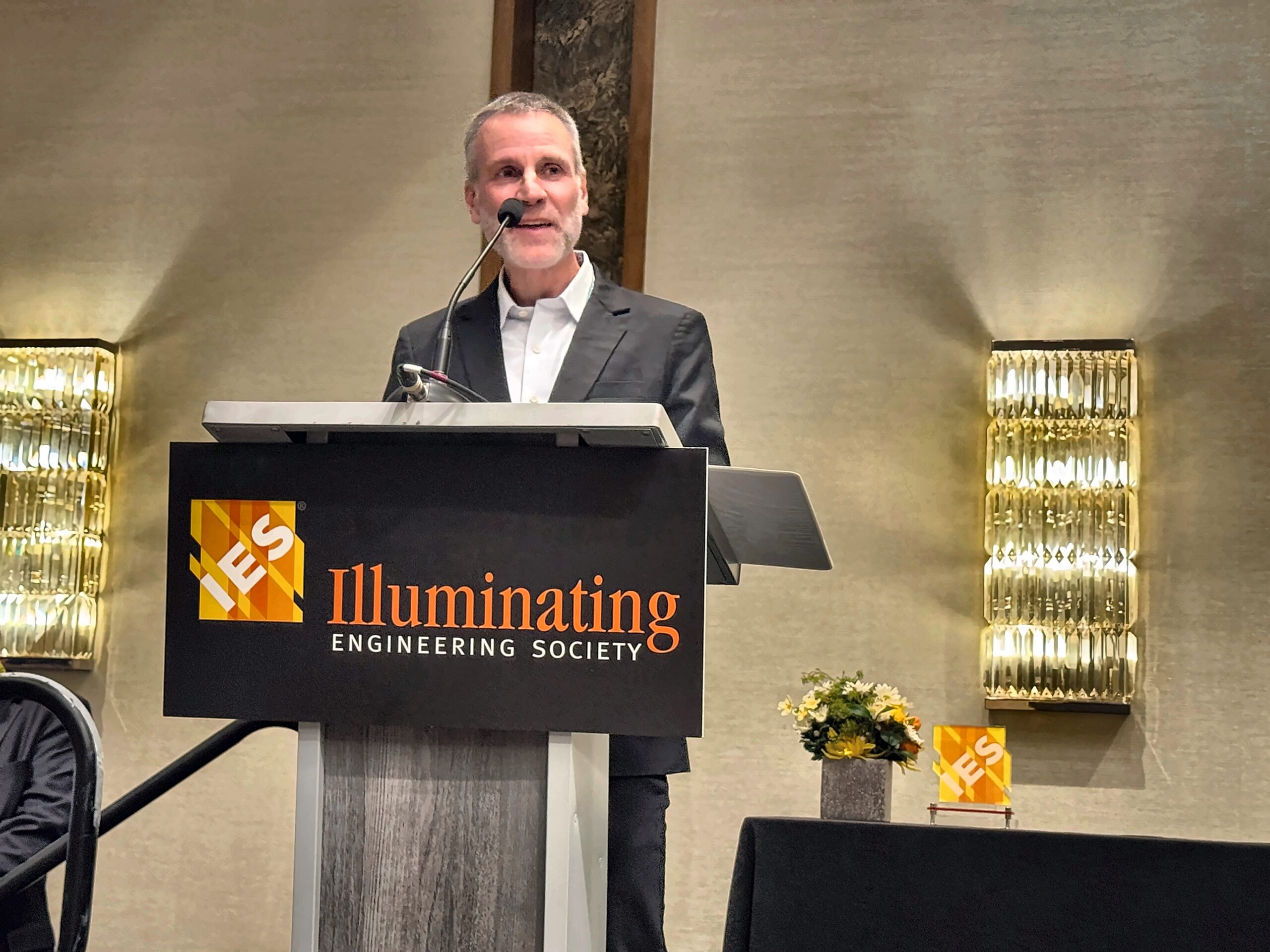
Many in the industry know Mark through his writing. His LD+A column has run for 20 years, while his lectures and webinars have attracted large audiences. Jared Smith praised his work as an educator, analyst and mentor who has elevated both the profession and the Society.
His acceptance remarks were characteristically brief. “I just find this industry to be infinitely interesting,” Mark said. “There is still a lot of mystery left to it.”
For someone who has spent decades studying lighting, the idea that there is still mystery left to discover seemed particularly appropriate.
 Leslie North: “The Rules Are Made by Those Who Show Up”
 Leslie North: “The Rules Are Made by Those Who Show Up”
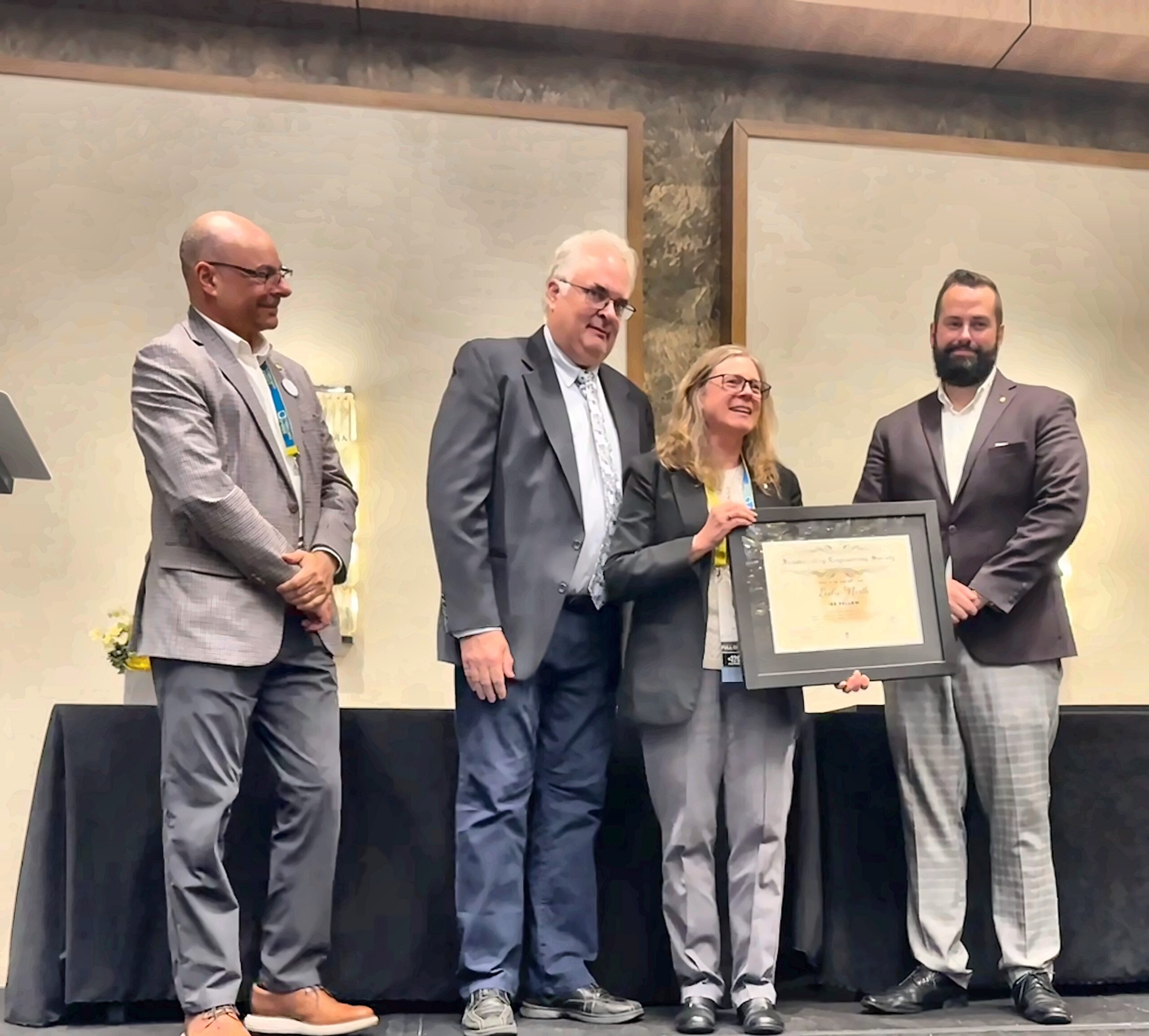
Ron Gibbons introduced Leslie North, who became an IES Fellow for her contributions to lighting design during a career spanning approximately 40 years. Her work combines the technical and aesthetic sides of illumination. IES also highlighted her leadership in creating healthcare environments that support patients and caregivers.
Leslie delivered one of the evening’s strongest messages about IES involvement. As she reflected on her career and the people who helped shape it, a touch of emotion came through in her voice.
“There’s an old saying that the rules are made by those who show up,” she said, before making her point even clearer: “Get your butts there.”
Her own involvement began when she was what IES would now call an Emerging Professional. At the time, Leslie didn’t believe she had much to contribute. She simply started showing up. She attended committees that interested her, listened to the discussions and learned from the people around her.
Over time, listening led to participation, and participation created opportunities that helped shape her career. “As it turns out, opportunities arise for those who show up,” Leslie said.
Her remarks then became more personal. With some emotion in her voice, Leslie reflected on just how much those years of involvement had given her. She said the trajectory of her life was “vastly richer” because of IES and thanked the mentors, colleagues, “fellow warriors” and friends she met along the way.
She closed by reminding the audience that the work continues. “There is still more to do,” Leslie said. “Do it.”
Shirley Coyle Receives Louis B. Marks Award
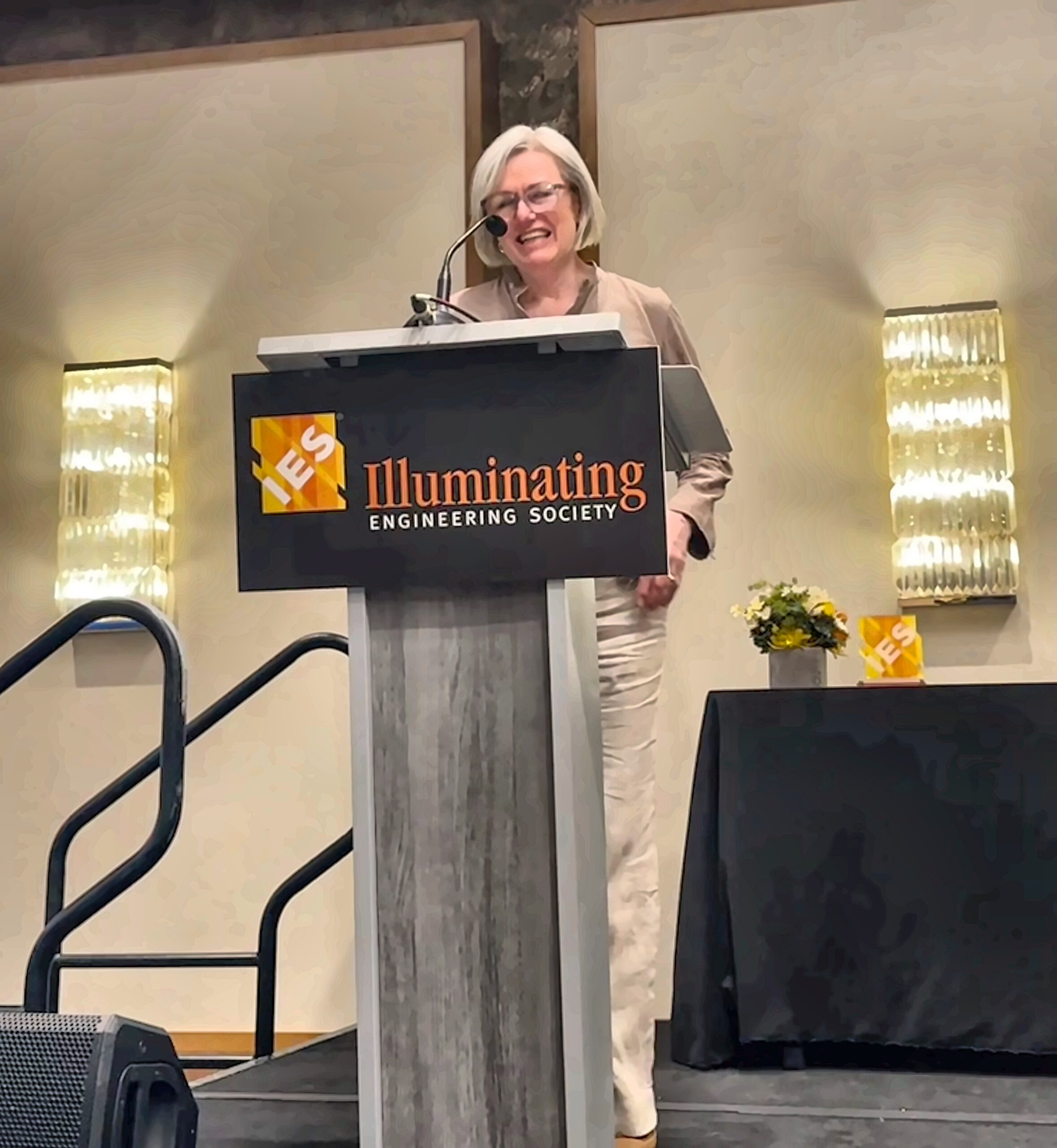 Shirley Coyle Receives Louis B. Marks Award
One of the Society’s highest honors, the Louis B. Marks Award, went to Shirley Coyle. Named for the first president of IES, the award recognizes exceptional nontechnical service.
Shirley has devoted roughly four decades to the Society. Her service includes leadership within the Toronto Section, seven years on the IES Board of Directors and a term as IES President. She has also contributed to business strategy, operations, standards, education and international relationships.
During her acceptance remarks, Shirley described IES with a phrase I particularly liked: “IES is a wonderful ‘choose your own adventure’ kind of experience.”
That opportunity, she explained, may not seem obvious when someone attends a first conference or local section meeting. However, involvement can lead in directions a young professional never anticipated.
Shirley credited the Toronto Section as her home within IES and spoke warmly about the friendships she has developed throughout her career. She also encouraged others to continue volunteering because the Society still has plenty of work ahead.
“There is still so much to be done,” Shirley said. “Thanks for all you’re doing, and keep doing it.”
Bob Davis Receives the IES Medal
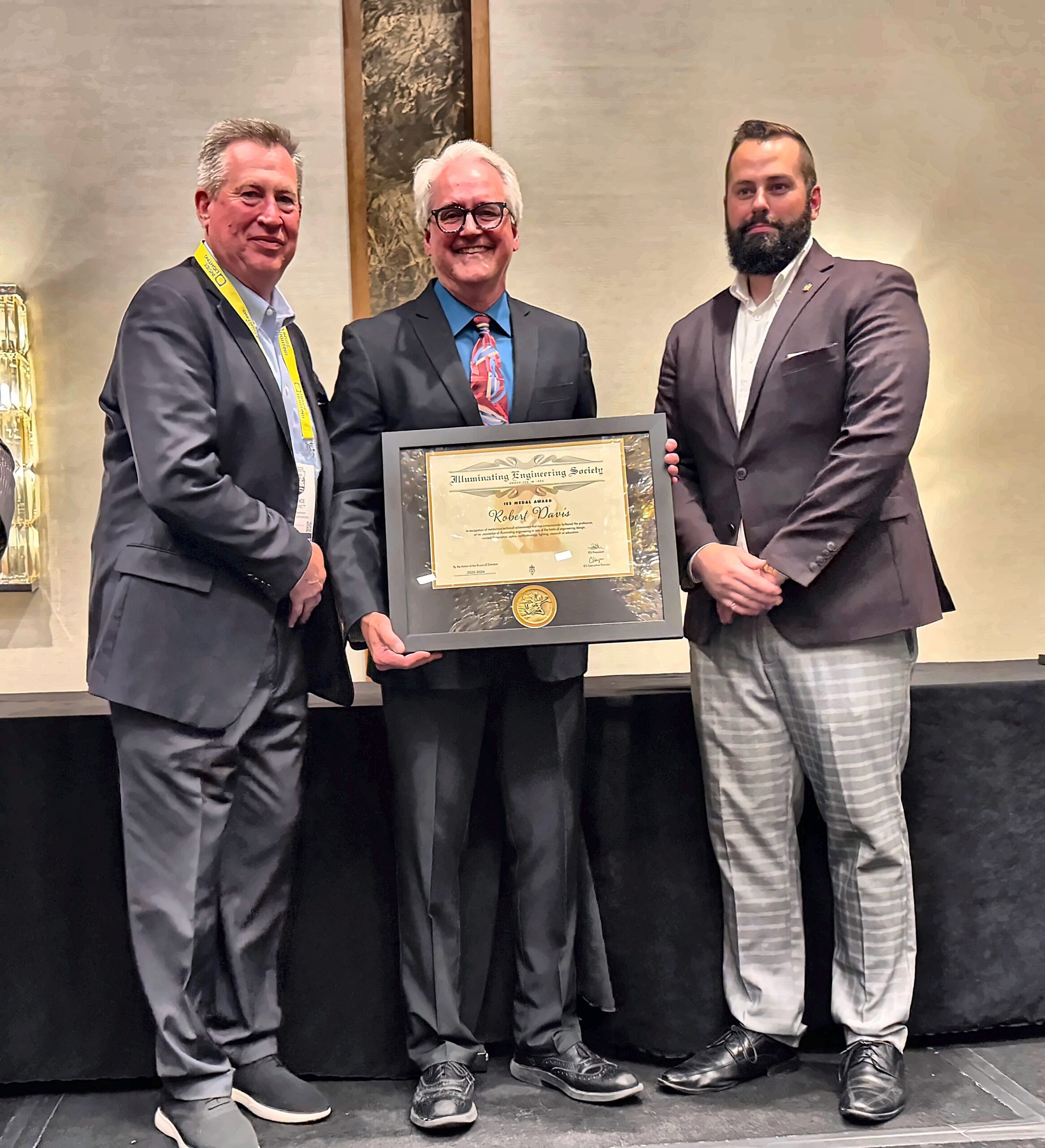 Bob Davis Receives the IES Medal
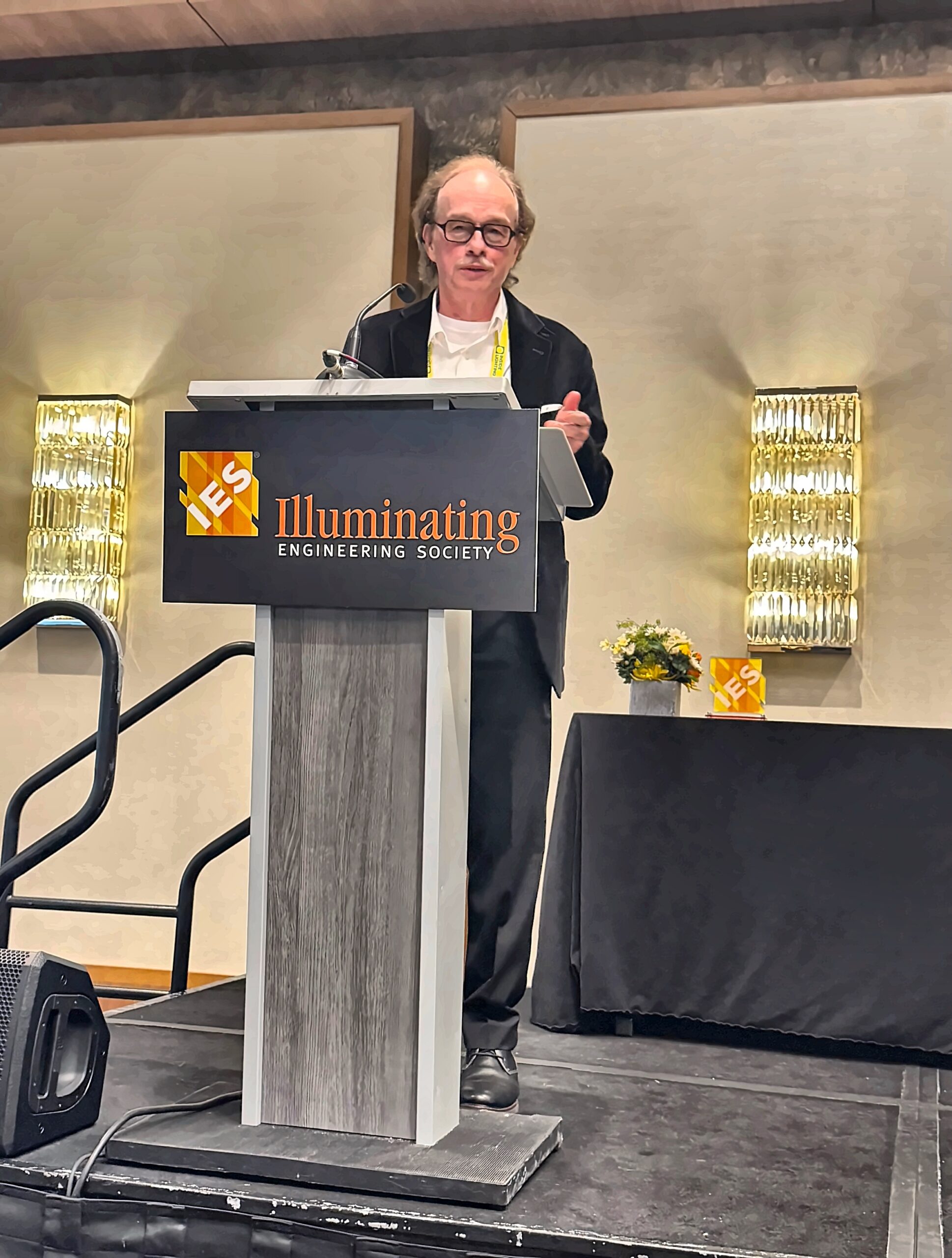
The evening’s highest technical recognition went to Dr. Bob Davis, recipient of the IES Medal. First presented in 1944, the medal honors technical achievement that has significantly advanced illuminating engineering. Its list of previous recipients reads like a history of the lighting profession.
IES honored Bob not only for his research but also for his impact as an educator and mentor. Across four teaching appointments, he has taught more than 75 courses to over 2,000 students. Many of those students now hold leadership positions in design firms and research organizations.
Rather than focus on those accomplishments, Bob used much of his speech to recognize the IES Medal recipients who helped shape his career.
His introduction to architectural lighting came in 1980 at Penn State through a class taught by John Flynn, an IES Medal recipient and Past President. Then, at Bob’s first IES conference in 1984, he began a relationship with David DiLaura. For the next 12 to 15 years, David regularly spent time with Bob at IES conferences discussing lighting and life.
At that same 1984 conference, Bob met Naomi Miller. The two later worked together at the Lighting Research Center, where Bob also credited Dr. Mark Rea for his influence and leadership during those formative years. Bob and Naomi later continued their work at Pacific Northwest National Laboratory. Their careers became so intertwined that, fittingly, they eventually shared a retirement party.
“Who Do I Want to Be When I Grow Up?”
Bob then told a story that had little to do with lighting but a great deal to do with careers.
While considering a job change in his 40s, a friend asked what he wanted to do next. Should he teach, conduct research, work in engineering, develop products or move into management?
She finally told him, “As you figure out what you want to do when you grow up, give me a call.”
The comment made Bob realize he had been asking himself the wrong question. Instead of “What do I want to do when I grow up?”, he began asking, “Who do I want to be when I grow up?”
That distinction allowed him to stop defining himself by a particular job title. He could teach, research or manage while still focusing on the kind of person he wanted to become.
Almost a decade ago, Bob considered retiring early. Then a message at his church about vocation caused him to reconsider. The pastor asked how people could use their vocation to contribute to society and build up those around them.
When Bob heard the word “society,” his mind immediately went to the Illuminating Engineering Society.
“Maybe I could still do something,” he recalled.
That decision helped lead to additional education efforts, including outreach to Tennessee State University in Nashville. Bob ended by challenging others to consider how their own work can build up the people around them and strengthen both IES and society at large.
Kevin Houser Finally Gets His Moment
The evening also included some unfinished business. Kevin Houser received the IES Medal in 2025 but could not attend last year’s ceremony, so Lance Bennett brought him to the stage this year.
Kevin has produced more than 60 peer-reviewed journal articles, more than 100 additional publications and five patents. Yet, like the other honorees, he spent much of his remarks talking about other people, particularly his students.
He also issued a direct invitation to Emerging Professionals: Don’t wait until you feel like an expert to get involved.
Kevin encouraged them to join a committee, contribute to a standard, help organize an event or simply raise their hand for something that interests them. In return, he said, they can gain knowledge, perspective, opportunities and friendships.
His remarks then turned to an important issue for an industry navigating complex questions about light and health. Kevin argued that IES needs people willing to challenge assumptions, ask difficult questions and seek evidence. However, the profession must also show restraint when evidence remains incomplete.
That requires distinguishing among what we know, what we think we know and what we simply don’t know yet.
“How much light do we need to feel safe?” Kevin asked. “What lighting conditions best support our health?”
Sometimes the most responsible answer, he explained, is: “That’s an important question, but we don’t yet really know the answer.”
Kevin emphasized that acknowledging uncertainty does not represent weakness. Instead, he called it part of “good science, sound engineering and responsible design.”
The Common Thread
On paper, these awards recognize very different accomplishments. Mark earned recognition for decades of service, while IES elevated Leslie to Fellow for her contributions to lighting design. Shirley received one of the Society’s highest service honors, and Bob earned its highest technical recognition. Kevin returned this year to receive the recognition he missed in 2025.
Yet their acceptance remarks shared a remarkably similar message. Each spoke about mentors, colleagues or students who influenced a career. They also encouraged younger professionals to get involved and contribute.
Most importantly, the recipients described IES as more than a professional organization. They talked about a community that gave them opportunities, challenged their thinking and helped shape their careers.
Kevin may have summarized the evening best when he described what IES has given him: “A professional home—a place to learn, to contribute, to question, to grow and to belong.”
For an awards ceremony honoring some of the Society’s most accomplished members, there was surprisingly little emphasis on individual accomplishment. Instead, the recipients focused on the people who helped them get there and their responsibility to help those coming next.