







Inside the ETI-Signify Markman Hearing
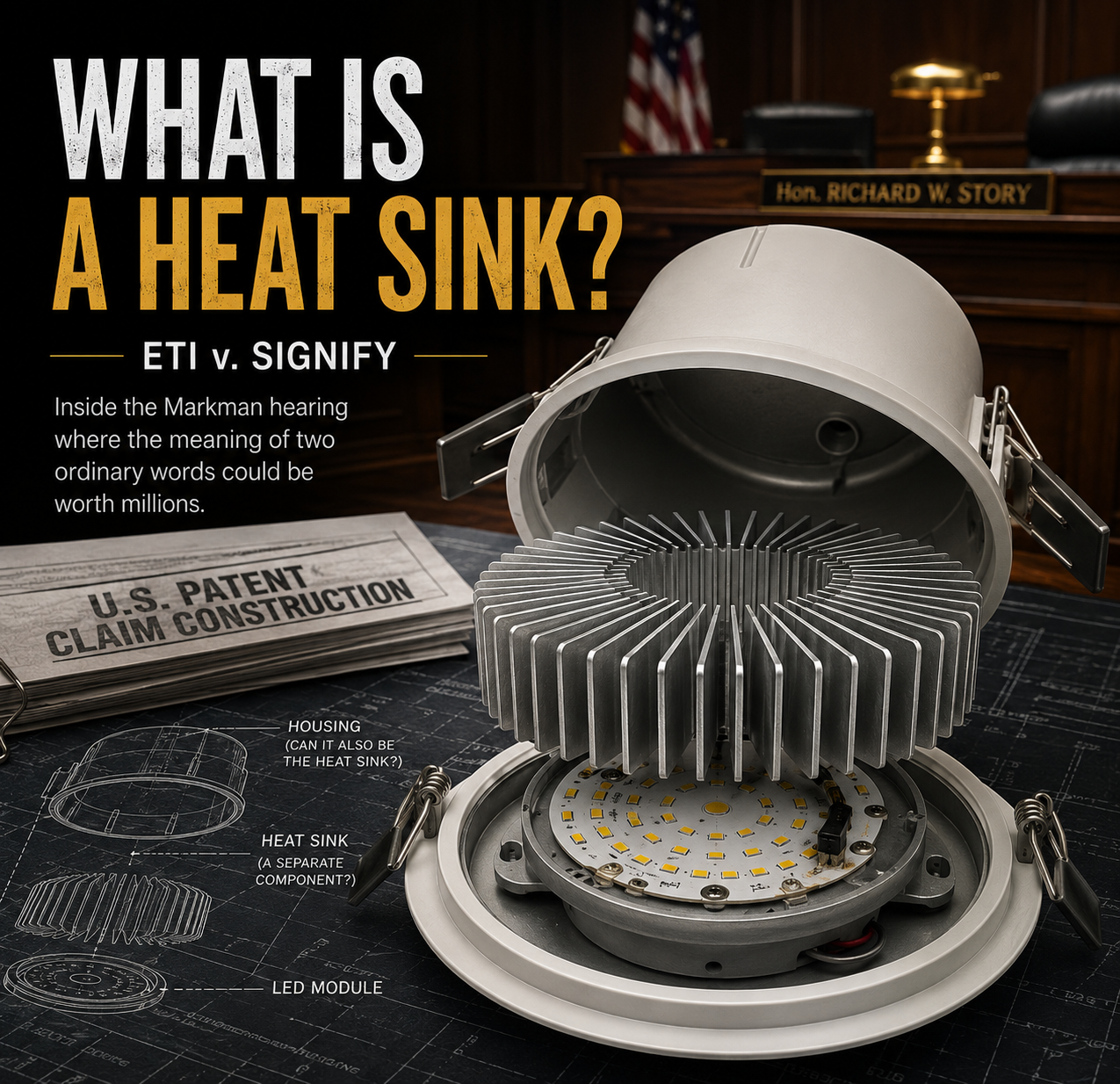
A day in federal court at the ETI-Signify Markman Hearing showed how a major lighting patent fight can come down to surprisingly basic questions: What is a heat sink? Can a housing be a heat sink? And what does it mean for two components to be “coupled”?
Last week, I spent a day in federal court in Gainesville, Georgia, attending the Markman hearing in Signify North America Corporation and Signify Holding B.V. v. ETI Solid State Lighting, Inc.
U.S. District Judge Richard W. Story presided over the hearing.
ETI was represented by Coby Nixon, Matthew Kavanaugh and David Cupar. Signify was represented by Adam Swain, Ravi Shah and Joshua Weeks. The federal docket also confirms Cupar’s representation of ETI.
I went into the courtroom expecting a complicated patent proceeding. I got one. But what surprised me was how much of the day revolved around terminology that we use every day. Heat sink. Housing. Downlight module. CCT switch. Edison screw-in plug. Those seemingly ordinary words could have an enormous impact on this case.
First, What Is a Markman Hearing?
It is Markman, not Marksman.
The name comes from the landmark patent case Markman v. Westview Instruments, Inc. The U.S. Supreme Court ruled in 1996 that interpreting the language of a patent claim is a matter of law for the judge rather than a question of fact for the jury.
Think of it as determining the rules of the game before deciding who won.
A patent contains claims that define the boundaries of the invention. When the parties disagree about what particular words in those claims mean, the judge determines their meaning.
Later, those definitions can become critical in deciding whether an accused product infringes the patent.
That is what Judge Story was being asked to do in Gainesville.
My notes identified 12 disputed claim terms across nine Signify U.S. patents and one ETI patent, including “heat sink,” “housing being coupled to heat sink,” “heat sink and housing are integrally formed,” “Edison screw-in plug,” “downlight module,” “at least one switch disposed on the housing” and “linking device.”
This Is Much Bigger Than One Heat Sink
The Markman hearing makes more sense when viewed against the size of the underlying lawsuit.
Signify filed the case on 2 MAY 2025 in the U.S. District Court for the Northern District of Georgia. The docket identifies the case as 2:25-cv-00121, with Judge Story presiding.
Signify alleges that ETI infringes nine U.S. patents covering several different aspects of LED lighting technology.
Three involve LED recessed light fixtures. Others cover configurable lighting, including selectable characteristics; wall-pack construction; thermally separated luminaire compartments; and LED power electronics.
The accused ETI products identified in the complaint include the Color Preference Downlight, LED Spin Light, Outdoor Wall Pack Light, VersaPak Adjustable Wall Pack, Adjustable LED Under Cabinet Light and 4 FT EL Install Wrap Light.
Signify also alleges willful infringement. According to the complaint, the companies’ discussions date back approximately a decade. Signify alleges that ETI was made aware of parts of its patent portfolio as early as 2015 and later received specific infringement notices in 2021 and 2023. Those are Signify’s allegations; ETI disputes the infringement case.
So there is a lot riding on how Judge Story defines the disputed language.
The Star of the Hearing: The Heat Sink
If I had to identify one recurring theme from the hearing, it would be the humble heat sink.
Anyone who has worked around LED lighting knows what a heat sink is—or at least thinks they do. After sitting through this hearing, I’m not sure patent lawyers would allow us to be quite so confident.
ETI argued for a relatively narrow understanding of the term. Its position was that a heat sink is a distinct component designed to draw heat away from the LED. Signify argued that “heat sink” is well understood by a person of ordinary skill in the field and does not need a special construction and should receive its plain and ordinary meaning.
That sounds like a small distinction. It isn’t.
Can the Housing Also Be the Heat Sink?
This became one of the most interesting exchanges of the day. ETI’s Cupar argued that Signify’s own patent language identifies the housing and heat sink as different components. The patents describe a housing being “coupled” to a heat sink.
Cupar’s argument was essentially this: If the housing is the heat sink, what is being coupled to what?
Judge Story asked whether the housing itself could be a heat sink.
Cupar said no and pointed to language describing a reflector housing connected to a heat sink. His emphasis was on the word connected. If two things are connected or coupled, ETI argues, there must be two things.
At one point, Judge Story acknowledged that Cupar was making a good argument. That was one of those moments when I sat up and paid particular attention.
Signify, however, had an answer.
Its position was that patent claims can describe different functions or elements without necessarily requiring two physically separate pieces. Signify’s Weeks cited precedent and a dependent patent claim involving a single formed component to support the proposition that one physical component can satisfy claim language describing multiple elements.
That leaves Judge Story with a deceptively difficult question: Can one piece of a luminaire legally be both the housing and the heat sink?
ETI Says Its Products Don’t Have Heat Sinks
Then Cupar made what, to me, was one of the boldest statements of the hearing. He maintained that ETI’s products do not have heat sinks.
I have spent many decades in the lighting industry, and that certainly caught my attention. My immediate reaction was that LEDs generate heat and that heat has to go somewhere.
But ETI’s legal argument is more precise than simply saying its products don’t dissipate heat. ETI appears to be arguing that its products don’t contain the separate, purpose-built component required by its proposed construction of the patent claims.
At one point, ETI’s proposed definition described a heat sink as a “distinct, purpose-built, heat-dissipating component—not a housing or other structural element that merely conducts heat incidentally.”
Signify strongly disagreed.
Weeks cited expert Michael Gertz for the position that a person of ordinary skill in the field would understand a heat sink to mean an element that draws heat away from an LED.
The original complaint helps explain why this argument matters.
For example, Signify’s ‘978 patent describes a downlight module containing a heat sink, LED, driver and adapter with an Edison-based connector. Signify alleges that ETI’s Color Preference Downlight contains the claimed elements.
If ETI convinces Judge Story that the patent requires a distinct heat-sink component, that construction could become very important when Signify attempts to map its patent claims onto ETI’s products.
A CCT Discussion That Made Me Cringe
The hearing wasn’t all about heat. Another disputed phrase was “at least one switch disposed on the housing.” This involves something nearly everyone in today’s lighting industry recognizes: field-selectable CCT lighting.
ETI argues that the switch on the accused product isn’t located on the housing but in the driver box. Signify argues that the language does not require the additional construction ETI proposes.
The original complaint shows why CCT selectable lighting is at issue in this case. Signify’s ‘682 patent covers a configurable lighting system involving a multi-position switch and control components. Its ‘588 patent involves luminaires capable of providing selected color temperature, lumen output or photometric distribution.
During the discussion, ETI’s Kavanaugh attempted to explain CCT to the court. He described warm white as an orange-brownish light and contrasted it with the brighter light one might associate with a hospital. Then he turned to Cupar and essentially asked whether he had gotten it right.
Your humble editor cringed.
Those of us in lighting know that higher CCT does not inherently mean “brighter.” And warm white isn’t quite the same thing as orange-brown.
It was also a reminder of the challenge facing the attorneys and the judge. They aren’t simply arguing law. They have to translate lighting technology into language that can withstand the precision demanded by patent litigation.
What Exactly Is a Downlight Module?
After lunch, another familiar lighting term went under the microscope: “Downlight module.” ETI argued that the term limits the patent claim and proposed that it mean a housing containing LED lights that projects light downward.
Signify argued that “downlight module” appears in the claim’s preamble and is not limiting. If the court decides otherwise, Signify maintains that the term should receive its plain and ordinary meaning.
Again, this may sound like lawyers arguing over words.
But the ‘978, ‘253 and ‘321 patents at issue all concern LED recessed-light technology. The complaint describes various combinations of heat sinks, LEDs, drivers, Edison-base adapters and, in the ‘321 patent, LEDs producing different color temperatures. In the Complaint filed by Signify, the accused ETI products appear to be downlights.
Whether something legally qualifies as a “downlight module” matters, but whether it makes any meaningful difference to Signify’s infringement claims remains to be seen.
Thermally Separated Isn’t the Same as Physically Separated
Another discussion involved the phrase: “First internal component thermally separated from the second internal component.”
This relates to the ‘703 patent, which Signify describes as covering devices with thermally separate compartments in a luminaire. The important distinction is between physical separation and thermal separation.
ETI argued that the patent requires thermal separation, not merely putting components in different physical locations. The discussion focused on whether there is a barrier that actually reduces heat transfer.
For a lighting engineer, that distinction makes sense. For a patent court, Judge Story now has to decide exactly what the words require.
Some Arguments Appeared to Land Better Than Others
A courtroom observer has to be careful about predicting a judge’s eventual ruling based on questions or comments during oral argument.
Still, there were moments when Judge Story gave some indication of what he was thinking.
On the dispute over an “Edison screw-in plug,” my impression was that ETI was having a tougher time. My notes reflect that the judge said he did understand ETI’s point but was not inclined to agree, while also making clear that he could change his mind.
On the question of two components being “coupled,” ETI’s argument seemed to get more traction.
And on the disputed “linking device” language from one of ETI’s patents, my impression from the hearing was that ETI may have had the stronger argument. My notes simply say, “ETI seems to have won on the linking device.”
Let me emphasize: those are my observations from sitting in the courtroom. They are not rulings.
Judge Story’s written claim-construction order will tell us what actually won.
“I Am the Guy in the Room Who Knows the Least”
Judge Story set an interesting tone early in the proceeding. According to my notes, he told the attorneys:
“I am the guy in the room who knows the least.”
He said he marveled at patent attorneys because of how much they have to know, and he encouraged the parties to find ways to resolve disagreements without requiring him to decide every issue.
I didn’t interpret that as a judge who wasn’t engaged. Quite the opposite.
Throughout the hearing, he asked practical questions that frequently stripped away layers of patent terminology and got directly to the underlying issue.
Toward the end, he put it succinctly:
“These are big ideas. Let’s focus. What are the real issues of the case?”
Then Things Got a Little Testy
Toward the end of the day, the conversation moved from claim construction into discovery.
Weeks told the court that Signify was having difficulty obtaining information about certain ETI products. According to my notes, Signify’s frustration was that ETI had responded to some inquiries by saying it didn’t manufacture or design the products and pointing toward other parties, including people in China.
Cupar pushed back strongly.
He argued that the necessary information was available and questioned why Signify was pursuing people in China when relevant people were available in Georgia.
Then he returned to the central argument of the day:
“They want to see a magic document that shows a heat sink. They won’t get it because heat sinks do not exist in our products.”
Judge Story’s message to both sides was straightforward:
“Just do it. Be professional. Don’t hide the ball.”
What Happens Next
Judge Story allowed the parties two weeks to submit supplemental information on issues they believe require further consideration. He also encouraged them to narrow the number of products and issues in dispute.
Then comes the important part: claim construction. Judge Story will determine what these disputed patent terms mean.
Those decisions could materially alter the litigation’s trajectory.
A broader construction of terms such as “heat sink” could help Signify as it attempts to show that ETI products fall within the asserted patent claims. A narrower construction requiring, for example, a separate and purpose-built heat sink could strengthen ETI’s non-infringement arguments.
But claim construction is not the same thing as deciding infringement, and a favorable construction on one term doesn’t necessarily determine the outcome of the case. Under Markman, the judge defines the patent language; questions of infringement can then be decided using those definitions.
Two Words Worth Millions?
I walked out of the courthouse thinking about just how unusual patent litigation can be.
Signify’s complaint is 116 pages. Nine patents are asserted. The technology ranges from recessed LED modules and selectable color temperature to wall packs, thermal management and power electronics.
There are highly experienced patent attorneys on both sides.
Yet much of the hearing kept returning to a question that could be asked in almost any lighting company’s engineering department: What is a heat sink?
ETI says the term should describe a distinct, purpose-built component. Signify says the term should receive its ordinary meaning and should not be artificially narrowed.
Judge Story now has to decide.
And depending on how he defines those two very ordinary words, the direction of this very complicated patent case could change considerably.
Go Deeper: