






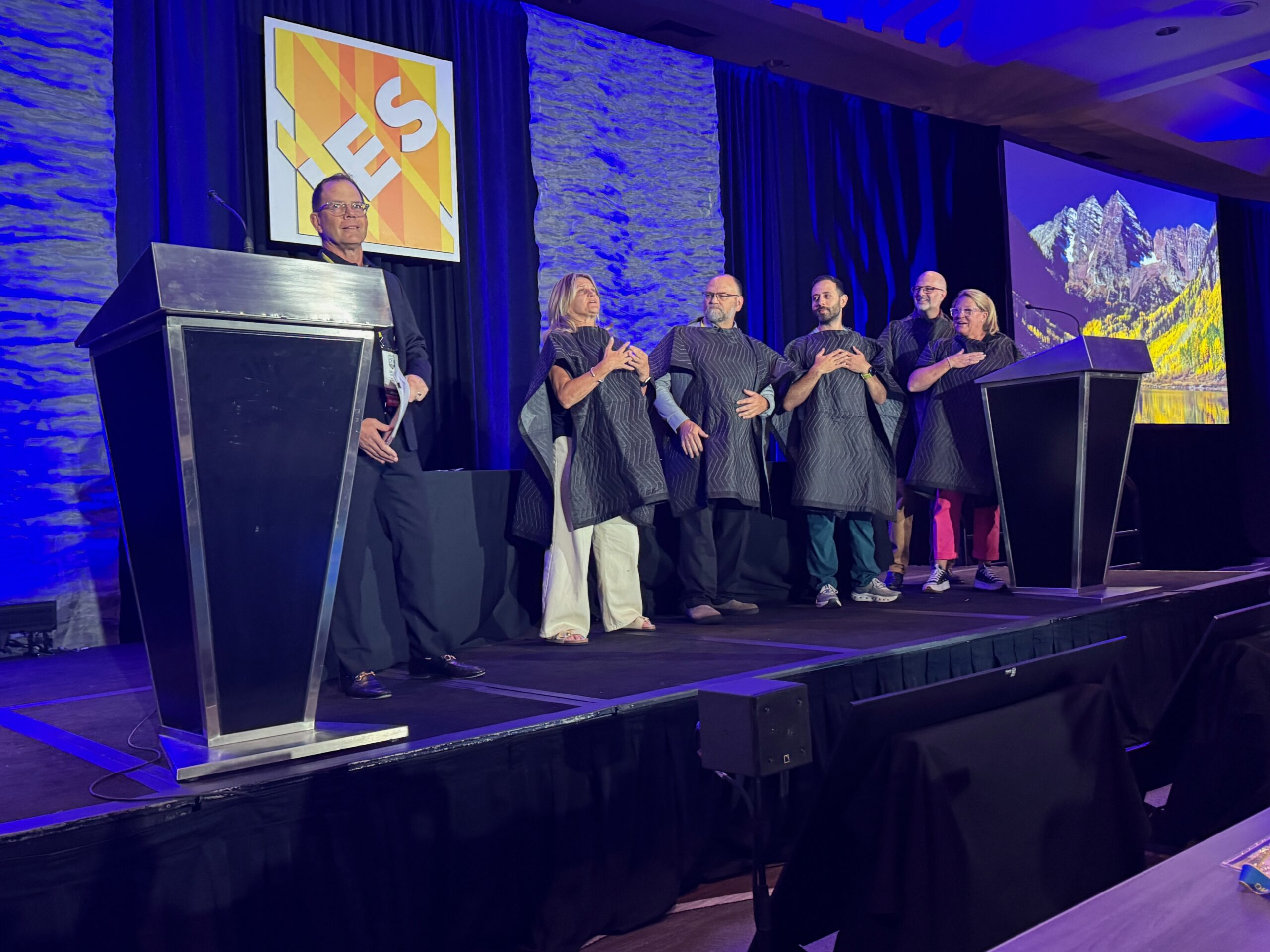
For many years, Mark Lien has taken the data and trends identified by the IES Progress Committee and brought them to a broader audience. Through presentations at conferences across the country and around the world, Mark has helped the industry understand not only which products represent progress, but what those products collectively tell us about where lighting is headed.
Each year, the Progress Committee reviews new products, technologies and publications to identify meaningful advancements in the art and science of lighting. Looking across the 58 selections recognized in the 2026 IES Progress Report, several clear themes emerged.
Below are the trends the IES Progress Committee identified from its 2026 selections—and together, they offer an interesting snapshot of where our industry is going.
2026 trends
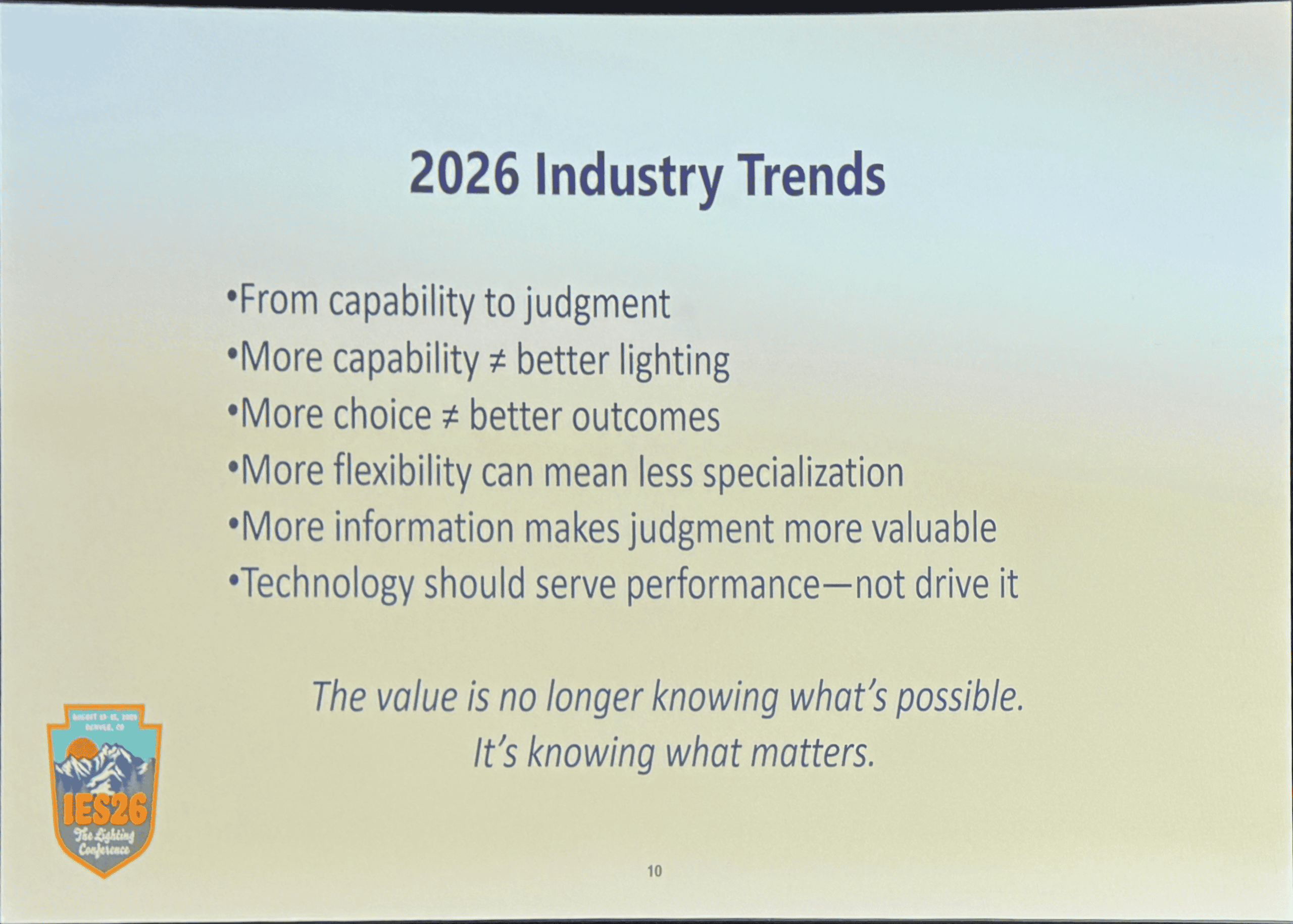
The 2026 trends presented in the Annual Conference Report point to a lighting industry that is maturing rather than standing still. Much of today’s progress is happening through refinement: more capable products, greater configurability, tighter integration, smaller form factors, and more deliberate use of spectrum and data. The common thread is that technology is creating more choices, but not eliminating the need for expertise.
1. Configurability Becomes the Norm
- Field-selectable lumen output, CCT, optics, and other settings are spreading across nearly every architectural luminaire category.
- Manufacturers are moving from fixed products toward configurable platforms, reducing SKUs and simplifying specification and procurement.
- As products become more universal, the industry must still preserve specialization, performance, and meaningful differentiation.
2. Smaller Fixtures, Higher Performance
- Miniaturization is moving beyond aesthetics.
- Smaller apertures are now being paired with increasingly sophisticated optics, shielding, diffusion, source placement, and light mixing.
- The real advance is the ability to combine small scale, useful output, precise optical control, and visual comfort in one product.
3. Spectrum Becomes an Engineering Tool
- LED development is moving beyond traditional CCT and CRI metrics toward purposeful spectral design.
- Manufacturers are increasingly engineering light for specific biological or application-driven outcomes involving people, plants, microorganisms, materials, and visual perception.
- The question is shifting from simply, “What does the light look like?” to “What is the spectrum intended to accomplish?”
4. 3D Printing Moves Into Architectural Production
- Additive manufacturing is no longer noteworthy simply because a luminaire can be printed.
- Its value is increasingly in customization, complex geometries, shorter production runs, reduced tooling, and architectural specificity.
- More importantly, it allows manufacturers to reconsider how structure, housing, diffusion, thermal management, and optical functions are integrated into the luminaire itself.
5. The Line Between Lighting and Controls Continues to Blur
- Wireless communication, sensors, apps, cloud platforms, and embedded intelligence are increasingly becoming part of the luminaire.
- This creates new opportunities for commissioning, flexibility, data collection, and system integration.
- It also raises bigger lifecycle questions around interoperability, cybersecurity, manufacturer lock-in, software support, and long-term ownership.
- A key distinction: wireless does not necessarily mean open, interoperable, or future-proof.
6. AI Enters as Decision Support
- The most credible near-term role for AI is not automated lighting design, but better and faster decision-making.
- Applications include product research, comparisons, substitution review, schedules, specifications, submittals, commissioning, troubleshooting, and analysis of controls and energy data.
- As information becomes easier to access, expertise increasingly lies in knowing what matters, what performs, and what is appropriate for the application.
The 2026 Submissions Data
- Luminaires remain dominant, accounting for roughly 65–75% of submissions.
- Most activity continues to occur in established categories such as linear, downlights, suspended luminaires, and high bays.
- Many submitted advances centered on selectable features, installation improvements, and optical refinements rather than entirely new product categories.
- The broader message is not that innovation has slowed, but that much of it is now occurring through incremental improvement and deeper integration within mature product platforms.